Catholic in Yanchep

Go out into the deep.


Leave a comment

10th Sunday in Ordinary Time, Year C | How the Chaser Made Me a Better Catholic


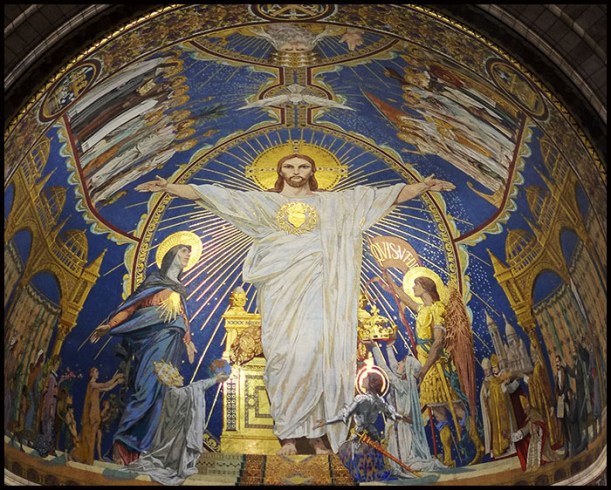
Sacred Heart Sacre Coeur Mosaic

Sacré Coeur Mosaic, Basilica of Sacré Coeur, Montmartre, Paris, Olivier Merson, H. M. Magne and R. Martin, 1923.

Today’s readings are, among other things, about God’s kindness to widows.  As a widow, I have a few things to say about that, but for the moment I actually want to describe how I was made a better Catholic by none other than those scallywags at The Chaser.   (For those of you who are not Australian, the comedians at The Chaser concentrate on political satire – almost always anti-conservative and anti-traditional-values.)

The reason I am raising this is that yesterday was the feast of the Sacred Heart of Jesus.  Several years ago (actually it would have been about 2007), we had a priest in the parish who had a great devotion to the Sacred Heart … and I had a difficulty with this devotion.  It wasn’t that I had an objection to the Sacred Heart per se, but more that it conjured up images of a style of art that offended my good taste.  The Jesus depicted in this particular genre of kitsch is usually a weak and effeminate Jesus who would definitely not make the rugby A team.  And artists have difficulties with interpreting the heart that is so central to this devotion – it appears either as an ugly fleshly pump, or reduced to a cartoon heart-and-thorns.  I think perhaps the only solution is to avoid realism and render it as an icon, along the lines of the beautiful mosaic in the Basilica of the Sacré Coeur in Montmartre.

So you see, my objection was on the most superficial level, and I was aware of this and wondering what to do about it.  Well the best answer I thought was to go straight to the source:  I decided to pray about it.  I said to God, “Look here, God,” (that was the way I used to pray).  “I am having trouble relating to this Sacred Heart caper.  The prayers are so gushingly sentimental and I’m a bit embarrassed by the paintings, which you must admit are not in the most sophisticated of taste.  Now, I am a reasonable person, and I think I am prepared to admit that I may be wrong.  Perhaps you are the sort of God who isn’t an art snob.  If so, I want you to tell me clearly.  I would like you to reveal to me whether I should give a bit more support to these Sacred Heart devotions.  Tell you what, I’ll give you two weeks, and you will have to make it obvious to me that the Sacred Heart is important.  And – second condition – you will have to reveal this to me through a source that is not Catholic!”

Well, not two weeks had gone by when I was watching The Chaser on the ABC.  And what should come up but mockery of the Catholic Church.  In particular, mockery of people who experience pareidolia – seeing images of Jesus or the saints in natural phenomena: plastered walls, tortillas, intergalactic nebulae and cinnamon buns.  Except the item they chose to ridicule was the Sacred Heart, and not the Sacred Heart appearing ephemerally in the clouds or even in an Indian chapati, but they made great play of zooming in on an image of the Sacred Heart embedded in a simulated lump of human excrement in a toilet bowl.

I was shocked and disgusted – shocked at the Chaser being so totally crass and objectionable (I shouldn’t have been, that is their MO).  And more shocked that Jesus had exactly answered my prayer!  I felt that he was saying to me: “OK. Here is the Sacred Heart.  Here is your non-Catholic source.  This is how they treat me.  And all I offer them is love.  Yet they choose to mock me, reject me, and reject those of my followers who have a simple and trusting loyalty to me.”

After that I was sad – sad about my arrogance, my snobbery, my tendency to look down on those aspects of Christianity that appeal to the ‘less cultured’ or ‘less intelligent’.  I was in danger of being a Pharisee.  Since then, I have found more and more occasions to respect those who don’t have delusions of grandeur.  By the way, I no longer watch The Chaser.  I think my time is more usefully spent offering novenas to the Sacred Heart of our Lord.  He is the one who bends down so lovingly to respond to all our needs.

Just as a postscript, in 2011, my husband and I discovered a pub where you can enjoy a beer and honour the religious kitsch style at the same time.  This is the café In den Ouden Vogelstruys (At the Home of the Old Ostrich) in Maastricht, just across the road from the Basilica to our family saint, Saint Servatius.In-Den-Ouden-Vogelstruys-Bar-110628

Today’s readings:

Word format: Year C 10th Sunday 2016

Pdf format: Year C 10th Sunday 2016


Leave a comment

Corpus Christi, Year C | The Mystery of Eating Jesus

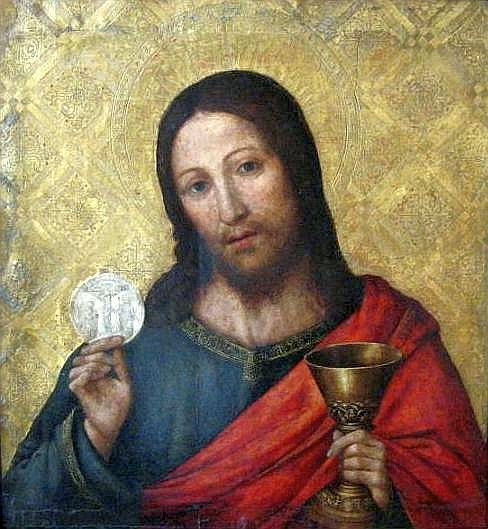
Christ With The Host Paolo de San Leocadio

Christ with the Host, Paolo de San Leocadio (1445-1520), oil and gold on wood, National Museum in Poznań (Muzeum Narodowe w Poznaniu), Poland. [Public domain], via Wikimedia Commons.

We are what we eat.  At least biologically, the molecules we ingest are assimilated and through a complex series of reactions either become part of our physical bodies, or are used for the production of energy via respiration – or are eliminated without being used.

So it is when we receive the Body and Blood of Our Lord in Holy Communion.  Jesus has left us this remarkable Sacrament, not only so that the physical molecules of the Eucharistic species can become part of our flesh and blood, but so that we can be drawn into Christ.  Though we are consuming Christ, he is in a way consuming us – it is as close as we can get in this life to a consummation of the wedding feast of the bride (the Church) and the Lamb.

Some Christians shake their heads at the thought that Catholics (and the Orthodox) think they are consuming Jesus’ actual body and blood.  But we are merely being Bible literalists in this particular case.  How many times does Jesus have to say it?

  1. I am the living bread which has come down from heaven.  Anyone who eats this bread will live for ever; and the bread that I shall give is my flesh, for the life of the world (John 6:51).
  2. In all truth I tell you, if you do not eat the flesh of the Son of man and drink his blood, you have no life in you (John 6:53).
  3. Anyone who does eat my flesh and drink my blood has eternal life, and I shall raise that person up on the last day. For my flesh is real food and my blood is real drink (John 6:55).
  4. Whoever eats my flesh and drinks my blood lives (remains, abides) in me and I live (remain/abide) in that person  (John 6:56).
  5. As the living Father sent me and I draw life from the Father, so whoever eats me will also draw life from me (John 5:57).
  6. This is the bread which has come down from heaven; it is not like the bread our ancestors ate: they are dead, but anyone who eats this bread will live for ever (John 6:58).

At the time of John’s writing of this Gospel, the Christian practice of the ‘Breaking of Bread’ was already well established.  There was no need for John to reiterate the Institution of the Eucharist which occurs in Matthew 26, Mark 14 and Luke 22.  His audience was already familiar with Jesus ‘ instructions to ‘do this in remembrance of me’.  However, the new challenge for John was the rise of false teachers.  For example, Cerinthus was a Gnostic contemporary of John who was confusing the faithful by suggesting that Jesus was not fully Divine, but that Christ ‘entered’ into Jesus at his baptism and left him before his crucifixion.  In the Gnostic view, matter was evil and the body was a prison from which the spirit needed to escape.  In all of Jesus statements above, John is emphasising that Jesus is referring to his flesh and blood in a literal sense.  Matter is the portkey (to use Harry Potter language) that God uses to help us remain (abide) in him.  Read John chapter 15 and you will see how important it is to remain in Jesus: “Whoever remains in me, with me in him, bears fruit in plenty; for cut off from me you can do nothing.”  “Remain in me, as I in you.”  “As a branch cannot bear fruit all by itself, unless it remains part of the vine, neither can you unless you remain in me.”  “Remain in my love.  If you keep my commandments you will remain in my love.”  Jesus doesn’t repeat himself unless it’s important!

My dear friends at the (Protestant) Bible Study I attend say that Jesus couldn’t have meant this literally because the consumption of blood is forbidden in the Old Testament.  What the OT actually says is “But be sure you do not eat the blood, because the blood is the life, and you must not eat the life with the meat.” (Deuteronomy 12:23).  But this is the whole point!  Jesus wants us to consume HIS blood, because he wants us to receive his life!  He wants us to remain in him!

We are such muggles when it comes to understanding Jesus, that no wonder he has to repeat himself several times for us to get the point.

From the Catechism:

It is highly fitting that Christ should have wanted to remain present to his Church in this unique way.  Since Christ was about to take his departure from his own in his visible form, he wanted to give us his sacramental presence … What material food produces in our bodily life, Holy Communion wonderfully achieves in our Spiritual life.  Communion with the flesh of the risen Christ, a flesh ‘given life and giving life through the Holy Spirit,” preserves, increases, and renews the life of grace received at Baptism.  This growth in Christian life needs the nourishment of Eucharistic Communion, the bread for our pilgrimage until the moment of death, when it will be given to us as viaticum. [1392]

Today’s readings:

Word format:Year C Body and Blood of Christ 2016

Pdf format: Year C Body and Blood of Christ 2016


Leave a comment

Prayer request for our Sacristan

Josephine-del-Bene-160522Please join with us in praying for the recovery of our dedicated Sacristan and long-time Two Rocks resident, Josephine Del Bene, who returns home this week after a month in rehabilitation at Osborne Park Hospital for a hip replacement.

Remember Sacristans go largely unappreciated (until they get sick and suddenly nobody knows what to do!)  Fortunately, the very capable Janie Bird and Sarah Knapp have stepped in so everything is running smoothly!


Leave a comment

The Most Holy Trinity, Year C | Beyond words (almost)

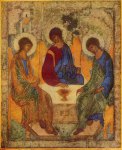
Trinity-Icon-Andrej-Rublev

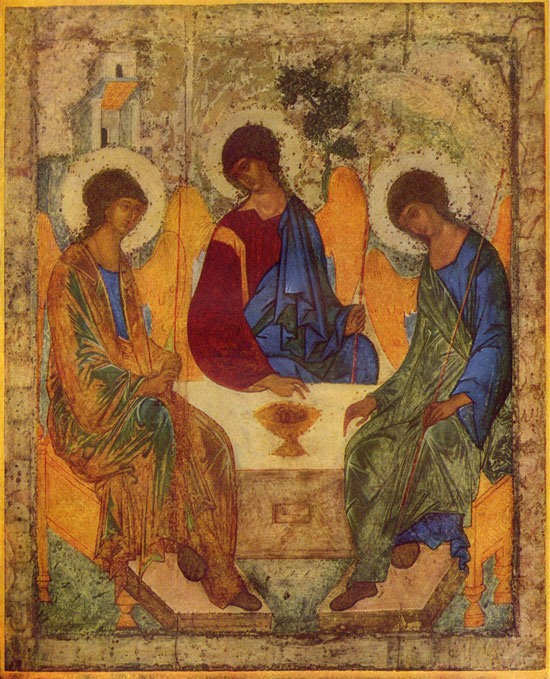
Holy Trinity Icon, Andrei Rublev, 1411-27, Tretyakov Gallery, Moscow

Apologies for the lateness of this post, but we had our first big winter front come through and were without power for most of the day.  The electricity being out, we also had to re-locate our Mass from Yanchep to the Presbytery in Two Rocks, where all fourteen of us snuggled up in the Chapel at the back of the house.  This is one of the most cheerful chapels I have seen, because Fr Augustine, in typical style, has furnished it with a profusion of the most brightly coloured flowers and candles to be had in plastic.  Not ideal according to canon law, but I am sure Our Lord will excuse us due to the small number of volunteers available, and it’s a kind of glorious celebration of our poverty.

Anyway, today we celebrate the Most Holy Trinity, and Fr A’s homily got to the heart of the matter:

  1. The Trinity is a mystery.
  2. Don’t fret if you can’t understand it. The main thing is that you can join, with the angels and saints, in a spirit of gratitude, glorifying the Father, the Son and the Holy Spirit.

There’s a lot to be said for this approach, because it’s too easy to botch a homily on the Trinity, if you’re not a philosophy major.  But understanding the Trinity, even a little bit, is vitally important if you want to understand God as a God of Covenantal Love, with the humans as family, rather than say, the Islamic understanding of God as Master, with the humans as slaves.

The Mystery of God is much greater than mere human words and thoughts can explain.  And humans tend not to be very precise with words, particularly where vested interests try to capture the word market.

If I were to give some advice to priests about homilies on the Trinity, I would say:

  1. Please don’t confuse the Catholic use of the word, person, with our everyday use of the word people. My friends at the Church of Christ have a very hard time of it describing the trinity because they don’t have the theological vocabulary to make this distinction.  When we’re talking about God, we use the word person to distinguish the three persons of Father, Son and Holy Spirit.   Make it clear to the congregation that person in this sense is more like an independent consciousness, while God at the same time is one divine essence.  Remember God is not a human, he does not fit into human categories, as he is the ultimate Cause of Everything.
  2. Please define your terms. I have heard some woolly and ill-defined homilies about ‘the Spirit of the Father’, the ‘Spirit of the Son’, the ‘Spirit of the Spirit’.  Note that there is only one Spirit in God – the Holy Spirit -which proceeds from the Father and the Son.  Stop dividing the Holy Spirit into a kind of exploding fractal.
  3. Please don’t describe God as ‘a being’. This makes God sound like another creature in the universe.  He is totally other than all created ‘beings’, and therefore requires a different language, perhaps in the end, the ‘I am’ of Exodus comes closest.
  4. Try not to be an Arian in your use of language. Arius thought that God created Jesus, and that Jesus didn’t exist prior to his incarnation.  My Church of Christ friends (sorry to pick on you again!) say things like, “God sent Jesus” when they really mean “the Father sent Jesus”.  We need to use language which reflects our Trinitarian understanding more accurately and emphasises the Love between the Father and the Son.
  5. Avoid Modalism. This is where the different hypostases of the Trinity are just God appearing in different forms, like the Marvel shape-shifter Mystique who pops up in different forms whenever its useful to her.

The Catechism of the Catholic Church is well worth reading when it comments on our understanding of the Trinity, and I quote it in large chunks here:

251 In order to articulate the dogma of the Trinity, the Church had to develop her own terminology with the help of certain notions of philosophical origin: “substance”, “person” or “hypostasis”, “relation” and so on. In doing this, she did not submit the faith to human wisdom, but gave a new and unprecedented meaning to these terms, which from then on would be used to signify an ineffable mystery, “infinitely beyond all that we can humanly understand”.

252 The Church uses (I) the term “substance” (rendered also at times by “essence” or “nature”) to designate the divine being in its unity, (II) the term “person” or “hypostasis” to designate the Father, Son and Holy Spirit in the real distinction among them, and (III) the term “relation” to designate the fact that their distinction lies in the relationship of each to the others.

The dogma of the Holy Trinity

253 The Trinity is One. We do not confess three Gods, but one God in three persons, the “consubstantial Trinity”. [83] The divine persons do not share the one divinity among themselves but each of them is God whole and entire: “The Father is that which the Son is, the Son that which the Father is, the Father and the Son that which the Holy Spirit is, i.e. by nature one God.” [84] In the words of the Fourth Lateran Council (1215), “Each of the persons is that supreme reality, viz., the divine substance, essence or nature.” [85]

254 The divine persons are really distinct from one another. “God is one but not solitary.” [86] “Father”, “Son”, “Holy Spirit” are not simply names designating modalities of the divine being, for they are really distinct from one another: “He is not the Father who is the Son, nor is the Son he who is the Father, nor is the Holy Spirit he who is the Father or the Son.” [87] They are distinct from one another in their relations of origin: “It is the Father who generates, the Son who is begotten, and the Holy Spirit who proceeds.” [88] The divine Unity is Triune.

255 The divine persons are relative to one another. Because it does not divide the divine unity, the real distinction of the persons from one another resides solely in the relationships which relate them to one another: “In the relational names of the persons the Father is related to the Son, the Son to the Father, and the Holy Spirit to both. While they are called three persons in view of their relations, we believe in one nature or substance.” [89] Indeed “everything (in them) is one where there is no opposition of relationship.” [90] “Because of that unity the Father is wholly in the Son and wholly in the Holy Spirit; the Son is wholly in the Father and wholly in the Holy Spirit; the Holy Spirit is wholly in the Father and wholly in the Son.” [91]

256 St. Gregory of Nazianzus, also called “the Theologian”, entrusts this summary of Trinitarian faith to the catechumens of Constantinople: Above all guard for me this great deposit of faith for which I live and fight, which I want to take with me as a companion, and which makes me bear all evils and despise all pleasures: I mean the profession of faith in the Father and the Son and the Holy Spirit. I entrust it to you today. By it I am soon going to plunge you into water and raise you up from it. I give it to you as the companion and patron of your whole life. I give you but one divinity and power, existing one in three, and containing the three in a distinct way. Divinity without disparity of substance or nature, without superior degree that raises up or inferior degree that casts down. . . the infinite co-naturality of three infinites. Each person considered in himself is entirely God. . . the three considered together. . . I have not even begun to think of unity when the Trinity bathes me in its splendour. I have not even begun to think of the Trinity when unity grasps me. . [92]

  1. THE DIVINE WORKS AND THE TRINITARIAN MISSIONS

257 “O blessed light, O Trinity and first Unity!” [93] God is eternal blessedness, undying life, unfading light. God is love: Father, Son and Holy Spirit. God freely wills to communicate the glory of his blessed life. Such is the “plan of his loving kindness”, conceived by the Father before the foundation of the world, in his beloved Son: “He destined us in love to be his sons” and “to be conformed to the image of his Son”, through “the spirit of sonship”. [94] This plan is a “grace [which] was given to us in Christ Jesus before the ages began”, stemming immediately from Trinitarian love. [95] It unfolds in the work of creation, the whole history of salvation after the fall, and the missions of the Son and the Spirit, which are continued in the mission of the Church. [96]

258 The whole divine economy is the common work of the three divine persons. For as the Trinity has only one and the same natures so too does it have only one and the same operation: “The Father, the Son and the Holy Spirit are not three principles of creation but one principle.” [97] However, each divine person performs the common work according to his unique personal property. Thus the Church confesses, following the New Testament, “one God and Father from whom all things are, and one Lord Jesus Christ, through whom all things are, and one Holy Spirit in whom all things are”. [98] It is above all the divine missions of the Son’s Incarnation and the gift of the Holy Spirit that show forth the properties of the divine persons.

259 Being a work at once common and personal, the whole divine economy makes known both what is proper to the divine persons, and their one divine nature. Hence the whole Christian life is a communion with each of the divine persons, without in any way separating them. Everyone who glorifies the Father does so through the Son in the Holy Spirit; everyone who follows Christ does so because the Father draws him and the Spirit moves him. [99]

260 The ultimate end of the whole divine economy is the entry of God’s creatures into the perfect unity of the Blessed Trinity. [100] But even now we are called to be a dwelling for the Most Holy Trinity: “If a man loves me”, says the Lord, “he will keep my word, and my Father will love him, and we will come to him, and make our home with him”: [101] O my God, Trinity whom I adore, help me forget myself entirely so to establish myself in you, unmovable and peaceful as if my soul were already in eternity. May nothing be able to trouble my peace or make me leave you, O my unchanging God, but may each minute bring me more deeply into your mystery! Grant my soul peace. Make it your heaven, your beloved dwelling and the place of your rest. May I never abandon you there, but may I be there, whole and entire, completely vigilant in my faith, entirely adoring, and wholly given over to your creative action. [102]

The Catholic Church. The Catechism Of The Catholic Church (Kindle Locations 1164-1168).  . Kindle Edition.

Readings for today:

Word format:Year C Trinity Sunday 2016

Pdf format:Year C Trinity Sunday 2016


Leave a comment

Pentecost, Year C |What does the Holy Spirit want for us?

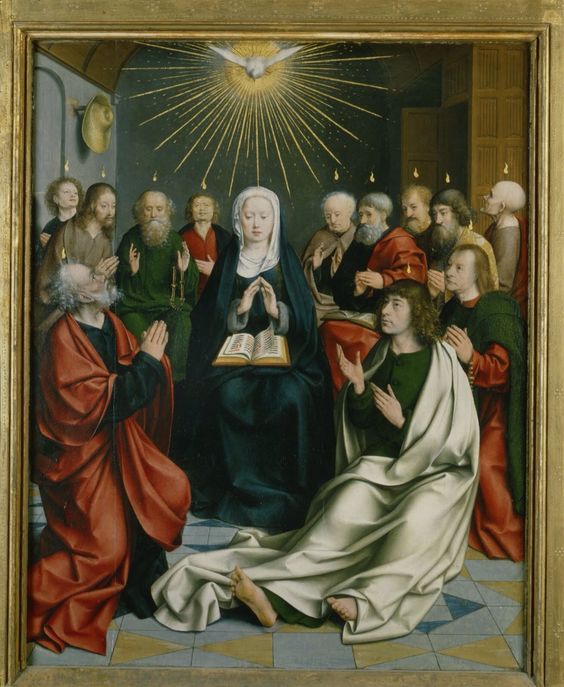
Pentecost Jan Joest van Kalkar

Pentecost (Pfingsten), Jan Joest van Kalkar (1505 – 1508), oil on wood, St. Nicolai’s Church, (Katholische Pfarrkirche Sankt Nikolai), Kalkar, Germany

Is your Christianity exciting you?  It should. When we look at today’s Gospel, we see the disciples and Mary gathered together in the upper room (note that it wasn’t a church building, just a room).  They have been praying fervently for nine days since the resurrection.  Suddenly,

they heard what sounded like a powerful wind from heaven, the noise of which filled the entire house in which they were sitting; and something appeared to them that seemed like tongues of fire; these separated and came to rest on the head of each of them. They were all filled with the Holy Spirit, and began to speak foreign languages as the Spirit gave them the gift of speech.

The Holy Spirit arrives with great power, and gives them extraordinary gifts.  Not only that, but he gives them the energy to go out and preach the Gospel boldly, so much so that by the end of the day, three thousand people have been baptised and added to those who believe Christ is the Son of God.

I once heard a priest from our pastoral area give a homily about this passage where he completely inverted the real message.  The priest said,

“At first there was noise and confusion (apparently referring to the “powerful wind from heaven”), but then after the Holy Spirit arrived, there was peace and calm.”  

“NO THERE WASN’T! ARE YOU STUPID?” I wanted to jump up and shout, but I didn’t because I was in church, and even thinking this way is uncharitable!   But I wanted to say, “Can’t you see that the Holy Spirit has transformed the apostles and given them the conviction and the power to get out of the upper room and take the Gospel to the streets?”

What does this mean for our church here in the Yanchep to Lancelin Pastoral Area.  At the moment we are carrying out a church census, and the numbers are showing how tragically few of us there are.  I don’t believe we are truly using the gifts that the Holy Spirit makes available to us.  On top of this, many of us are not well enough to be very active in parish life.  And unfortunately many people have been driven away from our church for various reasons.  We should be heartily ashamed and praying urgently for a renewal of the Holy Spirit in the life of the parish.  I have just been watching a video of the Confirmations we had in 2001, and wondering, “Where are all those children now, and why don’t they go to Mass any more?”  (I might share it with you later, so that we can all pray for them.)

And now for the Good News!  We may be too uncomfortable to take the Gospel to the streets, but we can all take the Gospel to our friends and family (many of whom are not attending church).  We absolutely need to if we want these people to be able to reach Heaven.   The trouble is, many of us do not know how to talk about Christ with others.  People get embarrassed when you start talking about religion.  Well, I have good news for you: there is a wonderful program that you can access which will show you how to help others towards faith in practical ways.  The RETURN program is packed with ideas you can use, and I urge you sit down and develop a strategy which is going to bring your loved ones to faith in God.   And please let us do this in a joy-filled way, or we’re giving the wrong message!  Otherwise we have missed the point of being Christian.

If anyone is interested in studying the Return program together, please give me a call on 0400-660-337.

Come Holy Spirit, and kindle in us the fire of your love!

Today’s readings:

Word format: Year C Pentecost Sunday

Pdf format: Year C Pentecost Sunday


Leave a comment

The Sixth Sunday of Easter, Year C | Faithfulness is beautiful!

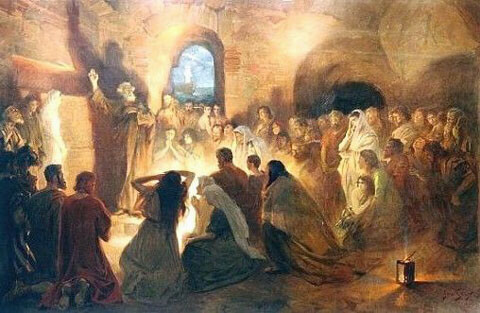
JanStyka-Saint Peter preaching in Catacombs

St Peter preaching the Gospel in the Catacombs, Jan Styka, 1902, original destroyed by fire, accessed at https://en.wikipedia.org/wiki/Jan_Styka#/media/File:JanStyka-SaintPeter.jpg

Hilaire Belloc, the famous satirist and historian, once said, “The Catholic Church is an institution I am bound to hold divine — but for unbelievers a proof of its divinity might be found in the fact that no merely human institution conducted with such knavish imbecility would have lasted a fortnight.”[1]

Our readings today show how God has made provision for the Church to continue and flourish over 2,000 years, despite the ‘knavish imbecility’ of some of its members.  If your first reaction is to feel insulted by this quote, stay with me for a minute while I explain.  The relationship between Christ and the Church is one of bridegroom and bride (Rev. 19:7-9).  Jesus wants us, above all, to be faithful to him, and he gives us the help of the Holy Spirit to do just that.  Jesus tells the Apostles in today’s gospel,

I have said these things to you while still with you, but the Advocate, the Holy Spirit, whom the Father will send in my name, will teach you everything and remind you of all I have said to you. (John 14:26) 

How do we stay close to the Holy Spirit?  A few verses earlier, Jesus says, “If anyone loves me he will keep my word, and my Father will love him, and we shall come to him and make our home with him.”

In my own experience of parish life, there have been many occasions when staying close to the Holy Spirit has been a challenge.  At times, I have thought it would just be easier to move to a different parish, or even a different church or even no church.  To give you an example, I once had a priest come to bless my house.  After the blessing, he stayed for another hour and a half berating the ‘knavish imbecility’ of his fellow priests.  But is this what the Holy Spirit wants?  Of course not: it’s always Satan that wants division and disharmony.  The Holy Spirit wants faithfulness.  The Holy Spirit wants us to build community.  The Holy Spirit wants us to keep persevering in spite of the individual characters of the members of the Church.  The Holy Spirit wants us to find the good points in others and build those up, rather than trying to destroy the other.  The Holy Spirit wants us to work diligently for the benefit of all.  Good parishioners and priests build up rather than break down.  That is how a parish receives blessing from the Lord.

The first reading today show an example of the Holy Spirit in action.  Here the Apostles meeting at the Council of Jerusalem (our first ecumenical council) come up with a solution to the problem of deciding exactly how much of the Jewish Law needs to be adhered to by the Gentile converts  (Acts 15:6 ff).  The difficulty is how to welcome Gentiles without alienating the Jewish followers of the Messiah.  After a long discussion, Peter speaks and the entire assembly falls silent.  The apostles and elders or priests (toi apostolois kai presbyterois / τοῖς ἀποστόλοις καὶ τοῖς πρεσβυτέροις) then write a letter to confirm the decision of the council, saying, “It has been decided by the Holy Spirit and by ourselves not to saddle you with any burden beyond these essentials …” They are very aware of the Holy Spirit guiding the Council which has assembled in the name of the Lord Jesus Christ.

So Hilaire Belloc was right:  as individuals we may be a bit stupid, but as a Catholic Church, listening to the Holy Spirit, we have been guided and kept faithful for 2,000 years, despite pressure from the outside world to ‘change our teaching’!  The Church and Christ are like a married couple, of whom everyone says, “This marriage cannot possibly last!” yet, there they are, celebrating their anniversary year after year!  I say hurrah for faithfulness!  Thank you to the Holy Spirit for holding us together.

[1] Hilaire Belloc, remark to William Temple, quoted in Robert Speaight, The Life of Hilaire Belloc (1957). London: Hollis and Carter, p. 383

Today’s readings:

Word format: Year C Easter 6th Sunday 2016

Pdf format: Year C Easter 6th Sunday 2016


Leave a comment

Fifth Sunday of Easter | The glory of God is …

Bamberg Apocalypse 55r New Jerusalem

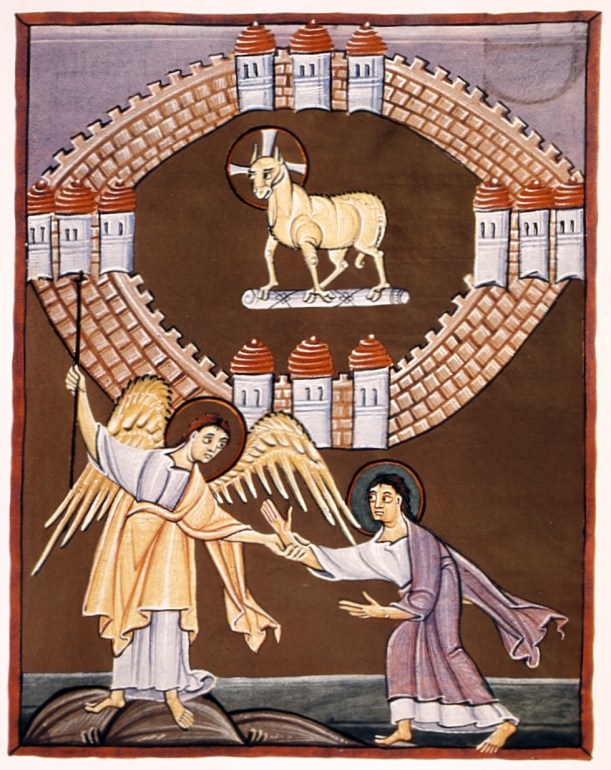
The New Jerusalem, Bamberg Apocalypse, 11th century, Folio 55, MS A.II.42, Bamberg State Library, commissioned by Otto III.

Today’s Gospel reading may at first sight seem a bit repetitive.  But remember, John has a purpose in everything he writes.  He tells us he could have written a whole lot more, but he has selected what he has, ‘so that we might believe’ (John 20:31)

The words he keeps repeating are ‘glorify’ (ἐδοξάσθη) and ‘love’ (ἀγάπη).

Why does Jesus say ‘Now has the Son of Man been glorified?’ What has just happened?  Judas has just received the Eucharist and slipped out of the room to deliver Christ to his enemies! (verse 27: At that instant, after Judas had taken the bread, Satan entered him).

It seems as if John has made a typographical error.  Didn’t he mean ‘Now has the Son of Man been betrayed?’  But no, John wants us to understand that the Glory of Christ is in his willingness to undergo betrayal by a close friend, with all that comes afterwards.

The next few lines read like a poem on the Trinity.  Everything that affects the Son, affects the Father.  Everything of the Father reflects back to the Son.  It’s almost mathematical in its expression.  Let a = Son and b = Father.  x = glorification.  If a has property x, then b has property x.  If b has property x, then a has property x, or to put it in the way John puts it:

Now has the Son of Man been glorified,

and in him God has been glorified.

If God has been glorified in him,

God will in turn glorify him in himself,

and will glorify him very soon.

Jesus turns the focus from this great act of betrayal by Judas into God’s great act of self-giving.  Self-giving is God’s glory.

Jesus is adding a whole new dimension to glory, usually understood as God’s holiness, majesty and power.  How could it be otherwise?  If God were selfish, he would not be glorious.  If God wanted us to love him merely because of his overwhelming power as Creator, that would not constitute greatness.  But a God who loves to the point of allowing himself to experience the most excruciatingly egregious behaviour of his creatures, and giving up everything he has by right, truly deserves our praise and respect.

In this passage the Son, the Father and the Holy Spirit are all present.  Where is the Holy Spirit?  He’s not actually mentioned.  But we know the Holy Spirit appears as a Cloud of Glory (the Shekinah cloud) elsewhere in Scripture.   And here John’s crescendo of glorification words describes what amounts to a verbal Cloud of Glory around the Father and the Son: what is this if not the Holy Spirit, the love between the Father and the Son?

Today’s readings (Australia):

Word format: Year C Easter 5th Sunday 2016

Pdf format: Year C Easter 5th Sunday 2016


Leave a comment

Fourth Sunday of Easter, Year C | On the joy of being a sheep

San Lorenzo Fuori Le Mura Good Shepherd Mosaic-600px

Christ the Good Shepherd, detail of mosaic from the Basilica of St Lawrence Outside the Walls, Rome (Basilica Papale di San Lorenzo fuori le Mura).

Today’s Readings

I have some relations and friends who are scornful of my Christianity.  Though they don’t always tell me to my face, I can tell from their resigned and patient expressions, that they think I have a screw loose.  To believe that someone can rise from the dead, or that miracles occur?  Pffft.  Some of the more honest ones have told me I learn to think for myself and not be a sheep who follows the teachings of a patriarchal bronze age society.

This line of reasoning falls flat on its face when we look at actual case studies of atheists who have changed their minds and turned to Christianity.  Christians, it turns out, are no more stupid than the rest of society.  And they are much better at handling rejection than some of the popular victim groups around today, because the cross comes with the territory of being a Christian.  We’re not in it for its popularity or for success (some are, but this is only a characteristic of some branches of Protestantism).

Today, we’re celebrating Good Shepherd Sunday.  We’re celebrating the fact that the Shepherd in charge is good – he wants what is best for us – and we follow him because we love him.  I can honestly say to the people who doubt me, that the relationship I (and many others) have with this Shepherd, is one so filled with joy that nothing can take that away from us, not even suffering.  That’s because it’s a living relationship.  Not only does Jesus appear in the pages of the Bible, but he actually establishes a living and present relationship with us through prayer, Baptism, Penance, Holy Communion and the other Sacraments.  Jesus tells us, “the sheep that belong to me listen to my voice; I know them and they follow me.  I give them eternal life; they will never be lost and no one will ever steal them from me.” (John 10: 27 ff.)

The ‘prayer’ one is particularly important for hearing the voice of the Shepherd.  I have a 50 minute drive in to work every day, and over time, have developed a ritual of prayer for filling in the time: morning offering, prayer to the guardian angel of every member of my family, likewise a prayer to St Michael for family members, followed by a Divine Mercy chaplet and later the Rosary.  I’m not telling you this to show off, I actually want to share that I’m not very good at praying like this, because my mind keeps wandering off on tangents.  Anyway, I was getting pretty frustrated at the tendency of my mind to drift away from the actual words of the prayers, but then I had a revelation.  It started to seem to me that in some of these ‘wanderings’ I was hearing the voice of the Shepherd guiding me in thinking about the people I was praying about.  So I have started listening more intently to what I think he is saying to me.  How do we know we’re hearing the Shepherd and not the Thief?  If I am in doubt about a particular course of action that has come to me, I now write it down, and pray about it in front of the Blessed Sacrament, and ask God for ‘more information’.  He will either confirm and strengthen the idea, and we will experience what St Ignatius calls consolation, or we will experience desolationMargaret Silf talks about this in her book, The Inner Compass.

It’s wonderful to be a sheep, to know I don’t have to re-invent everything as if I am a God unto myself, to be guided by one who is goodness, truth and beauty himself.  I love the obedience that being a sheep entails.  I love having the confidence that the Shepherd won’t let anyone steal me away from the Father.  And I love the hope that the Shepherd gives me for the other members of my family, even the ones who don’t trust him just yet …

Today’s readings

Word format: Year C Easter 4th Sunday 2016

Pdf format: Year C Easter 4th Sunday 2016


7 Comments

A tribute to Fr Tiziano Bogoni

140818-Father-Tiziano-Bogoni-All-Saints-Chapel-2Have you ever had the experience of God sending you to exactly the right person at exactly the right time?  Fr Bogoni was someone God placed in my life in answer to prayer.  Living in the far Northern suburbs of Perth, I never had much occasion to attend All Saints Chapel in Allendale Square, and so I had never met this remarkable priest.
But in September of 2013, my husband, Bill, was diagnosed with only six months to live because of secondary lung cancer.  My most distressing thought was not that he was going to die (though that was distressing enough), but that he was to all appearances going to die without the benefit of the sacraments.  I was overcome by the thought that if Bill died without seeking the mercy of God through the Sacrament of Penance, and then receiving the Bread of Life through Holy Communion, he might not make it to heaven (no matter how good, kind and generous he had been in life).   Yes, I know – everyone thinks I make God sound so unkind if I suggest that a person might forfeit heaven by not aligning himself with Christ.  But I think eternal separation from God is a very real risk, and that is why Jesus warns about hell so many times.

It happened that the previous eighteen months had been such an unfortunate series of events that I was beginning to wonder if we were under some sort of curse:

  • my daughter rolled her car – she survived but the car was a write-off
  • Bill was diagnosed with oesophageal cancer
  • someone collided with Bill’s car while it was innocently parked outside our house
  • my daughter had appendicitis with major complications
  • Bill developed thrombocytopenia after his operation (unrelated to the cancer) and required a splenectomy
  • Bill was then hospitalised with a bowel blockage (unrelated to the cancer and the thrombocytopenia)
  • Bill developed gastric dumping syndrome so that he was continually exhausted
  • Bill’s fishing friend drowned right next to him while they were diving at their cray pots
  • my daughter rolled the car that had replaced the first car – another write-off
  • Bill was diagnosed with secondary lung cancer

Little wonder, then, that after reading An Exorcist tells his Story by Fr Gabriele Amorth, I started wondering if we needed an exorcist and not just a healer.  So I phoned up the Perth Archdiocese and asked if we had one.  The dear lady at the office said, her voice dropping to a hushed whisper, that there was someone who normally dealt with ‘those sort of things’ and gave me the contact details for Fr Tiziano Bogoni.  So I wrote him a long letter and asked him if he had any thoughts on our series of unfortunate events.

I didn’t hear from him for several days, and thought that he had probably decided I was a nutter.  But then I received a text:  “Ave Maria.  Deirdre my apologies I forgot to say Fr Bogoni asked me to give you his mobile no in case you need to contact him while he’s away until 30th Nov.  Many thanks and God bless, Margaret, All Saints Chapel.”

Thus began a period when Fr Bogoni became my spiritual director and helped me navigate Bill through his last months.  And what a beautiful and unexpected chapel it was, hidden away among offices and corporate suites, with prominent place being given to Adoration of the Blessed Sacrament throughout office hours, Holy Mass and Rosary twice a day as well as daily Divine Mercy devotions, and the cheerful statues of saints surrounding us with their comforting protection on all sides.

I told him how Bill found Catholicism really difficult as a result of his experience of physical abuse at the Catholic school of his youth.  I explained that it was impossible except by the grace of God to get Bill to want to come back to Mass or spend time examining his conscience.  He said, “See if you can get him to come and talk to me.  I will give him a Life Confession.  That’s a confession for those who have been away from the Church for decades and find normal Confession too much of a challenge.  I’ll read out a list of sins, and all he has to do is say ‘yes’ or ‘no’.  Keep it simple.”

And of course, he gave me a strict schedule of prayer as well as a recommended course of reading.

It was something of a miracle that Bill eventually agreed to go (I asked for it as my Christmas present).  And after this he started attending Mass with us and receiving the Holy Eucharist.  Not only did Father Bogoni hear Bill’s confession, but he also drove all the way to Two Rocks, despite his crowded schedule, to give Bill the Last Rites and bless our house.  (And, by the way, he said there was no evidence whatsoever of demonic activity.)  I can only assume all the difficulties we had experienced were God’s way of driving us in the direction of someone who would help Bill end his life in a right relationship with God.

Fr Bogoni died last week, suddenly at the age of 51, with a Rosary in his hand.  How fitting that God should choose to take him suddenly, just like the way he would burst in suddenly through the chapel door as he went about his busy pastoral duties, in those sandals that flap-flapped across the floor.  And how fitting that God should take him home on the feast of Divine Mercy.  I was going to say, ‘his work done’, but no, I can see him being even more busy in Heaven, still interceding for those souls he helped so much on earth.

So thank you, Fr Bogoni.  Thank you for seeing what needed to be done, and doing it.  May God give you a great reward, good and faithful servant!  And please say hello to Bill while you’re there!


Leave a comment

3rd Sunday of Easter, Year C | Obedience to God comes before obedience to men

Bouts_Miraculous catch of Fish

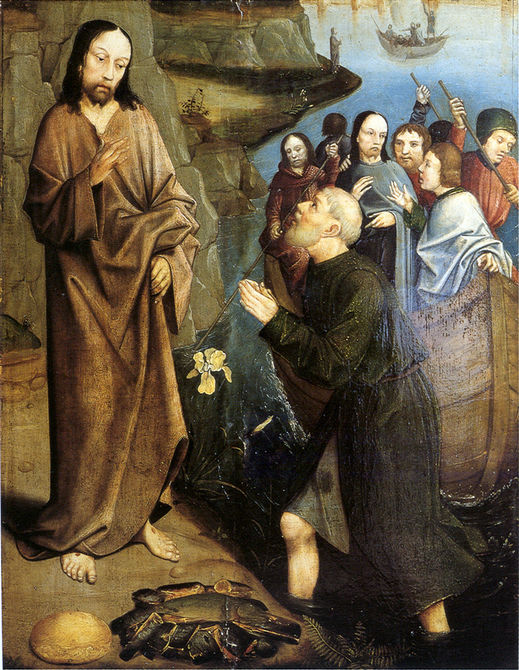
The Third Appearance of Christ, Dieric Bouts, 1415-1475, private collection.

I love this first reading we have today from Acts, chapter 5.  The high priest says, “We gave you a formal warning not to preach in this name and what have you done?  You have filled Jerusalem with your teaching!”  How it reminds me of today, when so many people want to silence the Word of God.  As Greg Sheridan says in The Australian, there is a real danger that in the near future “our often counter-­productive human rights bureaucracies will deem it an offence for people to propound traditional Christian teaching.”  Similarly, articles by Angela Shanahan and Caroline Overington have shown how universities are now discriminating against faith-based groups on the basis of inclusivity.  Ironic, isn’t it?

Where Uni Inclusivity means, ‘Get your beliefs out of here.’

Sydney Uni Catholic Society Faces Ban for Catholic-only Board

And in reply, Peter and the apostles say, “Obedience to God comes before obedience to men.”  In a nutshell, that’s what Jesus wants when he is asked, “What shall I do to inherit eternal life?”  And he answers, “You shall love the Lord your God with all your heart and with all your soul and with all your strength and with all your mind, and your neighbour as yourself” (Luke: 10:25-27).

In the tradition of filling the world with Christ’s teaching, Pope Francis, the Shepherd of the Church, has released his new exhortation, Amoris Laetitia – “The Joy of Love”, which is about the joy to be found in authentic families joined by love.  Do yourself a favour and ignore the newspaper headlines which want to put their own spin on this document, and read the original here.

For more on today’s readings, watch Brant Pitre’s commentary:

https://www.youtube.com/watch?v=1mGpZaPdT9A

Today’s readings

Word format:Year C Easter 3rd Sunday 2016

Pdf format: Year C Easter 3rd Sunday 2016