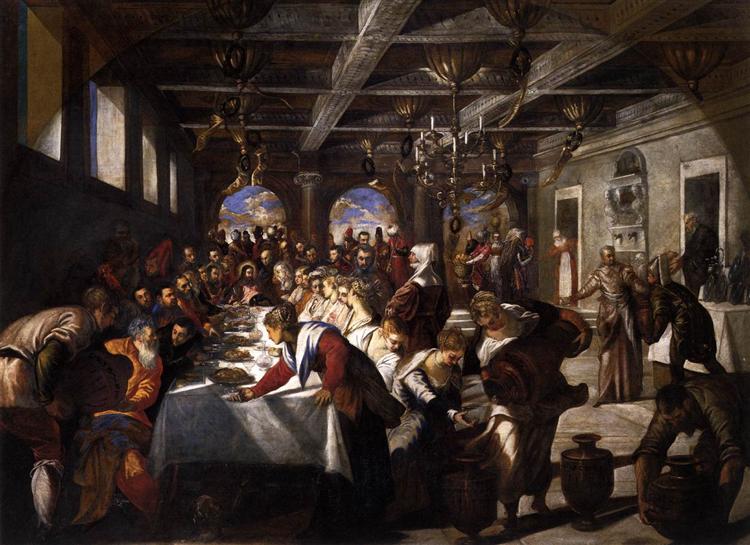
The Wedding Feast at Cana, Jacopo Tintoretto, 1561, oil on canvas, the church of Santa Maria della Salute (The Virgin Mary of Good Health), Venice, Italy.
I’m extremely busy with work commitments today, so I’ll just summarise in dot points and refer you to other pages that explain today’s readings in more detail.
Even in Proverbs (First Reading on Wisdom’s Table) and Psalms (Taste and See) God talks about the heavenly banquet he is inviting us to participate in.
St Paul (Ephesians 5) encourages us to give thanks constantly (links to the Todah sacrifice).
The heavenly banquet starts right here, right now in the Eucharist (the Todah sacrifice fulfilled):
“Amen, amen, I say to you,
unless you eat the flesh of the Son of Man and drink his blood,
you do not have life within you.
Whoever eats my flesh and drinks my blood
has eternal life,
and I will raise him on the last day.
For my flesh is true food,
and my blood is true drink.
Whoever eats my flesh and drinks my blood
remains in me and I in him.”
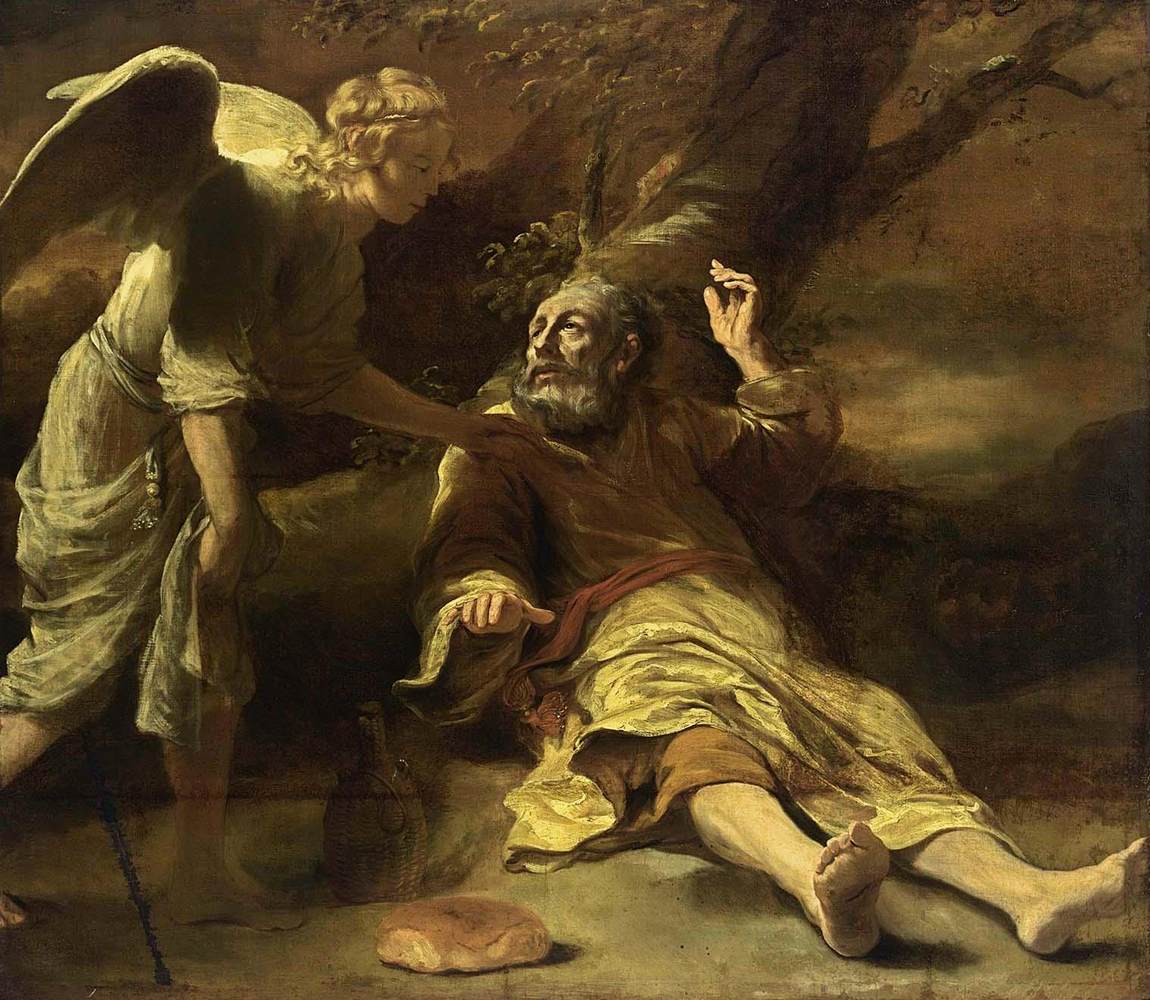
Elijah fed by an angel, Ferdinand Bol, 1660-1663, Private collection, New York.
Did God’s prophets ever contemplate suicide? Not exactly, but Elijah did feel so mentally and spiritually exhausted that he asked God to take his life (not at all the same thing as taking your own life). In today’s first reading from the book of Kings, Elijah,
sitting under a furze bush wished he were dead. ‘Lord,’ he said ‘I have had enough. Take my life; I am no better than my ancestors.’
Elijah was experiencing “ministry burnout.” Just days before, he had won a great show-down with 450 prophets of the false god Baal on Mt. Carmel, calling down fire from heaven and proving, in front of a crowd of thousands, that the LORD alone was the true God (1 Kings 18). Such a public demonstration of the power of God would seem like a tremendous victory that would lead to repentance and renewal in Israel, but that’s not what happened. The queen of Israel, a Gentile (Phoenician) princess by the name of Jezebel, was incensed by Elijah’s victory over her 450 prophets, and vowed to kill Elijah. When we find him in today’s reading, then, Elijah is fleeing for his life.
Elijah was waging a cultural and spiritual war in the kingdom of northern Israel. The war was between worship of the LORD and worship of Baal. One of the major cultural issues between these two religious was sexual practices and family life. Baal was a fertility god, and one of the ways he was worshiped was through ritual sex or “sacred” prostitution. What to do with the children that resulted? These could be sacrifice to the god (Jer 19:5). Needless to say, the standing of marriage in a culture with these practices was none too high.
By contrast, the law of the LORD had no place for sex outside of a covenant bond between a man and a woman, which would ensure that the child resulting would come into the world in the safety of a marriage, wherein he or she could be raised to adulthood by his/her own father and mother. This is “best practice” for human society. Marriage in Israel was modeled on God’s own fidelity to his covenant with the nation (Mal 2:16 and context). “Casual” sex, “cultic” sex, promiscuity, and the killing of infants had no place in worship of the God of Israel.
The king of northern Israel, Ahab, had married this Phoenician princess Jezebel, who was a Baal worshiper and was using government authority to promote Baal worship and its debased view of sexuality, marriage, and the value of infant children; and to suppress the religious freedom of the worshipers of the LORD, the God of Israel.
For all his efforts, Elijah was losing this cultural war, and now was in danger of his very life. We find him fleeing into the wilderness of Judah in order to escape from any of Jezebel’s agents. There he collapses in physical and spiritual exhaustion, and prays for death.
Yet God extends to Elijah a very gentle mercy in this passage. Twice he sends an angel to him, to awaken him and prod him to eat a mysterious meal: a jug of water and a cake of bread that inexplicably appears nearby. The nourishment from this food strengthens Elijah for a forty-day fast during his journey to Mt. Horeb (=Sinai), the mountain where God appeared to Moses. There at Horeb, Elijah will speak with God and his prophetic vocation will be renewed.
In this passage we see God’s compassion for the weakness of his prophet, expressed in the provision of this sacred meal which strengthens him for the next step in his prophetic ministry. In Christ, we “have not a high priest who is unable to sympathize with our weaknesses, but one who was tested in every way just as we are, yet without sin” (Heb 4:15). He knows our weakness and so has provided us day by day with a supernatural meal, the Eucharist, in which he comes into us and supplies the strength of spirit we need to carry on in our vocations.
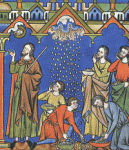
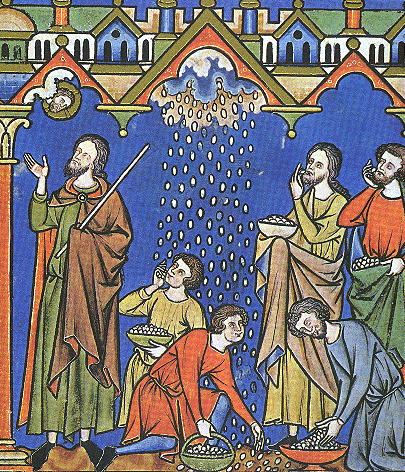
Manna, illuminated manuscript, 1244 to 1254, The Crusader Bible, MS M.638 (fol. 9v), Pierpont Morgan Library of Medieval and Renaissance Manuscripts, New York.
In conversation with atheist friends and colleagues, I have asked them, “What gives your life meaning?” Typical of the answers I have received are comments like, “I don’t care about meaning. I just want to pay the bills every week.” “I just want to be able to buy my children nice things.”(And in case you’re wondering, these comments came from people earning the average wage or higher.)
Is that all? No wonder there is such a high rate of suicide and depression! Christ came to give us so much more:
I came that they may have life and have it abundantly. (John 10:10)
In today’s readings (see end of page), Jesus tells the crowds following him,
Do not work for food that cannot last, but work for food that endures to eternal life, the kind of food the Son of Man is offering you, for on him the Father, God himself, has set his seal.’ (John 6:27)
Once you start attaching yourself to Christ and his teaching, your whole life will change from one of shallow materialism and selfishness to one of abundant life, joy and self-giving. Materialism and self-gratification can only lead to a callous disregard for others. As an example, the atheists I know, including close relatives, are all “pro-choice” when it comes to abortion. They hold that the freedom of the choice of the mother trumps the rights of the child. The fruits of this lack of respect for the most vulnerable of human lives has been supremely illustrated over the last few weeks by the secretly recorded videos made by the Center for Medical Progress. Only a few of the videos have so far been released, but they reveal the gruesome nature of the abortion industry and its profiteering from trade in the body parts of murdered children. Bishop-elect Robert Barron comments:
While they slurp wine in elegant restaurants, the good doctors—both women—blandly talk about what price they would expect for providing valuable inner organs, and how the skillful abortionists of Planned Parenthood know just how to murder babies so as not to damage the goods. One of the doctors specified that the abortion providers employ “less crunchy” methods when they know that the organs of a baby are going to be harvested for sale. Mind you, the “crunchiness” she’s talking about is a reference to the skull-crushing and dismemberment by knife and suction typically employed in abortions. For me, the most bone-chilling moment was when one of the kindly physicians, informed that the price she was asking was too low, leered and said, “Oh good, because I’d like a Lamborghini.” (The Death of God and the Loss of Human Dignity)
This issue is so important, I am posting links to all the videos that have been released so far:
VIDEO #1
A second undercover video shows Planned Parenthood Federation of America’s Medical Directors’ Council President, Dr. Mary Gatter, haggling over payments for intact fetal specimens and offering to use a “less crunchy technique” to get more intact body parts.
VIDEO #2
VIDEO #3
Dr Deborah Nucatola, Senior Director of Planned Parenthood’s Medical Services: “It makes a huge difference, I’d say a lot of people want liver. And for that reason, most providers will do this case under ultrasound guidance, so they’ll know where they’re putting their forceps. The kind of rate-limiting step of the procedure is calvarium. Calvarium—the head—is basically the biggest part. We’ve been very good at getting heart, lung, liver, because we know that, so I’m not gonna crush that part, I’m gonna basically crush below, I’m gonna crush above, and I’m gonna see if I can get it all intact.And wit h the calvarium, in general, some people will actually try to change the presentation so that it’s not vertex, so if you do it starting from the breech presentation, there’s dilation that happens as the case goes on, and often, the last step, you can evacuate an intact calvarium at the end.”
VIDEO #4
Dr Savita Ginde, Vice President and Medical Director of Planned Parenthood, Rocky Mountains: “We’d have to do a little bit of training with the providers or something to make sure that they don’t crush” [fetal organs during 2nd trimester abortions]. I think a per-item thing works a little better, just because we can see how much we can get out of it.”
Getting back to my first point, how is any of this “food that endures to eternal life”? Far more likely that it will result in eternal damnation. Pray for these people and for anyone that supports the ‘pro-choice’ lie, that their eyes will be opened to God’s light and love and that they will turn away from evil.
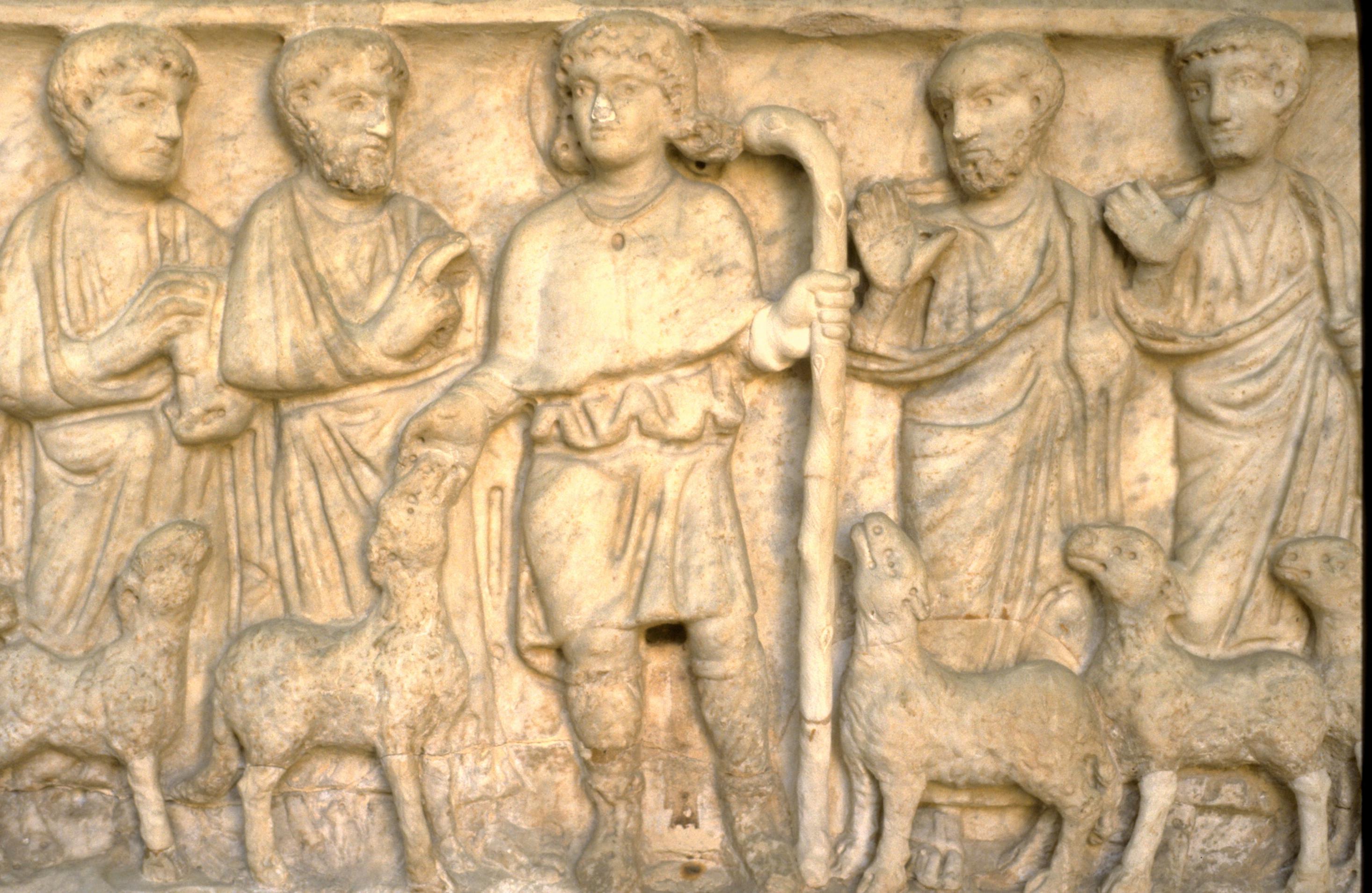
Christ as Good Shepherd with Apostles and lambs, Sarcophagus, 4th century, relief, Museo Pio Cristiano, Vatican.
We’re all looking for a leader, whether we realise it or not. This week, The Australian reported that ‘tipoffs to the National Security Hotline in Australia’s largest state have increased tenfold in two years’.
[NSW Police Force Counter Terrorism Command Head, Mark Murdoch] said that in 2013 NSW police received just 769 referrals from the National Security Hotline, which was set up in 2002 by the Howard government as a clearing-house for information from the public.
Last year, that figure jumped to 4600. This year, NSW police are projecting an estimated 6900 referrals, an almost tenfold increase on the figures of just two years ago.
…He said his officers often had just hours in which to thwart deadly terror attacks. Increasingly those attacks were either inspired or assisted by jihadists in Syria or Iraq, with the offenders getting younger and younger. Schoolchildren as young as 14 were falling under the spell of Islamic State, Mr Murdoch said.
These children are hungry for a leader, like sheep looking for a shepherd, except that they’ve attached themselves to evil shepherds, who are inspired by Satan himself. The news media will always attribute this to the wrong causes, because they do not understand the workings of Satan in the world. By contrast, the people in today’s Gospel are also described as ‘sheep without a shepherd’, but God rescues them by coming in his own person. Jesus ‘took pity on them because they were like sheep without a shepherd, and he set himself to teach them at some length.’ Let us pray that more of the lost sheep in our country will recognise the voice of the Good Shepherd, and that God will raise up strong evangelists and leaders in the Church.
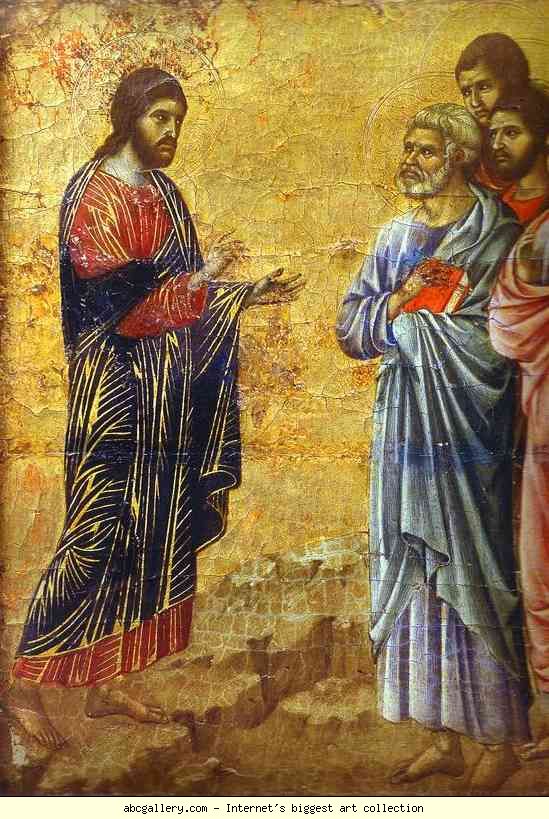
Christ commissions the disciples (detail), reverse surface of the Maesta, Altarpiece in Museo dell’Opera del Duomo, Siena, Duccio di Buoninsegna (ca 1255 – pre-1319), tempera on wood, 1308-1311.
To what extent are we free agents? Does God choose you to be saved, or do you get there (or not) by your own free choice? In his analysis of today’s readings, Dr John Bergsma says,
For myself, I’m not optimistic that I will ever understand predestination, or the mysterious interaction between God’s will and my own free will, in this life. With St. Paul, however, I do recognize that, although I often felt like I was “choosing for God” at various points in my life, when I look back now, it seems apparent that God was moving everything in a direction he always intended. How this works, I don’t know, but it is a common Christian experience. If someone wants to insist that it can’t be so, that God can’t “choose us” and at the same time we freely “choose him,” I would reply that reality is more mysterious then we realize. Even physicists have discovered this: there are apparent “contradictions” in the material world that are nevertheless true. For example, light is both a wave and particle at the same time, yet how this can be so is very difficult to imagine.
Read the rest of his commentary on the readings here. In particular he focuses on the unlikelihood of God’s choice of messengers. Download today’s Mass readings for Australia here:
Christ healing the woman with the haemorrhage, 3rd to 4th century, Catacombs of Marcellinus and Peter, Via Casilina, Rome.
Our First Reading from the book of Wisdom today says, ‘Death was not God’s doing … It was the devil’s envy that brought death into the world.’ Obviously creatures have been dying in our universe since time immemorial, so we have to go a bit deeper than a purely literal interpretation of Genesis (and Wisdom). The most satisfying commentary I have been able to find is this excellent one from Fr Barron:
Some helpful Ignatian reflections on physical versus spiritual death can be found here.
Finally, to flesh out the discussion on what Scripture means by death, the Dominicans of the Province of St Joseph have a very helpful article called Molecules and Mourning.
The Storm on the Sea of Galilee, Rembrandt, 1633, Oil on canvas, location unknown, stolen from the Isabella Stuart Gardner Museum, Boston.
Do you trust God? If you want to know what trust in God is, look at the reactions of the relatives of the victims of the Charleston Church Shooting when they are confronted with the murderer of their loved ones in court.
“I just want everyone to know I forgive you,” said Nadine Collier, the daughter of 70-year-old victim Ethel Lance. “You hurt me, you hurt a lot of people, but I forgive you.”
“I forgive you, my family forgives you,” said Anthony Thompson. “We would like you to take this opportunity to repent. … Do that and you’ll be better off than you are right now.” (The Australian)
Trust is putting our faith in God even in the most excruciatingly painful circumstances, and knowing that his plan is much greater than our minds can understand.
In today’s first reading, Job has lost everything – children, property and health – and has been pouring out his heart to God for 37 chapters. God replies by showing Job his omnipotence:
Where were you when I laid the earth’s foundations? Tell me, since you are so well-informed! (Job 38:4)
Job only comes to the end of his sufferings when he realises his own ignorance before God:
I know that you are all-powerful: what you conceive, you can perform. I was the man who misrepresented your intentions with my ignorant words. You have told me about great works that I cannot understand, about marvels which are beyond me, of which I know nothing. Before, I knew you only by hearsay but now, having seen you with my own eyes, I retract what I have said, and repent in dust and ashes. (Job 42:2-3, 5-6)
God rewards Job for his faithfulness and humility:
And the Lord restored Job’s condition, while Job was interceding for his friends. More than that, the Lord gave him double what he had before.
Job still doesn’t understand why he had to go through such suffering, but in this book full of dramatic irony, the reader knows, because back in Chapters One and Two, we saw how Satan wanted to test the faith of Job.
‘Yes,’ Satan said, ‘but Job is not God-fearing for nothing, is he? … You have blessed all he undertakes, and his flocks throng the countryside. But stretch out your hand and lay a finger on his possessions: then, I warrant you, he will curse you to your face.’ ‘Very well,’ Yahweh said to Satan, ‘all he has is in your power.’ (Job 1:9, 11-12)
It was actually Satan who caused all of Job’s misery, not God. God only permits Satan to ‘sift us like wheat’ when He has a larger purpose in mind: an expansion of faith and trust, as in Job’s situation and in today’s Gospel where the Apostles are astounded at Jesus’ Divine Power.
Jesus tells his apostles in today’s Gospel, after he has calmed the storm,
‘Why are you so frightened? How is it that you have no faith?’
Jesus wants a lived faith, a life of radical trust and immersion in Him, not a superficial faith that runs fleeing in the other direction as soon as it encounters a challenge.
Other resources:
Read Dr Michael Barber’s Scripture Study on today’s readings.
Fr Barron in his homily for today relates the readings to today’s crisis within the Church.
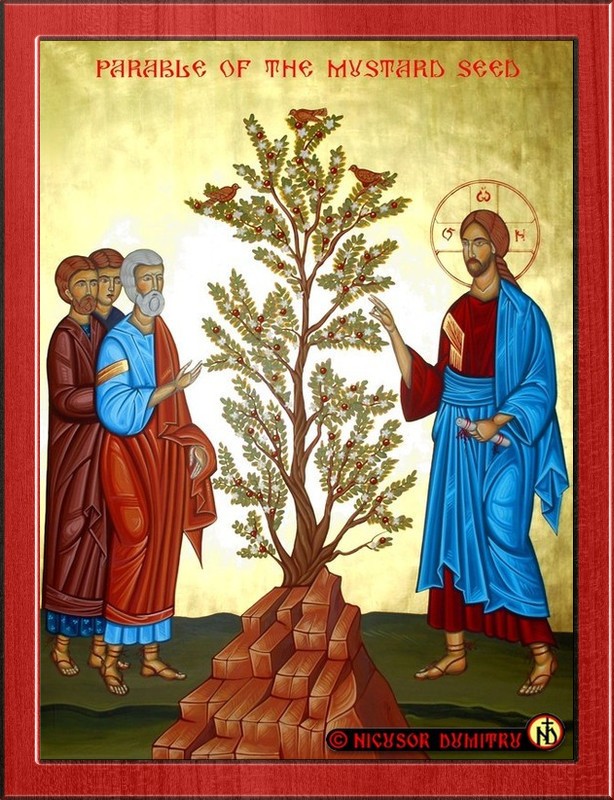
What can we say the kingdom of God is like? What parable can we find for it? It is like a mustard seed which at the time of its sowing in the soil is the smallest of all the seeds on earth; yet once it is sown it grows into the biggest shrub of them all and puts out big branches so that the birds of the air can shelter in its shade. (Mark 4:30-32)
What is this kingdom of God that Jesus keeps talking about in parables? Jesus is the seed described in John 12:24.
Truly, truly, I say to you, unless a grain of wheat falls into the earth and dies, it remains alone; but if it dies, it bears much fruit.
Jesus becomes that ‘smallest of all the seeds’ in his humiliation and death, but what follows is the Resurrection and the expansion of his Kingdom, the Church. We see this pattern repeated in so many ways in church history. Fr Barron illustrates this in his homily for today with the examples of Charles Lwanga, Mother Theresa and St Francis of Assisi.
It’s not only the membership of the church that grows like a mustard tree, but also our understanding of Jesus’ teaching. This is the image that Blessed John Henry Newman used in his Essay on the Development of Christian Doctrine. I have heard the Catholic Church described by Protestants as ‘legalistic’. It seems that part of the objection is that we have too much doctrine. But if we love the Lord, then exploring his word results in a natural growth in our understanding. New understandings never contradict previous understandings, but are brought forth from them in the same way that advances in the deductive sciences are made: by starting on the trunk of the tree with known knowns, and pursuing them along the branches and smaller twigs to areas which require further elucidation. In this way, the tree keeps becoming more all-encompassing. So, for example, the idea of Mary as the Mother of God (Theotokos) was premised on the prior understanding that Jesus the man was also fully Divine, and that he had two natures in one person: a divine nature and a human nature united in a ‘mystical union’ or hypostatic union. This doctrine was only formally defined at the First Council of Ephesus (431) and the Council of Chalcedon (451) as a response to Nestorianism which held that Jesus was not the same as the eternal Word of God, he was just a human who had received divinity from the Father. [For more on Newman’s concept of the Development of Doctrine, go here.]
Because new understandings must be consistent with previous understandings, the Church cannot change its teaching on Marriage, no matter what pressures are brought to bear by the culture. That is the beauty of the Catholic Church: consistent in its teachings from the Apostolic era until today. That is why Archbishop Costelloe has felt it necessary to reiterate the Church’s teaching during the current debate on same-sex marriage in Australia. A pastoral letter will be given out today at all Masses explaining the Church’s position. You can read it here: Same-sex Marriage Pastoral Letter FINAL
Please also read the ‘Don’t Mess with Marriage‘ document from the Australian Catholic Bishops’ Conference. Well done to the Bishops! You may well find that the media and the same-sex lobbyists want to crucify you too, but stand firm!
God is One, because he is the fullness of being and is not limited by something other than God. But Scripture also reveals that God is Love, and that means that God is by his very nature a relational community of persons: Father, Son and Holy Spirit. From John Bergsma at The Sacred Page:
If God is monopersonal and Jesus is not divine (=Arianism), then God showed his love for us by this: by creating another creature who came down to suffer, die, and save us. But God didn’t come Himself. That’s nice, but it’s hardly extreme love.
On the other hand, if the different persons of the Trinity are just “modes” of God’s one person (=Modalism), then there is nothing but self-love in God. God the “Father” and God the “Son” aren’t really different, so the love between them is either an illusion, an anthropomorphism, or self-love. Self-love is not the highest love—in fact, it may be the lowest. The implication is that until God created other persons (angels, humans) there was in Himself nothing but self-love, but not the highest form of love—total gift of self for another person (John 15:13).
If God is not a Trinity, he did not have the perfection of love in Himself until he created other persons to love. So God was imperfect until the world was made. That creates philosophical difficulties.
But God is a Trinity. There existed within Himself, without the need of creatures, the perfection of love from all time: the perfect and total gift of self from Father to Son and back again. The Self they exchange is the Spirit. Thus, God did not create out of a need to attain perfection Himself, but out of the gratuitous overflow of his love. And, as St. Paul teaches in this passage of Romans, his desire for us is to draw us into the burning circle of his love.
So there is a very great difference in how we relate to God because he is a Trinity, and if we do not understand or recognize his Trinitarian nature it impairs our union with Him due to misconceptions. A monopersonal God can be worshiped and even loved; but only the true, tripersonal God can draw us into the flow of love within Himself, making us “partakers of the divine nature” (2 Peter 1:4). Read more here.
But don’t expect to understand the Trinity fully. John Bergsma again:
Still, the Trinity is a mystery. But mysteries are not unique to theology or religion: in physics, it’s well-known that light is both a wave and a particle. How can this be? No one knows, but experiments show that it behaves like both. The doctrine of the Trinity is like that.
Fr Barron explains more in this series of videos:
Though contemplation of the Divine Nature is good, it’s not enough! Listen to Fr Barron explain that the doctrine of the Trinity is a call to action: click here to listen.
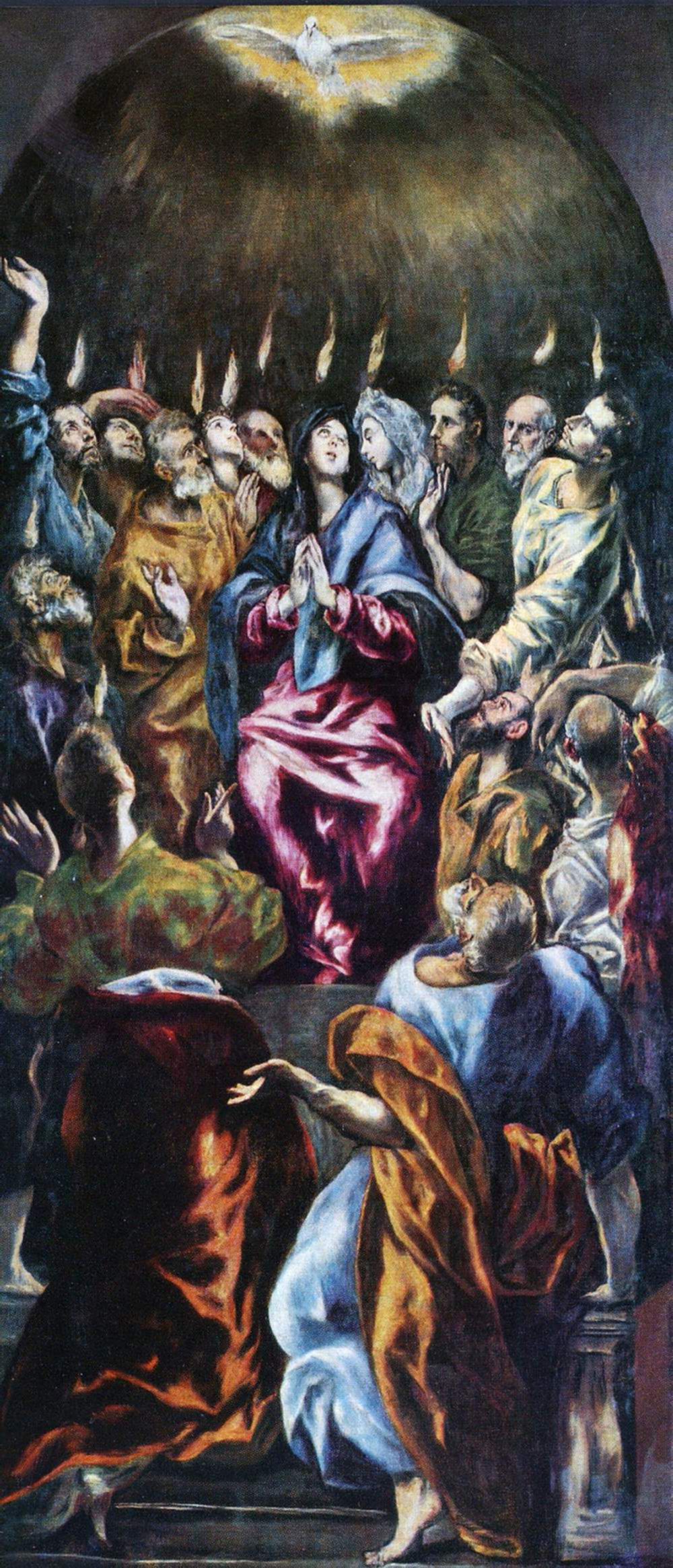
Pentecost, El Greco, c. 1600, Museo Nacional del Prado, Madrid, oil on canvas.
If the “fruit of the Spirit” is love, joy, peace, patience, kindness, goodness, trustfulness, gentleness and self-control (Gal. 5), then today the Holy Spirit has been showing me how poor I am in fruits! Our washing machine has been playing up the whole week, and finally I decided to get a new one. (This was after a week when I had already forked out $600 repairing the damage to our house caused by cockatoos. They had pecked a hole the size of a dinner plate into our western red cedar.) Anyway, when I went to collect the washing machine today (a two hour drive, as I had to borrow a larger car), I found the invoice I had been given the previous day was for someone else’s goods, which involved a trip to customer service to sort it out. At this stage I was still patient and forbearing. Anyway, the correct goods were eventually found and the new machine was brought home, but the brand new hoses wouldn’t attach without leaking! I tried various manoeuvres with washers, but eventually resigned myself to the fact that our taps were way too corroded and this was making it impossible to get a good seal. (Handy hint: old taps glued with large amounts of lime-scale prevent leaks!) So it was another hour’s trip to the hardware store to buy a new tap set. And, yes! This worked! The Widow Fleming strikes again! So I put on a load of washing, got the music ready for church, and made dinner. I was still congratulating myself on my patience and perseverance at this point, and we set off for the Pentecost Vigil. But at church, several things happened which annoyed me to bits. I won’t give the details, as we should be trying to build one another up in the Lord, and stirring up discord within a church community is one of Satan’s wiliest tricks. Still, I kept smiling. Back at home, it was finally time to relax and unwind, but not before we had hung out that first load of washing from the new machine. My son volunteered, but being the multi-tasking character that he is, decided he would save himself two trips and carry both the washing basket and his plate, which was loaded up with roast pork, vegetables and a rather wonderful gravy. Well, somehow the plate tipped over, spilling the wonderful gravy, peas and greasy pork all over our clean washing. And it was at this point that I completely lost it and managed both to shout at him and burst into tears at the same time. So much for patience, self-control, gentleness and the rest.
Holy Spirit, I’m obviously not there yet. Please take over! I need more of you! And while You’re at it, please help our Pastoral Area as well – we need your grace in order to grow.
Of course, all my little difficulties are first world problems, and the best way of coping with them is to laugh at them. Fr Longenecker has the right idea in his article on Hilarity and Holiness.
Anyway, today’s readings are here (now you know why I’m late posting this):





 Catholic in Yanchep