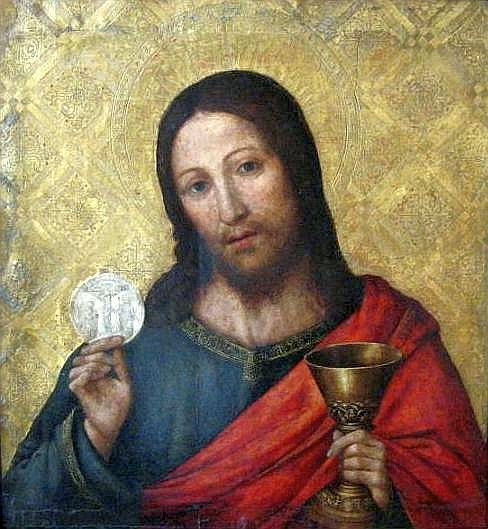
Christ with the Host, Paolo de San Leocadio (1445-1520), oil and gold on wood, National Museum in Poznań (Muzeum Narodowe w Poznaniu), Poland. [Public domain], via Wikimedia Commons.
We are what we eat. At least biologically, the molecules we ingest are assimilated and through a complex series of reactions either become part of our physical bodies, or are used for the production of energy via respiration – or are eliminated without being used.
So it is when we receive the Body and Blood of Our Lord in Holy Communion. Jesus has left us this remarkable Sacrament, not only so that the physical molecules of the Eucharistic species can become part of our flesh and blood, but so that we can be drawn into Christ. Though we are consuming Christ, he is in a way consuming us – it is as close as we can get in this life to a consummation of the wedding feast of the bride (the Church) and the Lamb.
Some Christians shake their heads at the thought that Catholics (and the Orthodox) think they are consuming Jesus’ actual body and blood. But we are merely being Bible literalists in this particular case. How many times does Jesus have to say it?
I am the living bread which has come down from heaven. Anyone who eats this bread will live for ever; and the bread that I shall give is my flesh, for the life of the world (John 6:51).
In all truth I tell you, if you do not eat the flesh of the Son of man and drink his blood, you have no life in you (John 6:53).
Anyone who does eat my flesh and drink my blood has eternal life, and I shall raise that person up on the last day. For my flesh is real food and my blood is real drink (John 6:55).
Whoever eats my flesh and drinks my blood lives (remains, abides) in me and I live (remain/abide) in that person (John 6:56).
As the living Father sent me and I draw life from the Father, so whoever eats me will also draw life from me (John 5:57).
This is the bread which has come down from heaven; it is not like the bread our ancestors ate: they are dead, but anyone who eats this bread will live for ever (John 6:58).
At the time of John’s writing of this Gospel, the Christian practice of the ‘Breaking of Bread’ was already well established. There was no need for John to reiterate the Institution of the Eucharist which occurs in Matthew 26, Mark 14 and Luke 22. His audience was already familiar with Jesus ‘ instructions to ‘do this in remembrance of me’. However, the new challenge for John was the rise of false teachers. For example, Cerinthus was a Gnostic contemporary of John who was confusing the faithful by suggesting that Jesus was not fully Divine, but that Christ ‘entered’ into Jesus at his baptism and left him before his crucifixion. In the Gnostic view, matter was evil and the body was a prison from which the spirit needed to escape. In all of Jesus statements above, John is emphasising that Jesus is referring to his flesh and blood in a literal sense. Matter is the portkey (to use Harry Potter language) that God uses to help us remain (abide) in him. Read John chapter 15 and you will see how important it is to remain in Jesus: “Whoever remains in me, with me in him, bears fruit in plenty; for cut off from me you can do nothing.” “Remain in me, as I in you.” “As a branch cannot bear fruit all by itself, unless it remains part of the vine, neither can you unless you remain in me.” “Remain in my love. If you keep my commandments you will remain in my love.” Jesus doesn’t repeat himself unless it’s important!
My dear friends at the (Protestant) Bible Study I attend say that Jesus couldn’t have meant this literally because the consumption of blood is forbidden in the Old Testament. What the OT actually says is “But be sure you do not eat the blood, because the blood is the life, and you must not eat the life with the meat.” (Deuteronomy 12:23). But this is the whole point! Jesus wants us to consume HIS blood, because he wants us to receive his life! He wants us to remain in him!
We are such muggles when it comes to understanding Jesus, that no wonder he has to repeat himself several times for us to get the point.
From the Catechism:
It is highly fitting that Christ should have wanted to remain present to his Church in this unique way. Since Christ was about to take his departure from his own in his visible form, he wanted to give us his sacramental presence … What material food produces in our bodily life, Holy Communion wonderfully achieves in our Spiritual life. Communion with the flesh of the risen Christ, a flesh ‘given life and giving life through the Holy Spirit,” preserves, increases, and renews the life of grace received at Baptism. This growth in Christian life needs the nourishment of Eucharistic Communion, the bread for our pilgrimage until the moment of death, when it will be given to us as viaticum. [1392]
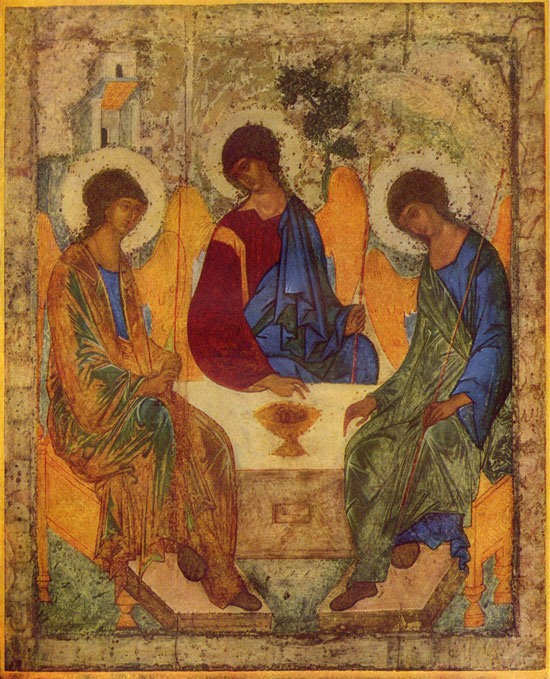
Holy Trinity Icon, Andrei Rublev, 1411-27, Tretyakov Gallery, Moscow
Apologies for the lateness of this post, but we had our first big winter front come through and were without power for most of the day. The electricity being out, we also had to re-locate our Mass from Yanchep to the Presbytery in Two Rocks, where all fourteen of us snuggled up in the Chapel at the back of the house. This is one of the most cheerful chapels I have seen, because Fr Augustine, in typical style, has furnished it with a profusion of the most brightly coloured flowers and candles to be had in plastic. Not ideal according to canon law, but I am sure Our Lord will excuse us due to the small number of volunteers available, and it’s a kind of glorious celebration of our poverty.
Anyway, today we celebrate the Most Holy Trinity, and Fr A’s homily got to the heart of the matter:
The Trinity is a mystery.
Don’t fret if you can’t understand it. The main thing is that you can join, with the angels and saints, in a spirit of gratitude, glorifying the Father, the Son and the Holy Spirit.
There’s a lot to be said for this approach, because it’s too easy to botch a homily on the Trinity, if you’re not a philosophy major. But understanding the Trinity, even a little bit, is vitally important if you want to understand God as a God of Covenantal Love, with the humans as family, rather than say, the Islamic understanding of God as Master, with the humans as slaves.
The Mystery of God is much greater than mere human words and thoughts can explain. And humans tend not to be very precise with words, particularly where vested interests try to capture the word market.
If I were to give some advice to priests about homilies on the Trinity, I would say:
Please don’t confuse the Catholic use of the word, person, with our everyday use of the word people. My friends at the Church of Christ have a very hard time of it describing the trinity because they don’t have the theological vocabulary to make this distinction. When we’re talking about God, we use the word person to distinguish the three persons of Father, Son and Holy Spirit. Make it clear to the congregation that person in this sense is more like an independent consciousness, while God at the same time is one divine essence. Remember God is not a human, he does not fit into human categories, as he is the ultimate Cause of Everything.
Please define your terms. I have heard some woolly and ill-defined homilies about ‘the Spirit of the Father’, the ‘Spirit of the Son’, the ‘Spirit of the Spirit’. Note that there is only one Spirit in God – the Holy Spirit -which proceeds from the Father and the Son. Stop dividing the Holy Spirit into a kind of exploding fractal.
Please don’t describe God as ‘a being’. This makes God sound like another creature in the universe. He is totally other than all created ‘beings’, and therefore requires a different language, perhaps in the end, the ‘I am’ of Exodus comes closest.
Try not to be an Arian in your use of language. Arius thought that God created Jesus, and that Jesus didn’t exist prior to his incarnation. My Church of Christ friends (sorry to pick on you again!) say things like, “God sent Jesus” when they really mean “the Father sent Jesus”. We need to use language which reflects our Trinitarian understanding more accurately and emphasises the Love between the Father and the Son.
Avoid Modalism. This is where the different hypostases of the Trinity are just God appearing in different forms, like the Marvel shape-shifter Mystique who pops up in different forms whenever its useful to her.
The Catechism of the Catholic Church is well worth reading when it comments on our understanding of the Trinity, and I quote it in large chunks here:
251 In order to articulate the dogma of the Trinity, the Church had to develop her own terminology with the help of certain notions of philosophical origin: “substance”, “person” or “hypostasis”, “relation” and so on. In doing this, she did not submit the faith to human wisdom, but gave a new and unprecedented meaning to these terms, which from then on would be used to signify an ineffable mystery, “infinitely beyond all that we can humanly understand”.
252 The Church uses (I) the term “substance” (rendered also at times by “essence” or “nature”) to designate the divine being in its unity, (II) the term “person” or “hypostasis” to designate the Father, Son and Holy Spirit in the real distinction among them, and (III) the term “relation” to designate the fact that their distinction lies in the relationship of each to the others.
The dogma of the Holy Trinity
253 The Trinity is One. We do not confess three Gods, but one God in three persons, the “consubstantial Trinity”. [83] The divine persons do not share the one divinity among themselves but each of them is God whole and entire: “The Father is that which the Son is, the Son that which the Father is, the Father and the Son that which the Holy Spirit is, i.e. by nature one God.” [84] In the words of the Fourth Lateran Council (1215), “Each of the persons is that supreme reality, viz., the divine substance, essence or nature.” [85]
254 The divine persons are really distinct from one another. “God is one but not solitary.” [86] “Father”, “Son”, “Holy Spirit” are not simply names designating modalities of the divine being, for they are really distinct from one another: “He is not the Father who is the Son, nor is the Son he who is the Father, nor is the Holy Spirit he who is the Father or the Son.” [87] They are distinct from one another in their relations of origin: “It is the Father who generates, the Son who is begotten, and the Holy Spirit who proceeds.” [88] The divine Unity is Triune.
255 The divine persons are relative to one another. Because it does not divide the divine unity, the real distinction of the persons from one another resides solely in the relationships which relate them to one another: “In the relational names of the persons the Father is related to the Son, the Son to the Father, and the Holy Spirit to both. While they are called three persons in view of their relations, we believe in one nature or substance.” [89] Indeed “everything (in them) is one where there is no opposition of relationship.” [90] “Because of that unity the Father is wholly in the Son and wholly in the Holy Spirit; the Son is wholly in the Father and wholly in the Holy Spirit; the Holy Spirit is wholly in the Father and wholly in the Son.” [91]
256 St. Gregory of Nazianzus, also called “the Theologian”, entrusts this summary of Trinitarian faith to the catechumens of Constantinople: Above all guard for me this great deposit of faith for which I live and fight, which I want to take with me as a companion, and which makes me bear all evils and despise all pleasures: I mean the profession of faith in the Father and the Son and the Holy Spirit. I entrust it to you today. By it I am soon going to plunge you into water and raise you up from it. I give it to you as the companion and patron of your whole life. I give you but one divinity and power, existing one in three, and containing the three in a distinct way. Divinity without disparity of substance or nature, without superior degree that raises up or inferior degree that casts down. . . the infinite co-naturality of three infinites. Each person considered in himself is entirely God. . . the three considered together. . . I have not even begun to think of unity when the Trinity bathes me in its splendour. I have not even begun to think of the Trinity when unity grasps me. . [92]
THE DIVINE WORKS AND THE TRINITARIAN MISSIONS
257 “O blessed light, O Trinity and first Unity!” [93] God is eternal blessedness, undying life, unfading light. God is love: Father, Son and Holy Spirit. God freely wills to communicate the glory of his blessed life. Such is the “plan of his loving kindness”, conceived by the Father before the foundation of the world, in his beloved Son: “He destined us in love to be his sons” and “to be conformed to the image of his Son”, through “the spirit of sonship”. [94] This plan is a “grace [which] was given to us in Christ Jesus before the ages began”, stemming immediately from Trinitarian love. [95] It unfolds in the work of creation, the whole history of salvation after the fall, and the missions of the Son and the Spirit, which are continued in the mission of the Church. [96]
258 The whole divine economy is the common work of the three divine persons. For as the Trinity has only one and the same natures so too does it have only one and the same operation: “The Father, the Son and the Holy Spirit are not three principles of creation but one principle.” [97] However, each divine person performs the common work according to his unique personal property. Thus the Church confesses, following the New Testament, “one God and Father from whom all things are, and one Lord Jesus Christ, through whom all things are, and one Holy Spirit in whom all things are”. [98] It is above all the divine missions of the Son’s Incarnation and the gift of the Holy Spirit that show forth the properties of the divine persons.
259 Being a work at once common and personal, the whole divine economy makes known both what is proper to the divine persons, and their one divine nature. Hence the whole Christian life is a communion with each of the divine persons, without in any way separating them. Everyone who glorifies the Father does so through the Son in the Holy Spirit; everyone who follows Christ does so because the Father draws him and the Spirit moves him. [99]
260 The ultimate end of the whole divine economy is the entry of God’s creatures into the perfect unity of the Blessed Trinity. [100] But even now we are called to be a dwelling for the Most Holy Trinity: “If a man loves me”, says the Lord, “he will keep my word, and my Father will love him, and we will come to him, and make our home with him”: [101] O my God, Trinity whom I adore, help me forget myself entirely so to establish myself in you, unmovable and peaceful as if my soul were already in eternity. May nothing be able to trouble my peace or make me leave you, O my unchanging God, but may each minute bring me more deeply into your mystery! Grant my soul peace. Make it your heaven, your beloved dwelling and the place of your rest. May I never abandon you there, but may I be there, whole and entire, completely vigilant in my faith, entirely adoring, and wholly given over to your creative action. [102]
The Catholic Church. The Catechism Of The Catholic Church (Kindle Locations 1164-1168). . Kindle Edition.
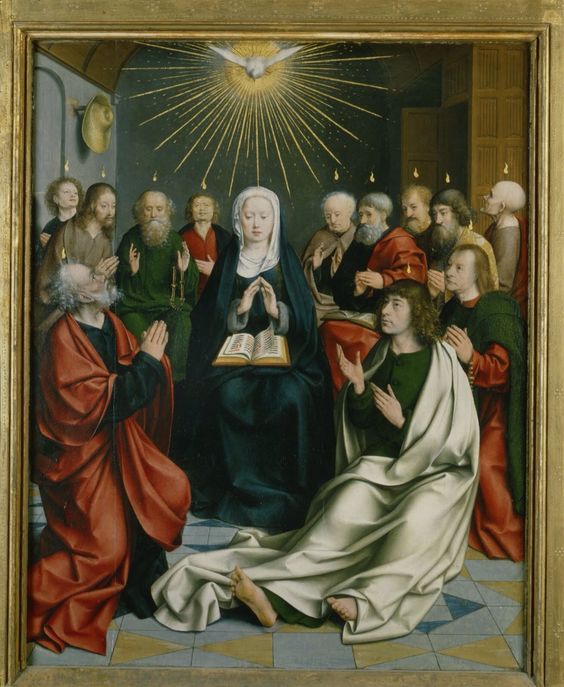
Pentecost (Pfingsten), Jan Joest van Kalkar (1505 – 1508), oil on wood, St. Nicolai’s Church, (Katholische Pfarrkirche Sankt Nikolai), Kalkar, Germany
Is your Christianity exciting you? It should. When we look at today’s Gospel, we see the disciples and Mary gathered together in the upper room (note that it wasn’t a church building, just a room). They have been praying fervently for nine days since the resurrection. Suddenly,
they heard what sounded like a powerful wind from heaven, the noise of which filled the entire house in which they were sitting; and something appeared to them that seemed like tongues of fire; these separated and came to rest on the head of each of them. They were all filled with the Holy Spirit, and began to speak foreign languages as the Spirit gave them the gift of speech.
The Holy Spirit arrives with great power, and gives them extraordinary gifts. Not only that, but he gives them the energy to go out and preach the Gospel boldly, so much so that by the end of the day, three thousand people have been baptised and added to those who believe Christ is the Son of God.
I once heard a priest from our pastoral area give a homily about this passage where he completely inverted the real message. The priest said,
“At first there was noise and confusion (apparently referring to the “powerful wind from heaven”), but then after the Holy Spirit arrived, there was peace and calm.”
“NO THERE WASN’T! ARE YOU STUPID?” I wanted to jump up and shout, but I didn’t because I was in church, and even thinking this way is uncharitable! But I wanted to say, “Can’t you see that the Holy Spirit has transformed the apostles and given them the conviction and the power to get out of the upper room and take the Gospel to the streets?”
What does this mean for our church here in the Yanchep to Lancelin Pastoral Area. At the moment we are carrying out a church census, and the numbers are showing how tragically few of us there are. I don’t believe we are truly using the gifts that the Holy Spirit makes available to us. On top of this, many of us are not well enough to be very active in parish life. And unfortunately many people have been driven away from our church for various reasons. We should be heartily ashamed and praying urgently for a renewal of the Holy Spirit in the life of the parish. I have just been watching a video of the Confirmations we had in 2001, and wondering, “Where are all those children now, and why don’t they go to Mass any more?” (I might share it with you later, so that we can all pray for them.)
And now for the Good News! We may be too uncomfortable to take the Gospel to the streets, but we can all take the Gospel to our friends and family (many of whom are not attending church). We absolutely need to if we want these people to be able to reach Heaven. The trouble is, many of us do not know how to talk about Christ with others. People get embarrassed when you start talking about religion. Well, I have good news for you: there is a wonderful program that you can access which will show you how to help others towards faith in practical ways. The RETURN program is packed with ideas you can use, and I urge you sit down and develop a strategy which is going to bring your loved ones to faith in God. And please let us do this in a joy-filled way, or we’re giving the wrong message! Otherwise we have missed the point of being Christian.
If anyone is interested in studying the Return program together, please give me a call on 0400-660-337.
Come Holy Spirit, and kindle in us the fire of your love!
Hilaire Belloc, the famous satirist and historian, once said, “The Catholic Church is an institution I am bound to hold divine — but for unbelievers a proof of its divinity might be found in the fact that no merely human institution conducted with such knavish imbecility would have lasted a fortnight.”[1]
Our readings today show how God has made provision for the Church to continue and flourish over 2,000 years, despite the ‘knavish imbecility’ of some of its members. If your first reaction is to feel insulted by this quote, stay with me for a minute while I explain. The relationship between Christ and the Church is one of bridegroom and bride (Rev. 19:7-9). Jesus wants us, above all, to be faithful to him, and he gives us the help of the Holy Spirit to do just that. Jesus tells the Apostles in today’s gospel,
I have said these things to you while still with you, but the Advocate, the Holy Spirit, whom the Father will send in my name, will teach you everything and remind you of all I have said to you. (John 14:26)
How do we stay close to the Holy Spirit? A few verses earlier, Jesus says, “If anyone loves me he will keep my word, and my Father will love him, and we shall come to him and make our home with him.”
In my own experience of parish life, there have been many occasions when staying close to the Holy Spirit has been a challenge. At times, I have thought it would just be easier to move to a different parish, or even a different church or even no church. To give you an example, I once had a priest come to bless my house. After the blessing, he stayed for another hour and a half berating the ‘knavish imbecility’ of his fellow priests. But is this what the Holy Spirit wants? Of course not: it’s always Satan that wants division and disharmony. The Holy Spirit wants faithfulness. The Holy Spirit wants us to build community. The Holy Spirit wants us to keep persevering in spite of the individual characters of the members of the Church. The Holy Spirit wants us to find the good points in others and build those up, rather than trying to destroy the other. The Holy Spirit wants us to work diligently for the benefit of all. Good parishioners and priests build up rather than break down. That is how a parish receives blessing from the Lord.
The first reading today show an example of the Holy Spirit in action. Here the Apostles meeting at the Council of Jerusalem (our first ecumenical council) come up with a solution to the problem of deciding exactly how much of the Jewish Law needs to be adhered to by the Gentile converts (Acts 15:6 ff). The difficulty is how to welcome Gentiles without alienating the Jewish followers of the Messiah. After a long discussion, Peter speaks and the entire assembly falls silent. The apostles and elders or priests (toi apostolois kai presbyterois / τοῖς ἀποστόλοις καὶ τοῖς πρεσβυτέροις) then write a letter to confirm the decision of the council, saying, “It has been decided by the Holy Spirit and by ourselves not to saddle you with any burden beyond these essentials …” They are very aware of the Holy Spirit guiding the Council which has assembled in the name of the Lord Jesus Christ.
So Hilaire Belloc was right: as individuals we may be a bit stupid, but as a Catholic Church, listening to the Holy Spirit, we have been guided and kept faithful for 2,000 years, despite pressure from the outside world to ‘change our teaching’! The Church and Christ are like a married couple, of whom everyone says, “This marriage cannot possibly last!” yet, there they are, celebrating their anniversary year after year! I say hurrah for faithfulness! Thank you to the Holy Spirit for holding us together.
[1] Hilaire Belloc, remark to William Temple, quoted in Robert Speaight, The Life of Hilaire Belloc (1957). London: Hollis and Carter, p. 383
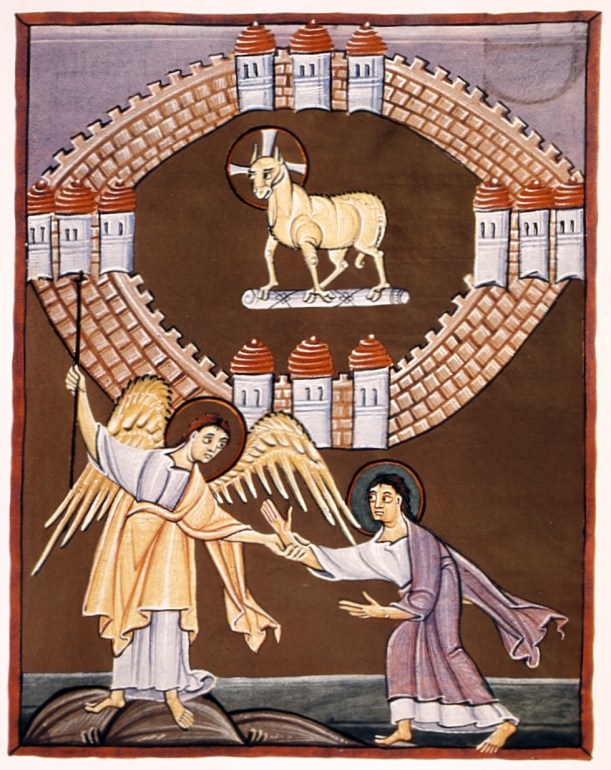
The New Jerusalem, Bamberg Apocalypse, 11th century, Folio 55, MS A.II.42, Bamberg State Library, commissioned by Otto III.
Today’s Gospel reading may at first sight seem a bit repetitive. But remember, John has a purpose in everything he writes. He tells us he could have written a whole lot more, but he has selected what he has, ‘so that we might believe’ (John 20:31)
The words he keeps repeating are ‘glorify’ (ἐδοξάσθη) and ‘love’ (ἀγάπη).
Why does Jesus say ‘Now has the Son of Man been glorified?’ What has just happened? Judas has just received the Eucharist and slipped out of the room to deliver Christ to his enemies! (verse 27: At that instant, after Judas had taken the bread, Satan entered him).
It seems as if John has made a typographical error. Didn’t he mean ‘Now has the Son of Man been betrayed?’ But no, John wants us to understand that the Glory of Christ is in his willingness to undergo betrayal by a close friend, with all that comes afterwards.
The next few lines read like a poem on the Trinity. Everything that affects the Son, affects the Father. Everything of the Father reflects back to the Son. It’s almost mathematical in its expression. Let a = Son and b = Father. x = glorification. If a has property x, then b has property x. If b has property x, then a has property x, or to put it in the way John puts it:
Now has the Son of Man been glorified,
and in him God has been glorified.
If God has been glorified in him,
God will in turn glorify him in himself,
and will glorify him very soon.
Jesus turns the focus from this great act of betrayal by Judas into God’s great act of self-giving. Self-giving is God’s glory.
Jesus is adding a whole new dimension to glory, usually understood as God’s holiness, majesty and power. How could it be otherwise? If God were selfish, he would not be glorious. If God wanted us to love him merely because of his overwhelming power as Creator, that would not constitute greatness. But a God who loves to the point of allowing himself to experience the most excruciatingly egregious behaviour of his creatures, and giving up everything he has by right, truly deserves our praise and respect.
In this passage the Son, the Father and the Holy Spirit are all present. Where is the Holy Spirit? He’s not actually mentioned. But we know the Holy Spirit appears as a Cloud of Glory (the Shekinah cloud) elsewhere in Scripture. And here John’s crescendo of glorification words describes what amounts to a verbal Cloud of Glory around the Father and the Son: what is this if not the Holy Spirit, the love between the Father and the Son?
I have some relations and friends who are scornful of my Christianity. Though they don’t always tell me to my face, I can tell from their resigned and patient expressions, that they think I have a screw loose. To believe that someone can rise from the dead, or that miracles occur? Pffft. Some of the more honest ones have told me I learn to think for myself and not be a sheep who follows the teachings of a patriarchal bronze age society.
This line of reasoning falls flat on its face when we look at actual case studies of atheists who have changed their minds and turned to Christianity. Christians, it turns out, are no more stupid than the rest of society. And they are much better at handling rejection than some of the popular victim groups around today, because the cross comes with the territory of being a Christian. We’re not in it for its popularity or for success (some are, but this is only a characteristic of some branches of Protestantism).
Today, we’re celebrating Good Shepherd Sunday. We’re celebrating the fact that the Shepherd in charge is good – he wants what is best for us – and we follow him because we love him. I can honestly say to the people who doubt me, that the relationship I (and many others) have with this Shepherd, is one so filled with joy that nothing can take that away from us, not even suffering. That’s because it’s a living relationship. Not only does Jesus appear in the pages of the Bible, but he actually establishes a living and present relationship with us through prayer, Baptism, Penance, Holy Communion and the other Sacraments. Jesus tells us, “the sheep that belong to me listen to my voice; I know them and they follow me. I give them eternal life; they will never be lost and no one will ever steal them from me.” (John 10: 27 ff.)
The ‘prayer’ one is particularly important for hearing the voice of the Shepherd. I have a 50 minute drive in to work every day, and over time, have developed a ritual of prayer for filling in the time: morning offering, prayer to the guardian angel of every member of my family, likewise a prayer to St Michael for family members, followed by a Divine Mercy chaplet and later the Rosary. I’m not telling you this to show off, I actually want to share that I’m not very good at praying like this, because my mind keeps wandering off on tangents. Anyway, I was getting pretty frustrated at the tendency of my mind to drift away from the actual words of the prayers, but then I had a revelation. It started to seem to me that in some of these ‘wanderings’ I was hearing the voice of the Shepherd guiding me in thinking about the people I was praying about. So I have started listening more intently to what I think he is saying to me. How do we know we’re hearing the Shepherd and not the Thief? If I am in doubt about a particular course of action that has come to me, I now write it down, and pray about it in front of the Blessed Sacrament, and ask God for ‘more information’. He will either confirm and strengthen the idea, and we will experience what St Ignatius calls consolation, or we will experience desolation. Margaret Silf talks about this in her book, The Inner Compass.
It’s wonderful to be a sheep, to know I don’t have to re-invent everything as if I am a God unto myself, to be guided by one who is goodness, truth and beauty himself. I love the obedience that being a sheep entails. I love having the confidence that the Shepherd won’t let anyone steal me away from the Father. And I love the hope that the Shepherd gives me for the other members of my family, even the ones who don’t trust him just yet …
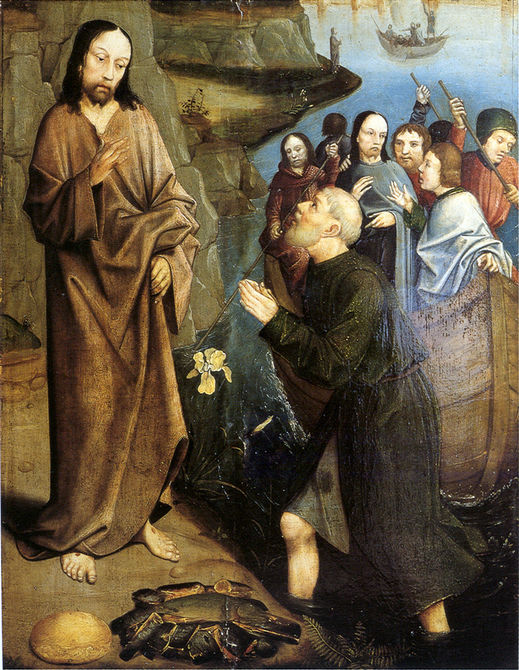
The Third Appearance of Christ, Dieric Bouts, 1415-1475, private collection.
I love this first reading we have today from Acts, chapter 5. The high priest says, “We gave you a formal warning not to preach in this name and what have you done? You have filled Jerusalem with your teaching!” How it reminds me of today, when so many people want to silence the Word of God. As Greg Sheridan says in The Australian, there is a real danger that in the near future “our often counter-productive human rights bureaucracies will deem it an offence for people to propound traditional Christian teaching.” Similarly, articles by Angela Shanahan and Caroline Overington have shown how universities are now discriminating against faith-based groups on the basis of inclusivity. Ironic, isn’t it?
And in reply, Peter and the apostles say, “Obedience to God comes before obedience to men.” In a nutshell, that’s what Jesus wants when he is asked, “What shall I do to inherit eternal life?” And he answers, “You shall love the Lord your God with all your heart and with all your soul and with all your strength and with all your mind, and your neighbour as yourself” (Luke: 10:25-27).
In the tradition of filling the world with Christ’s teaching, Pope Francis, the Shepherd of the Church, has released his new exhortation, Amoris Laetitia – “The Joy of Love”, which is about the joy to be found in authentic families joined by love. Do yourself a favour and ignore the newspaper headlines which want to put their own spin on this document, and read the original here.
The Incredulity of St Thomas, Caravaggio, (1602), oil on canvas, Sanssouci Palace, Potsdam, Germany.
If there really is a God in charge of the Universe, and a personal God at that, he would want to let us know, right? Well, it turns out that he has, but you have to have a humble heart that is open to persuasion in order to be convinced. There is a fascinating series of coincidences of dates associated with The Apparitions at Fatima, the Divine Mercy devotions, Pope St John Paul II and now most recently, the death of Mother Angelica. God gives us these clues because he knows how much we tend to be like Doubting Thomas in the gospel reading for today …
13th May and other thirteens
I’ll start with 13th May 1917, when the Virgin Mary appeared to Lucia, Jacinta and Francisco, three peasant children from Fatima in Portugal. There were a total of six apparitions, one on the 13th of each month from May to October that year. (The August apparition was on 15 August, the Feast of the Assumption of Mary.) About 70,000 people were present for the final apparition, and many supernatural phenomena, including the Miracle of the Sun, were observed. But the point of the appearance of the Virgin Mary was to encourage penance and prayer, especially the rosary, a meditation on events in the lives of Jesus and Mary.
13th May 1917 also just happened to be the date when Pope Pius XII, then Eugenio Pacelli, received his episcopal ordination. It was he who subsequently formally defined the ancient belief in the Virgin Mary’s Assumption, and he himself confirmed that he had witnessed the Miracle of the Sun several times in 1950, the year he proclaimed this dogma.
Meanwhile, in Poland …
Meanwhile in Poland, Sr Faustina (1905-1938), a Christian mystic, began to experience apparitions of Christ. She recorded her conversations with him in diaries over several years. It was February 1931 when he first appeared to her as King of Divine Mercy. Over the course of the apparitions, he asked her to have a painting made showing him with red and white rays emanating from his heart and instructed her to promote prayer through the Divine Mercy Chaplet, whose purposes were threefold: to obtain mercy, to trust in Christ’s mercy and to show mercy to others. Sr Faustina died of suspected tuberculosis at the age of 33, one year before Hitler invaded Poland, and for some time the Divine Mercy Devotions were destined to remain mostly hidden from the wider world.
Fast forwarding to World War 2, Karol Wojtyla, the future Polish Pope John Paul II, was told about the Divine Mercy Devotions by a classmate in the seminary he attended secretly in Krakow (the Communist government had attempted to eradicate religion from society) . He began to visit the grave of Sr. Faustina at the Convent of the Sisters of Our Lady of Mercy on his way home from night shift at the Solvay Chemical Plant.
There’s a long and fascinating story of how devotion to the Divine Mercy was banned and went underground for several decades, but to cut to the chase, Karol Wojtyla involved himself in collecting information about Sr Faustina’s life and in removing the prohibition that had been placed on her diaries. Six months after he had achieved this, he was elected Pope. The message of Divine Mercy was still close to his heart, and his second encyclical, Dives in Misericordia (Rich in Mercy), published in November 1980, was a reflection on God’s superabundant mercy and a plea for Christians to implore God’s mercy on the sinfulness of mankind.
Only six months later, on 13th May 1981, an assassination attempt was made on Pope John Paul II. He survived four shots from a 9 mm Browning fired at him by the Turk, Mehmet Ali Agca. Multiple perforations of his colon and small intestine caused him to lose three quarters of his blood before he was stabilized after five hours of surgery. But by October of that year he was back at work. In his audience address of 7 October 1981 (The Feast of the Holy Rosary) he said:
Today it has been granted me, after a long interruption, to resume the general audiences which have become one of the fundamental forms of pastoral service of the Bishop of Rome.
The last time, the pilgrims who came to Rome gathered for such an audience on 13 May. However, it could not take place. Everyone knows why …
Today, after an interval of five months, beginning this meeting so dear to me and to you, I cannot help referring to the day of 13 May.
… Could I forget that the event in St Peter’s Square took place on the day and at the hour when the first appearance of the Mother of Christ to the poor little peasants has been remembered for over sixty years at Fatima in Portugal? For, in everything that happened to me on that very day, I felt that extraordinary motherly protection and care, which turned out to be stronger than the deadly bullet.
Today is the memorial of Our Lady of the Holy Rosary. The whole month of October is the Month of the Rosary. Now that nearly five months later it has been granted me to meet you again at the Wednesday audience, dear brothers and sisters, I want these first words that I address to you to be words of gratitude, love and deep trust, just as the Holy Rosary is and always remains a prayer of gratitude, love and trustful request: the prayer of the Mother of the Church.
But even while Pope John Paul II was recovering from this attack, another milestone was unfolding in the history of the Church.
Broadcasting to the World
August 15th 1981 (yes, the Feast of the Assumption, again!) heralded the first broadcast from the Eternal Word Catholic Television Network (EWTN), an initiative of Mother Mary Angelica of the Annunciation, a Franciscan nun. Mother Angelica, who died last week on Easter Sunday, was known for the great suffering she endured throughout her life, her radical trust in Jesus, her no-nonsense style and her orthodoxy. Born Rita Rizzo, she was the only child of Italian-American immigrants who divorced when she was six years old; her father had abandoned the family when she was very young, and her mother struggled with chronic depression. She remembered her childhood as a constant battle to keep food on the table. But instead of thinking God had abandoned her, she developed an intense prayer life and her love of Jesus bore fruit in many miracles, which are amply described in Raymond Arroyo’s biography. EWTN has now grown to be the largest global religious media network, with a viewership of 250 million homes, not including those who watch it streamed online. You could say that God used EWTN to promote devotion to both the Divine Mercy Chaplet and the Holy Rosary – these are on its schedule every day of the week.
Not only that, but God organised things so that EWTN took off in the midst of the period when the Holy Father was undergoing a recovery from an attempted assassination. One could almost say that the Holy Father was required to undergo a great suffering himself in order for fruit to come forth elsewhere in the church. In similar fashion, according to Michael Warsaw, the CEO of EWTN, the network’s reach exploded most markedly in the 14 years since Mother Angelica suffered a debilitating stroke on Christmas Eve 2001. She had spoken many times of the redemptive power of uniting one’s sufferings to the Lord and had written a book on the subject, The Healing Power of Suffering (1977).
So how else did God orchestrate a new focus on his Divine Mercy? In April 2000, Sr Faustina became the first saint of the new millennium, when Pope John Paul II officially designated the 2nd Sunday of Easter as Divine Mercy Sunday and canonized her on that day. A year later, the Pope was diagnosed with Parkinson’s disease, and now began his time of deteriorating health and preparation to meet the Lord. He had achieved so much during his period as Pope: one of the chief forces behind the downfall of Communism in Eastern Europe, inspirational on the Theology of the Body, and tenacious in defending both faith and reason and bringing unity in the Church. His funeral was reportedly the single largest gathering of Heads of State in history with more than four million mourners gathered in Vatican City. So what time did God choose for his death? It was just after the Mass of the Vigil of the 2nd Sunday of Easter or Divine Mercy Sunday for 2005 had been celebrated in his room.
Only two months previously, the last of the Fatima visionaries was taken to heaven. Sr Lucia was 97 years old and yes, the date was another of the series of thirteens connected with the Fatima apparitions: 13th February2005.
And what of Mother Angelica, the woman who brought Catholic teaching to the world through her television network? How wonderful that God chose the day of her death as Easter Sunday, the most important day of the year for Christians.
Mother began to cry out early in the morning from the pain that she was having. She had a fracture in her bones because of the length of time she had been bedridden. They said you could hear it down the hallways, that she was crying out on Good Friday from what she was going through. These two people said to me she has excruciating pain. Well, do you know where that word ‘excruciating’ comes from? ‘Ex’, from, ‘cruce’, from the cross. Excruciating pain. After the 3 o’clock hour arrived on Good Friday she was more calm, she was more peaceful.
On Easter Sunday, Fr Wolfe was called again to her bedside.
I anointed her, did the litany for the dying, gave her the apostolic pardon that the church grants to someone who is dying, and the sisters prayed their divine office around her bed – the morning prayers.
At 10:30 Father Paschal offered Mass in her room and she received the precious blood, Viaticum, the food for her journey. The precious blood by which we have been saved. All of us have been saved by the precious blood of Jesus…., a drop or two of the precious blood, into her mouth.
It was in the afternoon that Father Miguel and I went to her bed at the hour of mercy, at 3 o’clock. We had just finished praying the divine mercy chaplet. We all continued to pray silently around her bed. Then it was shortly before 5 p.m. that she went to the Father’s house. She breathed her last.
Not only was it Easter Sunday, but as Fr Mitch Pacwa reported, it was also the Feast of the Annunciation in the Maronite Rite, and Mother Angelica had taken as her title, the name, Mother Mary Angelica of the Annunciation. And then, look at the year which God chose for her to die: she could have had another stroke at any old time in the last fourteen years, but she died in the year which Pope Francis has proclaimed as the Jubilee Year of Mercy, a time for all of us to say to him, “Jesus, I trust in you”. And, by the way, Pope Francis was ordained on 13 December 1969 and became Pope on 13 March 2013 and announced the Jubilee Year of Mercy on 13 March 2015.
I like to think of God as the creator of a glorious symphony, bringing in one part here, while another fades into the background after performing its virtuoso piece, making different voices interweave and coalesce into the climax of a harmonious chorus, while the instrumental section repeats an ostinato pattern underneath. In this last century we have seen the Holy Rosary, Divine Mercy, the Assumption and all those fabulous thirteens appear and reappear as motifs for our enjoyment and encouragement as we participate in the great symphony of the life of the Church.
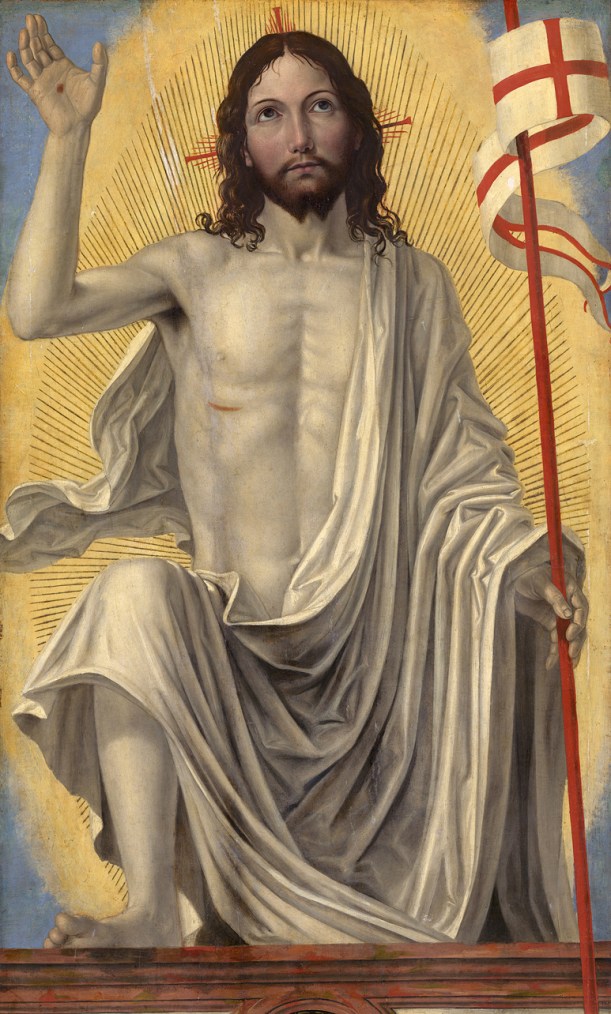
Christ Risen from the Tomb, Ambrogio Bergognone (c. 1470-1523), Samual H. Kress Collection, National Gallery of Art, Washington
A very Happy Easter to you all! Two messages today:
First Mark Shea: “The Resurrection did not happen in cloud-cuckoo land, Olympus, Shangrila or Once Upon a Time. It happened in a particular place locatable by GPS, on a particular morning during the rule of a minor Roman procurator named Pontius Pilate. A real physical body that had been buried on Friday evening was no longer there on Sunday morning because something beyond human language happened and it stopped being an it and resumed being He. The disciples who witnessed the Risen Christ struggle to describe the experience in human language and are ultimately stymied by the attempt. He is real, can be touched, can eat food, and is heard not “in the heart” but with the physical ear. He is not a ghost, yet can appear and disappear at will. He is capable of tearing a piece of bread it two, but also of vanishing from sight. Nor is he a hallucination since a) you don’t hallucinate someone you desperate want to see and then not recognize him on three occasions; b) nobody thought he was going to rise from the dead; and c) mass hallucinations don’t happen and are only invoked as a last ditch effort to explain away the Resurrection. Occam’s Razor says “The Resurrection actually happened and the Christian explanation is the actual one. Not that Christians understand it any more than anybody else. It’s just that they’ve abandoned all the other explanations as super lame.”
The resurrection of Jesus from the dead is the be-all and the end-all of the Christian faith. If Jesus didn’t rise from the dead, all bishops, priests, and Christian ministers should go home and get honest jobs, and all the Christian faithful should leave their churches immediately. As Paul himself put it: “If Jesus is not raised from the dead, our preaching is in vain and we are the most pitiable of men.” It’s no good, of course, trying to explain the resurrection away or rationalize it as a myth, a symbol, or an inner subjective experience. None of that does justice to the novelty and sheer strangeness of the Biblical message. It comes down finally to this: if Jesus was not raised from death, Christianity is a fraud and a joke; if he did rise from death, then Christianity is the fullness of God’s revelation, and Jesus must be the absolute center of our lives. There is no third option.
I want to explore, very briefly, a handful of lessons that follow from the disquieting fact of the Resurrection. First, this world is not it. What I mean is that this world is not all that there is. We live our lives with the reasonable assumption that the natural world as we’ve come to know it through the sciences and discern it through common sense is the final framework of our lives and activities. Everything (quite literally, everything) takes place within the theater of our ordinary experience. And one of the most powerful and frightening features of the common-sense world is death. Every living thing dies and stays dead. Indeed, everything in the universe, scientists tell us, comes into being and then fades away permanently.
But what if this is not in fact the case? What if the laws of nature are not as iron-clad as we thought? What if death and dissolution did not have the final say? What if, through God’s power and according to his providence, a “new heavens and a new earth” were being born? The resurrection of Jesus from the dead shows as definitively as possible that God is up to something greater than we had imagined or thought possible. And therefore we don’t have to live as though death were our master and as though nihilism were the only coherent point of view. After he had encountered the risen Christ, Paul could even taunt death: “Where is your sting?” In light of the resurrection, we can, in fact, begin to see this world as a place of gestation, growth and maturation toward something higher, more permanent, more splendid.
Here’s a second lesson derived from the resurrection: the tyrants know that their time is up. Remember that the cross was Rome’s way of asserting its authority. Roman authorities declared that if you run afoul of our system, we will torture you to death in the most excruciating (ex cruce, from the cross) way possible and then we will leave your body to waste away be devoured by the beasts of the field. The threat of violence is how tyrants up and down the centuries have always asserted their authority. Might makes right. The crucified Jesus appeared to anyone who was witnessing the awful events on Calvary to be one more affirmation of this principle: Caesar always wins in the end. But when Jesus was raised from the dead through the power of the Holy Spirit, the first Christians knew that Caesar’s days were numbered. Jesus had taken the worst that the world could throw at him and he returned, alive and triumphant. They knew that the Lord of the world was no longer Caesar, but rather someone whom Caesar had killed but whom God had raised from death. This is why the risen Christ has been the inspiration for resistance movements up and down the centuries. In our own time we saw how deftly John Paul II wielded the power of the cross in Communist Poland. Though he had no nuclear weapons or tanks or mighty armies, John Paul had the power of the resurrection, and that proved strong enough to bring down one of the most imposing empires in the history of the world. Once again, the faculty lounge interpretation of resurrection as a subjective event or a mere symbol is exactly what the tyrants of the world want, for it poses no real threat to them.
The third great lesson of the resurrection is that the path of salvation has been opened to everyone. Paul told us that “though he was in the form of God, Jesus did not deem equality with God something to be grasped. Rather he emptied himself and took the form of slave…accepting even death, death on a cross.” In a word, Jesus went all the way down, journeying into pain, despair, alienation, even godforsakenness. He went as far as you can go away from the Father. Why? In order to reach all of those who had wandered from God. Then, in light of the resurrection, the first Christians came to know that, even as we run as fast as we can away from the Father, all the way to godforsakenness, we are running into the arms of the Son. The opening up of the divine life allows everyone free access to the divine mercy. And this is why the Lord himself could say, “When the Son of Man is lifted up, he will draw all people to himself,” and why Paul could assert in 1 Corinthians, “When everything is subjected to him, then the Son himself will also be subjected to the one who subjected everything to him, so that God may be all in all.” The resurrection shows that Christ can gather back to the Father everyone whom he has embraced through his suffering love.
So on Easter Sunday, let us not domesticate the still stunning and disturbing message of resurrection. Rather, let us allow it to unnerve us, change us, set us on fire.
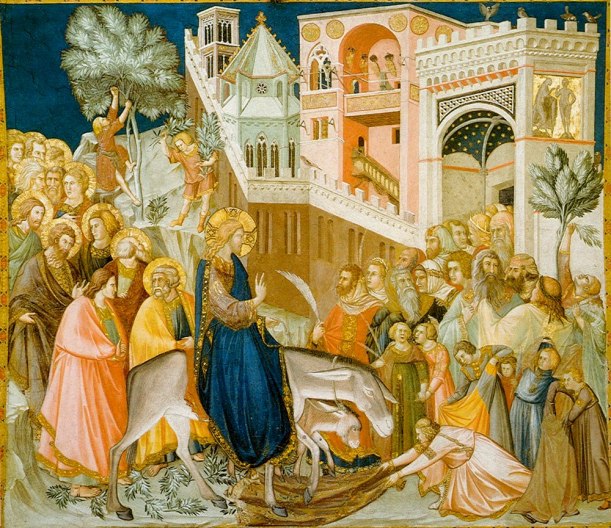
Entry into Jerusalem, Pietro Lorenzetti, 1320, Southern Transept of Lower Basilica of San Francesco, Assisi, Italy.
This Sunday our readings swing from the cheering crowds waving palm branches as Jesus enters Jerusalem to the angry mob shouting “Crucify him!” We can learn a lot about how to cope with life’s ups and downs from seeing how Jesus behaves throughout the Passion Narrative. What does God want from us? Only to be faithful to him, to cooperate with him. When we do that, God can use us in amazing ways and change our lives from dreary to hope-filled!
Bishop Robert Barron shares some thoughts for this Sunday on the opening Gospel in today’s Liturgy in his talk, The Master has need of you.
For more on today’s readings watch here:
Don’t forget to watch Part 2 as well (available on Youtube), and for some extra reflections for Holy Week, try John Bergsma’s Jesus Cheered, Then Killed.





 Catholic in Yanchep
