Catholic in Yanchep

Go out into the deep.


Leave a comment

32nd Sunday in OT | Maccabees, Martyrdom and Meaning

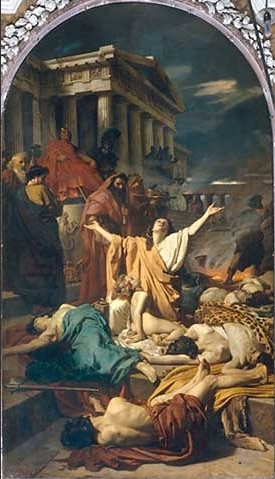
ciseri-antonio-the-martyrdom-of-the-seven-maccabees

The Martyrdom of the Seven Maccabees, Antonio Ciseri, 1863, Oil on Canvas, St Felicita, Florence, Italy.

One of Satan’s wiles is the distortion of words, so that they lose distinctions and create confusion where previously there was clarity.  That this would happen is predicted in Isaiah.

Woe to those who call evil good and good evil, who put darkness for light and light for darkness, who put bitter for sweet and sweet for bitter! (Isaiah 5:20)

One of the words under attack in our time is ‘martyrdom’.

We have a superb, if gruesome, illustration of the traditional meaning of martyrdom in today’s Old Testament reading from 2 Maccabees.  In fact, this is one of the first descriptions of martyrdom in a distinctively Jewish context, aside from prophetic accounts such as Isaiah’s Suffering Servant passages.

The setting is the Greek empire during the period after the death of Alexander the Great, when the empire was split between the northern Seleucids (Mesopotamia, Persia – Iraq and Iran in our day – and Syria) and the southern Ptolemies (Egypt and Palestine).  Antiochus IV, king of the Seleucids, a man seized by a thirst for power, wrested control of Palestine away from Ptolemy IV, Pharaoh of Egypt, in 169 BC.  In an extraordinary display of self-aggrandisement, he assumed the title “Theos Epiphanes” or “God Manifest”.  He then set about a systematic destruction of Jewish culture and religious practice.  The aim was to unify the territory he controlled by replacing the ‘backward’ religious beliefs and observances of the Jews with ‘enlightened’ Greek (Hellenistic) culture and religious practice.  He attacked the temple, carrying off its altar and sacred vessels, pillaged the city and tore down Jerusalem’s wall that had been rebuilt by Nehemiah after the Babylonian captivity, took women, children and cattle captive, and rebuilt the city with a stronger wall and a Citadel.

The king then issued a proclamation to his whole kingdom that all were to become a single people, each nation renouncing its particular customs.  All the gentiles conformed to the king’s decree, and many Israelites chose to accept his religion, sacrificing to idols and profaning the Sabbath.  The king also sent edicts by messenger to Jerusalem and the towns of Judah, directing them to adopt customs foreign to the country, banning burnt offerings, sacrifices and libations from the sanctuary, profaning Sabbaths and feasts, defiling the sanctuary and everything holy, building altars, shrines and temples for idols, sacrificing pigs and unclean beasts, leaving their sons uncircumcised, and prostituting themselves to all kinds of impurity and abomination, so that they should forget the Law and revoke all observance of it.  Anyone not obeying the king’s command was to be put to death.  Writing in such terms to every part of his kingdom, the king appointed inspectors for the whole people and directed all the towns of Judah to offer sacrifice city by city.  Many of the people – that is, every apostate from the Law – rallied to them and so committed evil in the country, forcing Israel into hiding in any possible place of refuge.  (1 Maccabees 1:41-53)

To the horror of the Jews, sacrifices to Olympian Zeus were made in the Temple on the Altar of Burnt Offering on the 25th of each month, (2 M 1:59) any copies of the Torah that were found were torn up and burned, and women who had had their children circumcised were put to death with their babies hung round their necks.

Today’s reading from 2 Maccabees gives us a vivid portrayal of a particular family of Jews who resist this ideological colonisation.  Seven brothers and their mother are arrested and tortured to force them to taste pork.  Their eldest brother has his tongue cut out, his head scalped and his extremities cut off before he is fried while still alive in a red-hot pan before his brothers and mother.  Slowly the torturers make their way through all the brothers and finally the mother.  With remarkable courage they stand firm in their resolution to be faithful to the Torah and their covenant relationship with God.  You might wonder why they didn’t just eat the pork – it’s only food after all.  But to the Jews, adherence to the dietary laws was not just a meaningless dietary restriction.  It was symbolic of their relationship of familial trust, love and duty towards the God who had formed them and led them since earliest times.

Now what is remarkable about their martyrdom is that they see it, not as a failure, but as the occasion for a number of opportunities, namely,

  1. An opportunity to participate in the future, bodily resurrection:

“Ours is the better choice, to meet death at men’s hands, yet relying on God’s promise that we shall be raised up by him; whereas for you there can be no resurrection to new life.”  “Cruel brute, you may discharge us from this present life, but the King of the world will raise us up, since we die for his laws, to live again for ever.”

  1. An opportunity to explain God’s plan for his people and his intervention in human history.

“You have power over human beings, mortal as you are, and can act as you please.  But do not think that our race has been deserted by God.  Only wait and you will see in your turn how his mighty power will torment you and your descendants.” 

(In fact, within 5 years, Antiochus IV is dead, and within 100 years, the Greek empire is overcome by the Romans under Pompey.)

  1. An opportunity to die to self – to give up concern for one’s own safety and security to uphold what is good and true.

“Heaven gave me these limbs; for the sake of his laws I have no concern for them; from him I hope to receive them again.”

  1. An opportunity to atone for the sins of their fellow Jews; they are able to redeem the sins of other people by taking on suffering themselves:

“Do not delude yourself: we are suffering like this through our own fault, having sinned against our own God; hence, appalling things have befallen us.”

  1. An opportunity to show profound humility and trust in God’s ultimate plan. The mother says,

“I do not know how you appeared in my womb; it was not I who endowed you with breath and life, I had not the shaping of your every part.  And hence, the Creator of the world, who made everyone and ordained the origin of all things, will in his mercy give you back breath and life, since for the sake of his laws you have no concern for yourselves.”

Now contrast all this with the other kind of (self-described) martyrdom, the kind on display so frequently these days among terrorists.  The type of martyrdom that says you can kill yourself in the name of religion.  When a terrorist blows himself up, hoping to take as many others with him as possible, this is as unlike a Jewish or Christian martyrdom as it is possible to get.  If there is anything in common between the two ‘martyrdoms’, it is the zeal and commitment of the participants, but that is all.  It is possible to make several distinctions between these martyrdoms:

  • Judaeo-Christian martyrs have historically been innocent victims. The martyrs of Islamic State are perpetrators of terror and cruelty, not victims.
  • Judaeo-Christian martyrs give up their own lives in non-violent surrender to the violence of others. They do not seek death, merely surrender to it when death becomes inevitable.  Martyrs of the Islamic State actively seek death and are effectively committing suicide.
  • Judaeo-Christian martyrs see their suffering as redemptive. Their willingness to undergo suffering is an atoning sacrifice which has a redemptive effect.  Witness how the Holocaust of World War II led to the reversal of the Jewish diaspora and the re-creation of Israel.  Witness how the blood of the early Christian martyrs was the seed of the Church.
  • The heavenly reward that Judaeo-Christian martyrs hope for is one where they will be united with God in a living relationship of selflessness, perfect love and joy in His presence … the reward that the martyrs of ISIS hope for seems to be focused on selfish pleasures and unbridled lust – men being rewarded with 72 virgins, for example.

These are just a few differences; others could be found.  Right now, there is an unprecedented number of Christian martyrdoms occurring, particularly in the Middle East and Africa.  The perpetrators are ISIS, Al Quaeda, Al Shabaab, the Taliban, Boko Haram, Wilayat Sayna, Lashkar-e-Taiba and their ilk. Many of these go unreported by a media that is hostile to Christianity, but you can easily find them here.  Right now, the state of Christian martyrdom in the world is so dire, that we pray that God will soon end this torment and restore the world to himself.  May the blood of the real martyrs atone for the sins of a world that has abandoned God in so many ways, and may God strengthen us to resist any attempts of the state to restrict religious freedom.

Today’s readings:

Word format: year-c-32nd-sunday-2016

Pdf format: year-c-32nd-sunday-2016


Leave a comment

31st Sunday in OT | Two Meals, Two Attitudes

zacchaeus-in-the-sycamore-tree

Zacchaeus in the Sycamore Tree, Icon, unknown artist.

The Gospel of Luke gives us accounts of two meals which bring out the differences that our attitudes can make.  One is in Luke, Chapter 7 (Jesus in the Home of Simon the Pharisee) and one is in Luke 19 (The story of Zacchaeus, the Tax Collector).

In the second of these, which we have in the Gospel for today, Jesus invites himself to the house of Zacchaeus, the tax collector.  Being a tax collector in Judaea in Jesus’ day was nothing like being an employee of the ATO today.  To understand why the point is made that Zacchaeus is a chief tax collector (architelones) and a wealthy man, you have to understand the historical context.  Firstly, tax collectors were regarded by the Jews as traitors.  They were in league with the occupying power, the Romans.  Secondly, they were very likely to collect more money than was strictly required, due to the structural features of the Roman tax system.  The practice was for the government to sub-contract out the collection of taxes in a particular area to ‘tax farmers’ or telonai.  The tax collector would make an advance payment to the state of the “working capital” that he had been contracted to collect.  It then became the job of the tax collector to raise this amount from the people, plus sufficient funds to cover his overheads.  Except that the tax collectors didn’t usually just cover their overheads.  Any excess funds were retained by the tax collectors as profit.  Tax collectors were therefore not only wealthy ab initio (because they had the capital to invest in the Roman tax enterprise), but there was a constant temptation to add to their wealth by collecting more than they strictly required.  How much is too much, after all?  If you want to know how the ordinary people felt about tax collectors in Jesus’ day, consider John Bergsma’s remarks:

[Zacchaeus] was a wealthy tax collector, a social oppressor and collaborator with an oppressive and dictatorial foreign government.  How do we feel about drug dealers riding by in black Lexuses and pulling out rolls of $50 bills?  How do we feel about former Enron executives now comfortably retired in Aspen?  How do we feel about shady political campaign operatives taking millions in donations from foreign governments while manipulating a domestic election? [Gosh, I wonder who he could mean!] The emotions would be similar for the Jews with respect to Zacchaeus. 

But what Zacchaeus has in his favour is an interest in Jesus.  He feels drawn to him to the point where he is prepared to climb a tree in order to ‘catch a glimpse’ of Jesus as he passes through Jericho.  And this tiny movement of Zacchaeus’s heart is enough to set in motion a flow of grace, as Jesus invites himself to Zacchaeus’s house.

[Jesus] is thereby requesting the conventional hospitality owed to traveling strangers but without showing the least concern for Zacchaeus’s perpetual ritual impurity due to his immoral and traitorous lifestyle. Perhaps for that very reason, Zacchaeus is so humbled that, when the entourage has reached his home, he announces that he is giving half of his goods to the poor and restoring fourfold to those whom he has defrauded—good signs of genuine repentance (v. 8; cf. John the Baptist’s charge to tax collectors in 3:13, unpacking his call to repentance in 3:2). Jesus’ holiness, not Zacchaeus’s past immorality, has rubbed off on his counterpart.  (Craig Blomberg, Jesus, Sinners and Table Fellowship)

I recently heard a homily that implied that when Zacchaeus says ‘if I have cheated anybody I will pay him back four times the amount’, he didn’t really mean that he had actually cheated anybody, it was just a hypothetical statement.  He knew he was really innocent, and it was the bad will of those who would prejudge him that was the real problem in this scenario.

But such an interpretation makes no sense of Jesus’s statement, “Today salvation has come to this house.”  And if you look at the Greek, you find that the sentence is in the form of a First Class Condition (i.e. that the premise or protasis is true).  [For more on Greek conditional sentences, go here.]   As Craig Blomberg says,

If Luke wanted to portray Zacchaeus as promising to restore fourfold anything he has defrauded without believing that he had in fact defrauded anyone, or if he meant to imply “whenever” defrauding of this sort occurs, Luke would have used a third-class (hypothetical) condition.

The other character in our comparison is Simon the Pharisee, who invites Jesus to his house for a meal.  For the Pharisees, strict observance of the Mosaic Law and ‘the traditions of the elders’ (Matt 15:1-20) was paramount.  The Pharisees are one of the groups for whom Jesus most frequently has harsh words – not because they are legalistic, but because they are legalistic and morbidly self-righteous without the love of God.  He says in Luke 11:42 “But alas for you Pharisees, because you pay your tithe of mint and rue and all sorts of garden herbs and neglect justice and the love of God!  These you should have practised, without neglecting the others.”  So when Jesus has taken his place at table, a woman with a bad reputation enters and in an extravagant display, falls weeping at his feet, kissing them and anointing them with ointment.  Simon is horrified that Jesus permits such attention, saying, “If this man were a prophet, he would know who this woman is and what sort of person it is who is touching him and what a bad name she has.’  But Jesus rebukes him, pointing out the several ways in which the woman has shown love and the Pharisee has neglected to show either love or customary good manners.

So what are the essential differences in attitude between the two protagonists, Zacchaeus and Simon, and the events that take place in their houses?

  1. In both cases, elements of the crowd are shocked. The people complain when they see Jesus wanting to eat with, wait … a tax-collector!  Simon complains when Jesus shows no hesitation in receiving the attention of a woman of ill-repute.  People are wondering whether Jesus’ keeping company with the unrespectable means that Jesus approves of their behaviour.
  2. Zacchaeus is open to discovering more about Jesus and readily receives Jesus at his house. Simon, although he has taken the initiative of inviting Jesus, only invites him so that he can point out what he thinks are Jesus’s faults.
  3. The tables are turned on Simon when it is Jesus who shows Simon where he is failing to perform the social conventions.   Zacchaeus , on the other hand, doesn’t need his faults pointed out – he himself calls attention to his greed and extortion.
  4. Salvation comes to Zacchaeus precisely because of his willingness to recognise and abandon his sin. Simon, on the other hand, is sidelined while the unnamed woman, the woman who has the humility to acknowledge her sinfulness, has her sins forgiven.

Examination of conscience:

  1. Do I enjoy finding fault with others? Have I asked God to reveal to me the faults I have in myself that I may not be aware of?
  2. Do I reach out to people with the love of Christ – people who are outside my circle of comfort?
  3. How interested am I in the person of Jesus? Do I have a living relationship with him?

Today’s readings:

Word format: year-c-31st-sunday-2016

Pdf format: year-c-31st-sunday-2016


Leave a comment

Prayer Vigil and Mass for Murdered Children

john-paul-ii-hopeThe Catholic Church of Yanchep will be holding a prayer vigil and Mass today, 22 October, with the special intention of praying for the deceased children, Andreas (3) and Lily Headland (5) and for their parents and extended family.  We will commence a vigil at 5.30 today in the carpark of the Yanchep Community Centre, followed by our usual Mass at 6 p.m. in the Community Centre’s Activity Room for anyone who would like to stay on and pray with us.  Let us pray that the Light of Christ will draw us together in solidarity, mutual support and community spirit to fight Satan and his forces of darkness.
At times like this we often ask why God permits such evil.  Why does he allow children to suffer?

The answer is that God has given us free will and he asks us to use it to choose the good. He doesn’t prevent us from experiencing the consequences of our evil actions.  Satan seeks to entrap us in fear, in depression, in darkness and despair.  Satan seeks to attack, divide and destroy families.  The Light of Christ, on the other hand, brings hope, joy and love.  We need to pray that the Light of Christ envelops our community and that we in Yanchep Two Rocks become a community of care for one another, a community that prays together, a community that calls down the power of the Holy Spirit upon us and that banishes sin and evil.

Watch this video from Bishop Robert Barron on why God allows suffering:


Leave a comment

29th Sunday, Year C | Our help is from the Lord

persistent-prayerIf you thought being a Christian was a life of pure unadulterated blessing, think again. Sure, you will receive many blessings along the way, but today’s readings tell us that we can also expect attacks and difficulties. It’s part of the journey. The attack may not be physical – it may be the things people say (or do), or it may be any number of other difficult circumstances.

In the first reading today, we see that the Israelites – the people God has chosen to educate about Himself – are being harried by the Amalekites. This is just after the Israelites have crossed the Red Sea and are journeying through the desert on their way to Canaan. They are having difficulty trusting God. Typical humans, they are a rabble of moaners and groaners. First it’s the food, then it’s the water, and every time, God demonstrates that he will provide for them. We find out in Deuteronomy 25:17 about what happens to them next: “Remember how Amalek treated you when you were on your way out of Egypt. He met you on your way and, after you had gone by, he fell on you from the rear and cut off the stragglers; when you were faint and weary, he had no fear of God.” They are being attacked, unprovoked. And now, emboldened by these cowardly rearguard attacks, the Amalekites come to Rephidim and wage open warfare on the Israelites (Exodus 17:8).

We can expect this same sort of attack on us in the course of our lives: Satan will send one thing or another to draw us away from our faith. Perhaps our faith is weakened by public criticism of Christian teaching or by our own moral failures. Only this week, we had the leaking of emails showing the behind-the-scenes politicking which aims to bring down the Catholic Church, manifested by the anti-Catholic bigotry of the Clinton campaign team. Those of us who have not strengthened themselves may be like the stragglers who are cut off at the rear. Perhaps some other challenge will confront us which makes us wonder whether we can trust God any more – maybe our wife or husband has left us, our children have turned away from us, we have lost all our savings or a tragic event has occurred in our lives. Do we then turn away from God, saying “See how He doesn’t care about me”?

We find the answer in the readings today:
1. We need to be like Moses, who, when the going gets tough, keeps praying. Standing on the hilltop, he intercedes for the Israelites until he is physically worn out. In the Gospel, too, we see Jesus talking about the sheer physical effort we need to make in prayer, when he says “Will not God see justice done to his chosen who cry to him day and night even when he delays to help them?” How many times are we that bothered that we “cry to him day and night?”
2. It helps if we have a support group like Moses, who is able to continue with the help of Aaron and Hur, holding him up on either side. Do you have a support group which prays together or studies the Bible with you? If not, you need to find one or start one.
3. Like the Israelites, when we’re going through challenging times, God is trying to help us grow in trust. Jesus says, “I promise you, [God] will see justice done to them, and done speedily.” We should never doubt that God wants what is best for us.
4. So what does it mean if God seems to be ‘delaying to help’? And how can God be getting justice done ‘speedily’ even while ‘delaying to help’? Isn’t this a contradiction? In my own life, I’ve found that the period of waiting for an answer from God is usually the most fruitful for my own spiritual development. It is during these times that my prayer life loses its tendency to lukewarmness and takes on the urgency and energy of a heart passionate for results. It is during these times that I examine myself more and start to notice areas that God might want me to work on. Even though God doesn’t seem to be working on the person who is causing me problems, he seems to be working on me! Maybe that was what he was after all the time!

If the whole point of our lives is for us to discover God and learn to work with him, then we should regard every difficulty as a marvellous opportunity to expand our trust in him.

Today’s readings:

Word format: year-c-29th-sunday-2016

Pdf format: year-c-29th-sunday-2016


Leave a comment

26th Sunday, Year C | Overcoming Indifference

rich-man-and-lazarus-codex-aureus_epternacensis

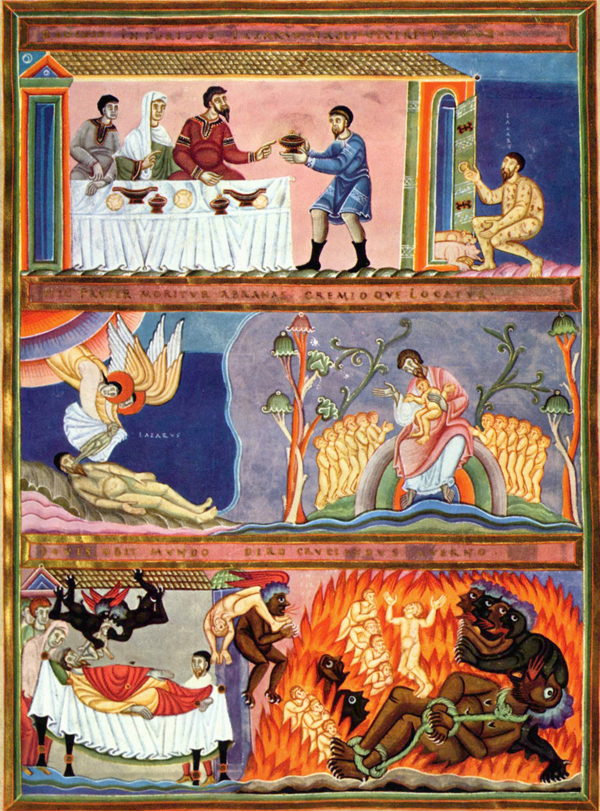
The Parable of the Rich Man and Lazarus, Illumination from the Codex Aureus of Echternach, 1035-1040, German National Museum, Nürnberg. Top panel: Lazarus at the rich man’s door Middle panel: Lazarus’ soul is carried to Paradise by two angels; Lazarus in Abraham’s bosom Bottom panel: Dives’ soul is carried off by two devils to Hell; Dives is tortured in Hades.

This week’s Gospel from Luke 16 should be compulsory reading for all.  Jesus tells a parable in which he contrasts a poor man, Lazarus, ‘covered with sores’, who goes hungry and unnoticed outside the gate of a rich man who enjoys a life of ease and comfort.  After the rich man dies, he finds himself in torment in Hades, not because of any particular cruelty he has meted out, but merely because he has been totally indifferent to the suffering of the man who lay at his gate.  Abraham says to him, “My son, remember that during your life good things came your way, just as bad things came the way of Lazarus.  Now he is being comforted while you are in agony.”

It’s easy in a country like Australia which has an advanced system of welfare and safety nets, to avoid being confronted with real poverty.  And sometimes, social welfare systems are so generous that they have the unintended effect of cementing and rewarding dysfunctional behaviours.  Hence the current conversation about whether school attendance should be a requirement for receiving family welfare.  But it is largely because Australia was founded on the sort of Judaeo-Christian principles explained in this parable and in the first reading from the prophet Amos, that it has had such a commitment to justice and a fair go for everyone.

At the moment I am in Cape Town, South Africa, where it almost impossible to be unaware of the poor around you, and there is a huge gulf between the haves and the have-nots.  I am well aware that I am more like the rich man in the parable when I am visiting here, so I am making an effort not to be indifferent.

On my way to Mass in the morning, I pass by a small park where I used to play as a child.  In this park lives a woman called Ursula, often accompanied by her friend Anthony.  Both Ursula and Anthony have mental health problems.  As I arrive, Anthony is sweeping the soil around the park bench, behind which is a bundle of plastic bags containing all their worldly goods.

“Good morning, Ursula.  How are you today?”  “Hello lady.  Can’t complain.”  “It looks as if it might rain today.  Where do you go if it rains?”  “I stay here.  I come from Somerset East, but I live here now.”  “I can see someone has given you some chicken.  Are you going to cook it?”  “No it’s cooked already.”  (It looks raw and it still in a polystyrene meat tray.)  “Oh well, here’s a sandwich for your breakfast, if you like.”  “Thank you, lady, I appreciate it.” “Hope you have a lovely day.”

Then there is Martin, who has come to South Africa from the DRC.  Every morning, Martin comes to Mass at Nazareth House, and picks up a sandwich from the nuns at the convent in exchange for some light duties.  After Mass, Martin walks up the steep hill to the Kwikspar, wheeling his travel luggage behind him, and all the way, carrying on a lively conversation with himself in French.  I think the Kwikspar might give away some out-of-code items.  At night, Martin stays at one of the homeless shelters which fortunately are available in this area for those who want to make use of them.

The third friend I have made here is one of the carers at Nazareth House.  I will call her Nomandla (not her real name).  Nomandla’s problem is an example of the structural problems in the South African wage system.  For 15 twelve-hour days a month, Nomandla earns R3,000 (that’s about AUD300).  So her weekly wage is approximately R750 or $75.  How is this possibly a living wage?  Nomandla is also supporting her son, who is studying at UWC to be a lawyer and will graduate in 2018.  Nomandla has a grade 12 education, but because of family circumstances, never had the opportunity to study further.  She would like to upgrade her skills and study nursing as soon as her son has graduated.  I am hoping I can help Nomandla achieve this goal.  If anyone is interested in this, I like the idea of direct action without going through all the administration costs involved in charitable donations, so please contact me.

I should also mention that Catholic Welfare and Development have a number of outreach programs here in the Western Cape, if you would like to donate to them.

Today’s readings:

Word format: year-c-26th-sunday-2016

Pdf format: year-c-26th-sunday-2016


Leave a comment

25th Sunday in Ordinary Time, Year C | Will the poor plead for your soul?

the-parable-of-the-shrewd-steward-reymerswaele

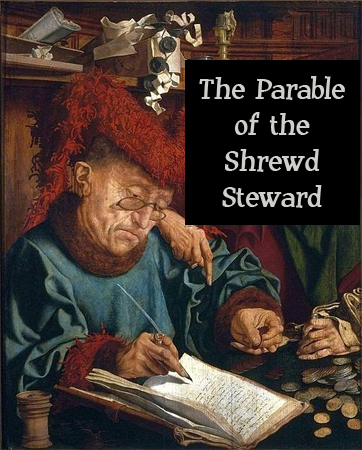
Two tax collectors, Marinus van Reymerswaele, 1540s, oil on panel, National Museum of Warsaw, Poland

I tell you, make friends for yourselves with dishonest wealth,
so that when it fails, you will be welcomed into eternal dwellings.
(Luke 16:9)

Today’s Gospel gives us one of the strangest of Jesus’ parables: The Dishonest Steward.  The dishonest steward has been wasteful with his master’s property, and when he is caught out, instead of changing his ways, he continues in the same vein, writing off debts owed to his master in the hope that this will win him a few friends when he is sacked from his job.

One wonders if Jesus is holding up the steward as someone to be praised (“the master praised the dishonest steward for his astuteness”).  But a closer reading shows us that the point of the story is that Jesus is asking us to be astute with the gifts he has given us.  Apart from the necessities of life, what is our money for?  Is it so that we can complete our bucket list?  Is it to amass goods that will allow us to live lives of comfort?

Jesus says, “Use money, tainted as it is, to win you friends, and thus make sure that when it fails you, they will welcome you into the tent of eternity.”  In my imagination, I can picture myself after death, being brought out before God for judgement, and while the demons are crowding around and accusing me loudly of various acts of neglect and tightfistedness towards the poor, those souls who have lived lives of privation and suffering on Earth will be given the opportunity to speak up for me.

When I stand before God for judgement, will anyone come forward and say, “She helped me out when my family was going through hard times?”

At the moment I am on holiday in the land of my birth, South Africa, for the St Cyprian’s class of ‘76’s 40-year reunion.  I count myself lucky to have been born in a country where great poverty exists (alongside great wealth, mind you) – because it is now prompting my conscience to find more opportunities for taking Jesus seriously on this question.  Much of the conversation about money in Australia concerns superannuation, which is really about hoarding money for one’s own future provision.  I’m not saying we shouldn’t provide for our retirement, but from a God’s eye view, it is more important for us to give money where it is needed here and now, rather than focus solely on a future that may never arrive.  How do I know that God won’t take me to himself suddenly, and what provision have I made for my savings to go to those who are unable to lift themselves out of poverty?  These are not easy questions, but God asks that we address ourselves shrewdly to how we allocate our resources, while we still have time, and not leave it to somebody else to do for us after we are dead or have become incapacitated by old age.

Changing the subject somewhat, the second reading from Paul’s letter to Timothy talks about our responsibility to pray for ‘kings and others in authority, so that we might be able to live religious and reverent lives in peace and quiet’.  We need also to pray for our bishops, because the current charged atmosphere in Australia requires clear teaching and unambiguous language from our shepherds.  During the past few weeks, we have had Bishop Vincent Long of Parramatta Diocese giving the Ann D Clark Lecture at the Penrith Panthers Club, only to be represented in the media as supporting a change in church teaching on homosexuality.  Fr Terence Mary Naughtin OFM Conv., Latin Mass chaplain for Wagga Wagga, has responded in detail to Bishop Long’s lecture, explaining where things might have been stated more accurately.    It is clear from Fr Naughtin’s measured response that he has made every effort to be fair to Bishop Long, while at the same time not being afraid to speak up boldly for truth.

Corporal acts of mercy are always desired but they will never be as great or as merciful as the acts of love by which the Church rescues souls from sin and error and eternal damnation.

Bishops around Australia will need to be fearless in countering the threats and intimidation which are being levelled against Christians and Christian teaching, especially in the lead-up to the proposed plebiscite in February.  No longer can we rely on a culture that is friendly to the church, when we can’t even book a hotel room to discuss traditional marriage, the foundation for a stable society.

Today’s readings:

Word format: year-c-25th-sunday-2016

Pdf format: year-c-25th-sunday-2016


Leave a comment

22nd Sunday in Ordinary Time, Year C | A twelve step course in humility

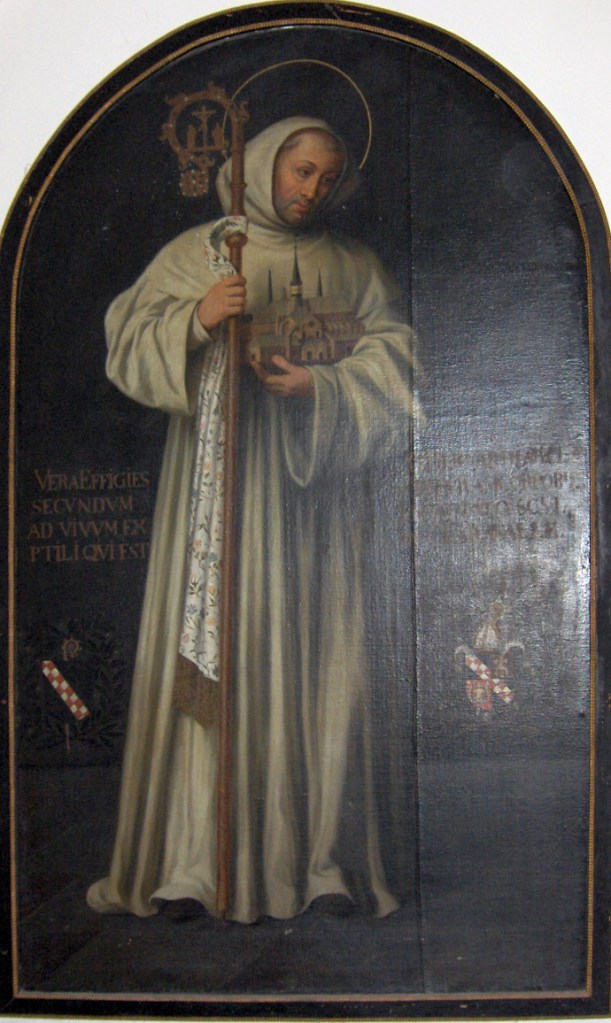
Bernard of Clairvaux

St Bernard of Clairvaux, Georg Andreas Wasshuber (1650-1732), Heiligenkreuz Abbey near Baden bei Wien, Lower Austria.

You would have to say the most annoying character trait in a person is pride.  Both the gospel and the first reading draw our attention to this.  “The greater you are, the more you should behave humbly” and “There is no cure for the proud man’s malady, since an evil growth has taken root in him” (Sirach 3).  And then, “For everyone who exalts himself will be humbled, and the man who humbles himself will be exalted.”

It’s embarrassing, too, when people in an attempt to be humble, draw attention to their humility.  That’s not humble.  (I always wonder about that when I’m praying the St Michael Prayer: “… may God rebuke him [Satan], we humbly pray …)  How do we get out of the  vicious circle of avoiding pride, while at the same time, not claiming to be humble?

St Bernard of Clairvaux has a twelve step process described here by Monsignor Charles Pope.  There are two parts, the Twelve Steps Up the Mountain of Pride, and then the Twelve Steps Down the Mountain to Humility.

Another great resource for reflection is C.S. Lewis’s analysis of Pride in Mere Christianity.

There is no fault which makes a man more unpopular, and no fault which we are more unconscious of in ourselves. And the more we have it ourselves, the more we dislike it in others.

The vice I am talking of is Pride or Self-Conceit: and the virtue opposite to it, in Christian morals, is called Humility. You may remember, when I was talking about sexual morality, I warned you that the centre of Christian morals did not lie there. Well, now, we have come to the centre. According to Christian teachers, the essential vice, the utmost evil, is Pride. Unchastity, anger, greed, drunkenness, and all that, are mere fleabites in comparison: it was through Pride that the devil became the devil: Pride leads to every other vice: it is the complete anti-God state of mind.

Does this seem to you exaggerated? If so, think it over. I pointed out a moment ago that the more pride one had, the more one disliked pride in others. In fact, if you want to find out how proud you are the easiest way is to ask yourself, ‘How much do I dislike it when other people snub me, or refuse to take notice of me, or shove their oar in, or patronise me or show off?’  The point is that each person’s pride is in competition with every one else’s pride.  It is because I wanted to be the big noise at the party that I am so annoyed at someone else being the big noise.  Two of a trade never agree.  Now what you want to get clear is that pride is essentially competitive – is competitive by its very nature – while the other vices are competitive only, so to speak, by accident.  Pride gets no pleasure out of having something, only out of having more of it than the next man.  We say that people are proud of being rich, or clever, or good-looking, but they are not.  They are proud of being richer, or cleverer, or better-looking than others.  If every one else became equally rich or clever or good-looking there would be nothing to be proud about.  It is the comparison that makes you proud: the pleasure of being above the rest.  Once the element of competition has gone, pride has gone… The sexual impulse may drive two men into competition if they both want the same girl.  But that is only by accident; they might just have likely have wanted two  different girls. But a proud man will take your girl from you, not because he wants her, but just to prove to himself that he is a better man than you. Greed may drive men into competition if there is not enough to go round; but the proud man, even when he has got more than he can possibly want, will try to get still more just to assert his power. Nearly all those evils in the world which people put down to greed or selfishness are really far more the result of Pride.

Take it with money. Greed will certainly make a man want money, for the sake of a better house, better holidays, better things to eat and drink. But only up to a point. What is it that makes a man with £ 10,000 a year anxious to get £ 20,000 a year? It is not the greed for more pleasure. £ 10,000 will give all the luxuries that any man can really enjoy. It is Pride— the wish to be richer than some other rich man, and (still more) the wish for power. For, of course, power is what Pride really enjoys: there is nothing makes a man feel so superior to others as being able to move them about like toy soldiers. What makes a pretty girl spread misery wherever she goes by collecting admirers? Certainly not her sexual instinct: that kind of girl is quite often sexually frigid. It is Pride. What is it that makes a political leader or a whole nation go on and on, demanding more and more? Pride again. Pride is competitive by its very nature: that is why it goes on and on. If I am a proud man, then, as long as there is one man in the whole world more powerful, or richer, or cleverer than I, he is my rival and my enemy.

The Christians are right: it is Pride which has been the chief cause of misery in every nation and every family since the world began. Other vices may sometimes bring people together: you may find good fellowship and jokes and friendliness among drunken people or unchaste people. But pride always means enmity— it is enmity. And not only enmity between man and man, but enmity to God.

In God you come up against something which is in every respect immeasurably superior to yourself. Unless you know God as that— and, therefore, know yourself as nothing in comparison— you do not know God at all. As long as you are proud you cannot know God. A proud man is always looking down on things and people: and, of course, as long as you are looking down, you cannot see something that is above you.

That raises a terrible question. How is it that people who are quite obviously eaten up with Pride can say they believe in God and appear to themselves very religious? I am afraid it means they are worshipping an imaginary God. They theoretically admit themselves to be nothing in the presence of this phantom God, but are really all the time imagining how He approves of them and thinks them far better than ordinary people: that is, they pay a pennyworth of imaginary humility to Him and get out of it a pound’s worth of Pride towards their fellow-men. I suppose it was of those people Christ was thinking when He said that some would preach about Him and cast out devils in His name, only to be told at the end of the world that He had never known them. And any of us may at any moment be in this death-trap. Luckily, we have a test. Whenever we find that our religious life is making us feel that we are good— above all, that we are better than someone else— I think we may be sure that we are being acted on, not by God, but by the devil. The real test of being in the presence of God is, that you either forget about yourself altogether or see yourself as a small, dirty object. It is better to forget about yourself altogether.

It is a terrible thing that the worst of all the vices can smuggle itself into the very centre of our religious life. But you can see why. The other, and less bad, vices come from the devil working on us through our animal nature. But this does not come through our animal nature at all. It comes direct from Hell. It is purely spiritual: consequently it is far more subtle and deadly. For the same reason, Pride can often be used to beat down the simpler vices. Teachers, in fact, often appeal to a boy’s Pride, or, as they call it, his self-respect, to make him behave decently: many a man has overcome cowardice, or lust, or ill-temper, by learning to think that they are beneath his dignity— that is, by Pride. The devil laughs. He is perfectly content to see you becoming chaste and brave and self-controlled provided, all the time, he is setting up in you the Dictatorship of Pride— just as he would be quite content to see your chilblains cured if he was allowed, in return, to give you cancer. For Pride is spiritual cancer: it eats up the very possibility of love, or contentment, or even common sense.

Before leaving this subject I must guard against some possible misunderstandings:

(1) Pleasure in being praised is not Pride. The child who is patted on the back for doing a lesson well, the woman whose beauty is praised by her lover, the saved soul to whom Christ says ‘Well done,’ are pleased and ought to be. For here the pleasure lies not in what you are but in the fact that you have pleased someone you wanted (and rightly wanted) to please. The trouble begins when you pass from thinking, ‘I have pleased him; all is well,’ to thinking, ‘What a fine person I must be to have done it.’ The more you delight in yourself and the less you delight in the praise, the worse you are becoming. When you delight wholly in yourself and do not care about the praise at all, you have reached the bottom. That is why vanity, though it is the sort of Pride which shows most on the surface, is really the least bad and most pardonable sort. The vain person wants praise, applause, admiration, too much and is always angling for it. It is a fault, but a child-like and even (in an odd way) a humble fault. It shows that you are not yet completely contented with your own admiration. You value other people enough to want them to look at you. You are, in fact, still human. The real black, diabolical Pride, comes when you look down on others so much that you do not care what they think of you. Of course, it is very right, and often our duty, not to care what people think of us, if we do so for the right reason; namely, because we care so incomparably more what God thinks. But the Proud man has a different reason for not caring. He says ‘Why should I care for the applause of that rabble as if their opinion were worth anything? And even if their opinions were of value, am I the sort of man to blush with pleasure at a compliment like some chit of a girl at her first dance? No, I am an integrated, adult personality. All I have done has been done to satisfy my own ideals— or my artistic conscience— or the traditions of my family— or, in a word, because I’m That Kind of Chap. If the mob like it, let them. They’re nothing to me.’ In this way real thoroughgoing pride may act as a check on vanity; for, as I said a moment ago, the devil loves ‘curing’ a small fault by giving you a great one. We must try not to be vain, but we must never call in our Pride to cure our vanity.

(2) We say in English that a man is ‘proud’ of his son, or his father, or his school, or regiment, and it may be asked whether ‘pride’ in this sense is a sin. I think it depends on what, exactly, we mean by ‘proud of’. Very often, in such sentences, the phrase ‘is proud of’ means ‘has a warm-hearted admiration for’. Such an admiration is, of course, very far from being a sin. But it might, perhaps, mean that the person in question gives himself airs on the ground of his distinguished father, or because he belongs to a famous regiment. This would, clearly, be a fault; but even then, it would be better than being proud simply of himself. To love and admire anything outside yourself is to take one step away from utter spiritual ruin; though we shall not be well so long as we love and admire anything more than we love and admire God.

(3) We must not think Pride is something God forbids because He is offended at it, or that Humility is something He demands as due to His own dignity— as if God Himself was proud. He is not in the least worried about His dignity. The point is, He wants you to know Him: wants to give you Himself. And He and you are two things of such a kind that if you really get into any kind of touch with Him you will, in fact, be humble— delightedly humble, feeling the infinite relief of having for once got rid of all the silly nonsense about your own dignity which has made you restless and unhappy all your life. He is trying to make you humble in order to make this moment possible: trying to take off a lot of silly, ugly, fancy-dress in which we have all got ourselves up and are strutting about like the little idiots we are. I wish I had got a bit further with humility myself: if I had, I could probably tell you more about the relief, the comfort, of taking the fancy-dress off— getting rid of the false self, with all its ‘Look at me’ and ‘Aren’t I a good boy?’ and all its posing and posturing. To get even near it, even for a moment, is like a drink of cold water to a man in a desert.

(4) Do not imagine that if you meet a really humble man he will be what most people call ‘humble’ nowadays: he will not be a sort of greasy, smarmy person, who is always telling you that, of course, he is nobody. Probably all you will think about him is that he seemed a cheerful, intelligent chap who took a real interest in what you said to him. If you do dislike him it will be because you feel a little envious of anyone who seems to enjoy life so easily. He will not be thinking about humility: he will not be thinking about himself at all. If anyone would like to acquire humility, I can, I think, tell him the first step. The first step is to realise that one is proud. And a biggish step, too. At least, nothing whatever can be done before it. If you think you are not conceited, it means you are very conceited indeed.

Lewis, C. S.. Mere Christianity (C.S. Lewis Signature Classics) (p. 128). HarperCollins. Kindle Edition.

Today’s readings:

Word format: Year C 22nd Sunday-v2

Pdf format: Year C 22nd Sunday-v2


1 Comment

Some photos from Dante’s Divine Comedy in New Norcia, 20 August 2016

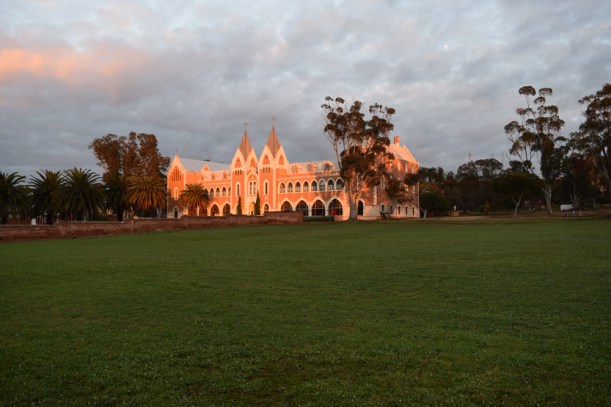
160821-1-St-Gertrudes-College-at-Sunrise-New-Norcia

St Gertrude’s College at sunrise, New Norcia.

Here are a few photos from last week’s trip to New Norcia.  I thought it was one of those lovely coincidences that the Divine Comedy was being performed on the Feast Day of the Cistercian Abbot, St Bernard of Clairvaux, the saint whom Dante held up as the paragon of mystical contemplatives and has himself meeting in the highest level of the Paradiso.

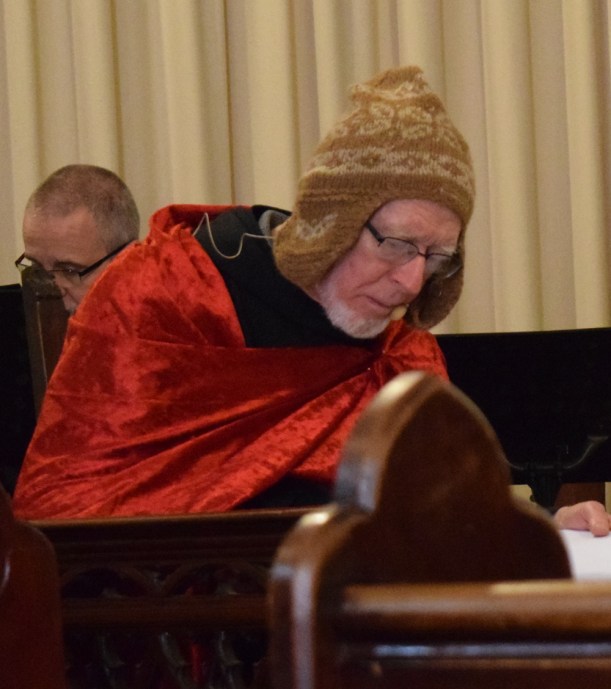
160820-Fr-David-Barry-as-Dante

Father David Barry plays Dante

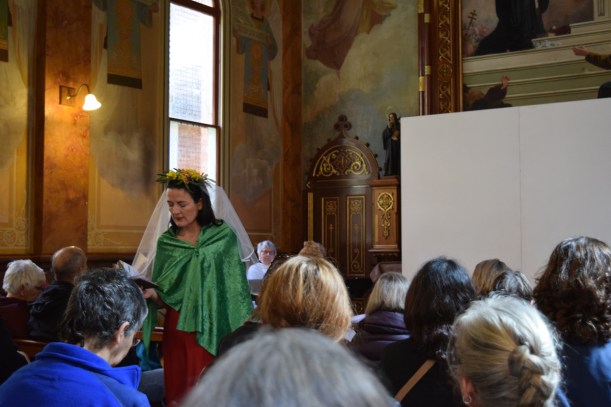
160820-9-Mary-Creed-plays-Beatrice-New-Norcia

Mary Creed as Beatrice.

160820-1-Dante-Virgil-New-Norcia

Fr David Barry as Dante with Abbot Bernard Rooney as Virgil, his guide through Hell and Purgatory.

160820-2-Ceiling-St-Gertrude-Chapel-New-Norcia

The ceiling of St Gertrude’s Chapel, where the first half of the Divine Comedy was performed.

160820-7-St-Ildephonsus-New-Norcia

St Ildephonsus’ Chapel, where the second half of the Divine Comedy was performed.

160820-4-St-Ildephonsus-Chapel-New-Norcia

Inside St Ildephonsus’ Chapel, New Norcia

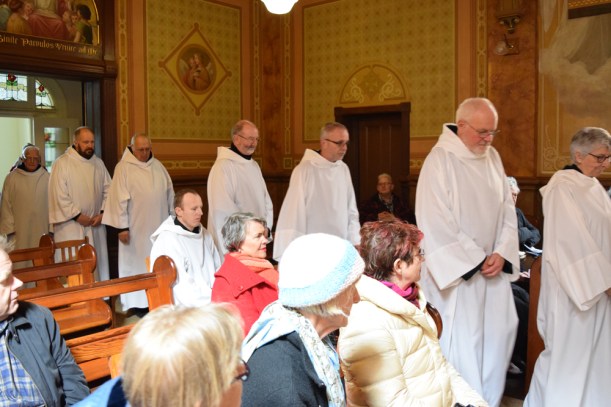
160820-8-Benedictines-New-Norcia

The monks of New Norcia, entering St Ildephonsus’ Chapel for the second half of the performance.

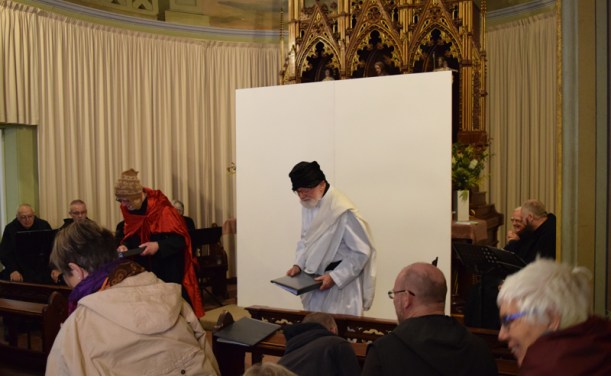
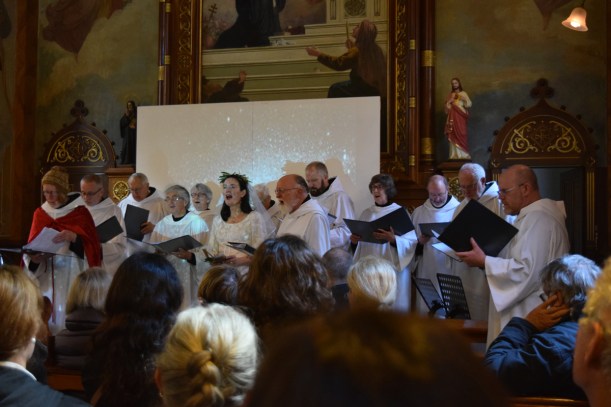
160820-9-Dante-Divine-Comedy-New-Norcia

Dante’s Divine Comedy performed by the monks and friends of New Norcia

160820-11-Walter-Cerquetti-Lippi-and-Benedictines

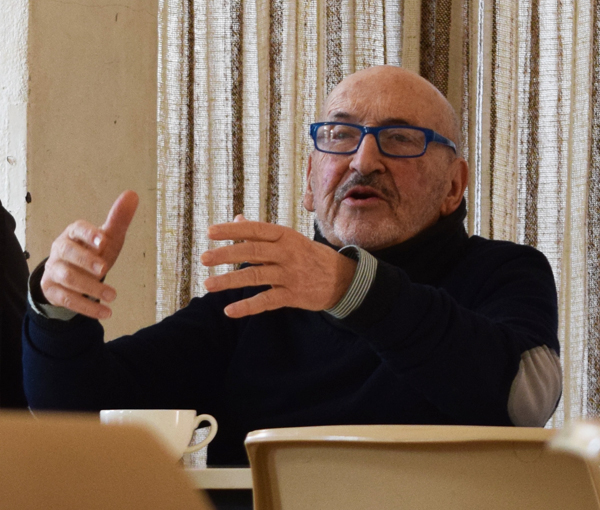
Fr John Herbert, Walter Cerquetti Lippi (producer and director), Abbot Bernard Rooney and Fr David Barry discussing the performance.

160820-10-Walter-Cerquetti-Lippi

Walter Cerquetti Lippi, Director and Producer of The Divine Comedy, New Norcia.

Walter Cerquetti Lippi at the age of 79 is still a powerhouse of activity.  His passion for Sacred Theatre has spurred him to produce at least 125 Mystery Plays since 1967, as well as other plays with a religious theme, such as the Ecstasies of St Therese of Lisieux, St Francis of Assisi and Murder in the Cathedral, in venues as diverse as Rome, Florence, Vienna, the Festival of Canterbury, Slovakia and Australia.

Sacred Theatre has a long tradition dating back to the fall of the Roman Empire, around 500 A.D.  Abbeys used drama and Mystery plays to explain the Passion, the Nativity, and the Miracles of Jesus to the largely illiterate population.   Indeed, the first published woman playwright was a Benedictine nun – Hildegard of Bingen, with the oldest surviving morality play being her Ordo Virtutum.

Walter described for us how he sees his role in the production of Sacred Theatre as a form of self-development for his own interior life, in the manner of Dante whose writing of the Divine Comedy was itself a guide for his soul’s journey.

160821-2-Abbey-Church-Sunrise-New-Norcia

The Abbey Church, New Norcia, at dawn.

160821-5-New-Norcia-from-the-east

The monastery town of New Norcia from the East, across oat fields.

160821-3-Abbey-Church-New-Norcia-at-Dawn

Front view of the Abbey Church, New Norcia

160821-10-Monastery-orchard-New-Norcia

The monastery orchard, New Norcia, on the east side.


Leave a comment

21st Sunday in Ordinary Time, Year C | The Divine Comedy takes me to New Norcia

160820-9-Dante-Divine-Comedy-New-Norcia

Dante’s Divine Comedy performed by the monks and friends of New Norcia

Last weekend, I had the opportunity of visiting New Norcia, Australia’s only monastic town, for the Benedictine Community’s presentation of Dante’s Divine Comedy (I picked up the 100th of 100 tickets, after a cancellation, so I took it as a sign that God had intended me to be there!

After the previous week’s shenanigans, I was in sympathy with Dante, who was exiled from his beloved Florence during the turbulent political battles between the white and black Guelphs in the period immediately following the Guelph-Ghibelline conflict of the late 13th century.  One can see him reassessing his situation in the opening lines of the Divina Commedia.

In the midway of this our mortal life, I found me in a gloomy wood, astray

It’s interesting how God works in our lives, because if Dante had not been exiled from Florence, he might never have written this work which is arguably the pinnacle of Italian literature, not only during the Medieval period, but of all time.  Dante’s gift was to create in poetic form a kind of applied Thomistic universe – Dante takes us on a tour of the spiritual cosmos so that we can see the effects of our choices played out in our destination after departing this earthly life.  James Hitchcock in History of the Catholic Church, describes Dante’s contribution like this:

Scholasticism, a comprehensive system that sought to understand every aspect of reality in relation to the whole, expressed the idea of Christendom itself, the organization of the entire universe according to an overriding spiritual principle. 

This sense of unity was carried to its highest point by Dante, whose Divine Comedy, written in the early fourteenth century, was the most vivid expression of that ideal, bringing together abstract doctrine and concrete humanity in a great imaginative unity, an epic drama that revealed the divine plan and the way in which divine justice governed the universe. 

In the Comedy, Dante, lost and spiritually imperilled by his illicit and unrequited love for the memory of a deceased married woman named Beatrice, received from God – at Beatrice’s entreaty – the guidance of the Roman poet Virgil, who took him on a tour of Hell and Purgatory to show him the reality of sin … 

Dante’s tour of Hell revealed that punishment for sin was not an arbitrary divine decree but rather the patterns of human behaviour carried into eternity, with the sinner suffering in ways that were the natural and inevitable results of his earthly behaviour: the lustful blown helplessly about like dry leaves, because they allowed their passions to dominate them; the gluttonous force-fed to the point of continuously regurgitating their food; the hypocrites weighed down by heavy-leaden robes that appeared beautiful on the outside.  The men and women in Hell were shown to be not so much damned by God as having damned themselves, by refusing to repent of their choices and accept the grace that would have enabled them to overcome their vices either during their lives on earth or in Purgatory. 

Dante delineated a hierarchy of sins that, as a Thomist, he based on human reason.  Thus the worst sins were lying, deceit, and treachery – the use of the intellect to subvert the truth rather than to disclose it.  Those guilty of such sins, especially Judas, were trapped in ice in the lowest depths of Hell, because of their calculating and unloving acts of betrayal. 

An equivalent array of sinners were in Purgatory, where, however, they had the joy of the certainty of eventual salvation, their crucial difference from the souls in Hell being the fact that they had repented and accepted divine mercy.  The sufferings of Purgatory were not so much punitive as therapeutic, purifying the soul and making it worthy of Paradise. 

Virgil could show Dante the nature of evil because, as a good pagan, the Roman poet understood the natural law.  But also as a pagan, he could not enter Heaven, at whose gates Beatrice herself became Dante’s guide, since by her prayers Dante’s disordered human love had been transformed into an understanding of divine love. 

Beatrice guided Dante through the levels of Paradise on an upward spiritual journey that was the reverse of his journeys through Hell and Purgatory.  The experience of Paradise was overwhelmingly that of a light so bright that it obscured much of what Dante encountered, of which he was not as yet worthy.  In his spiritual ascent, he encountered the great saints, who by their words and deeds illustrated the hierarchy of virtues.  His final guide in Paradise was St Bernard (Dante as author giving him the honour of that role because Bernard had reached the heights of contemplation and because of his deep devotion to the Virgin Mary).  Dante was finally drawn upward to the ultimate union of love with truth: “Like a wheel that as a whole rotates, my yearning and my will were borne along by the love that moves the Sun and all the stars.” 

Dante revealed the ordered unity of the cosmos itself, the linkage between Heaven and earth.  But his great poetic synthesis was created at the very point when Christendom was on the verge of unravelling.

How appropriate then, that the Gospel for the 21st Sunday is on the subject of “last things”(Luke 13:22-30).

Through towns and villages Jesus went teaching, making his way to Jerusalem. Someone said to him, ‘Sir, will there be only a few saved?’ He said to them, ‘Try your best to enter by the narrow door, because, I tell you, many will try to enter and will not succeed.

 ‘Once the master of the house has got up and locked the door, you may find yourself knocking on the door, saying, “Lord, open to us” but he will answer, “I do not know where you come from.”  Then you will find yourself saying, “We once ate and drank in your company; you taught in our streets” but he will reply, “I do not know where you come from. Away from me, all you wicked men!”

  ‘Then there will be weeping and grinding of teeth, when you see Abraham and Isaac and Jacob and all the prophets in the kingdom of God, and yourselves turned outside. And men from east and west, from north and south, will come to take their places at the feast in the kingdom of God.

  ‘Yes, there are those now last who will be first, and those now first who will be last.’

This is an extremely difficult message for many Christians, because we don’t want to believe that anyone will end up in hell.  I have even heard many priests say that Judas might not be in hell.  But then it would make nonsense of these words of Jesus, “but woe to that man by whom the Son of Man is betrayed! It would have been better for that man if he had not been born.” (Mark 14:21)

So, if you’re disturbed by the idea of hell, pray harder, pray and fast for your friends and relations, for those you love, and for those you find it hard to love.

In my next post, I will feature some photos from New Norcia.


Leave a comment

20th Sunday, Year C | Divisive? Only if you’re an enemy of Truth.

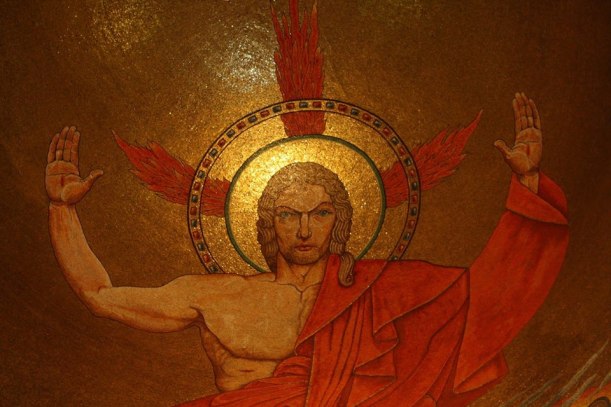
Christ in Majesty Washington Basilica

Christ in Majesty, Jan Henryk de Rosen, 1959, mosaic, Basilica of the National Shrine of the Immaculate Conception, Washington, D.C.

‘Do you suppose that I am here to bring peace on earth? No, I tell you, but rather division. For from now on a household of five will be divided: three against two and two against three; the father divided against the son, son against father, mother against daughter, daughter against mother, mother-in-law against daughter-in-law, daughter-in-law against mother-in-law.’ (Luke 12:49-52)

Wait a second, didn’t Jesus say, “Peace I leave with you, my peace I give to you?” (John 14:27)  And now he’s saying he’s come to bring division?  How can both of these statements be true?

Easy.  When Jesus is talking about giving us peace, he means that one of the fruits of the Holy Spirit is that we will have peace in our hearts.  When we stay close to Christ and are filled with the Holy Spirit, we will experience a profound peace, in spite of any difficulties that may arise.

But there are many in the world who will see Christians as an enemy or a cause of division, because we do not (or should not, if we are being faithful) compromise on truth.  And this will lead others to hate us or think we are insane.  Those who do not follow Christ may, if they choose, decide to persecute us, take us to court or remove privileges (such as tax-free status) from us.  So it is that some of our family members will turn away from us, because we refuse to lie.  Now for some examples of lies we have to resist in our popular culture today:

  • We refuse to agree that an unborn child is just a clump of cells whose rights are trumped by the mother’s rights, but we say the developing human embryo or foetus is an individual worthy of respect, and that God intends the existence of each child:

 ‘Before I formed you in the womb I knew you,
and before you were born I consecrated you’ (Jeremiah 1:5)

  • We refuse to agree that two men or two women in a sexual relationship are equivalent to the free, total, faithful and fruitful marriage of a man and a woman whose bodies are by nature complementary to one another. If you’re going to deface language by calling homosexual unions marriage, then we need a new name to define that kind of marriage which is made of opposite-sex partners, freely chosen, faithfully held, and open to fruitfulness.
  • We refuse to be quiet about saying that it is in the best interests of a child to have both a mother and a father.
  • We refuse to agree with the laughable suggestion that a person can choose their gender. People with gender dysphoria need counselling to treat their disorder, not pandering to affirm their disorder.
  • We refuse to believe the lies that are told about certain other religions.  [The Archdiocesan Media Office has just phoned me and asked me to tone down the paragraph I had previously written here (!!), as they thought I was being inflammatory.]  I will merely refer you to this article, for an indication of what I was driving at.

We Christians should not be afraid to speak the truth.  But the truth must be spoken with love.  We should not be the ones who start war and division, but if others choose to hate us or call us names, this just demonstrates that their arguments are so weak that they have to resort to name-calling.  We should return their hate with unconditional love.  Unconditional love doesn’t mean agreement, but it may mean reaching out with a smile and in friendship.  It may mean being an uncomplaining victim.  I stress the word uncomplaining because we need to model Jesus in this, and not be like all the other victim groups out there in SJW world.  Jesus, even though God incarnate, did not resist persecution, but offered himself up ‘as a lamb to the slaughter’, so that we might be saved from our sinfulness.

God’s love is like a fire: burning up the dross and purifying the world.  This is why Jesus says to us today:

I have come to bring fire to the earth, and how I wish it were blazing already!

 Today’s readings:

Word format: Year C 20th Sunday 2016

Pdf format: Year C 20th Sunday 2016