Why do we need a saviour anyway? Fr Barron explains here. Unfortunately, contemporary culture and our own pride make us think we are self-sufficient and that God is irrelevant to our lives. More thoughts here.
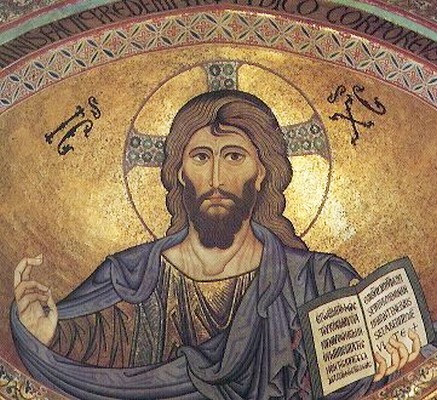
Christ Pantokrator, mosaic, (1145-60), Cathedral of Cefalu, Sicily.
I’m writing this from the beautiful Avalon Homestead in Toodyay, where we’re having a women’s retreat all weekend. We’re going to be prayerfully silent until Sunday lunch – what a challenge for the ladies!
Here are the readings for this Sunday, the Solemnity of Christ the King:
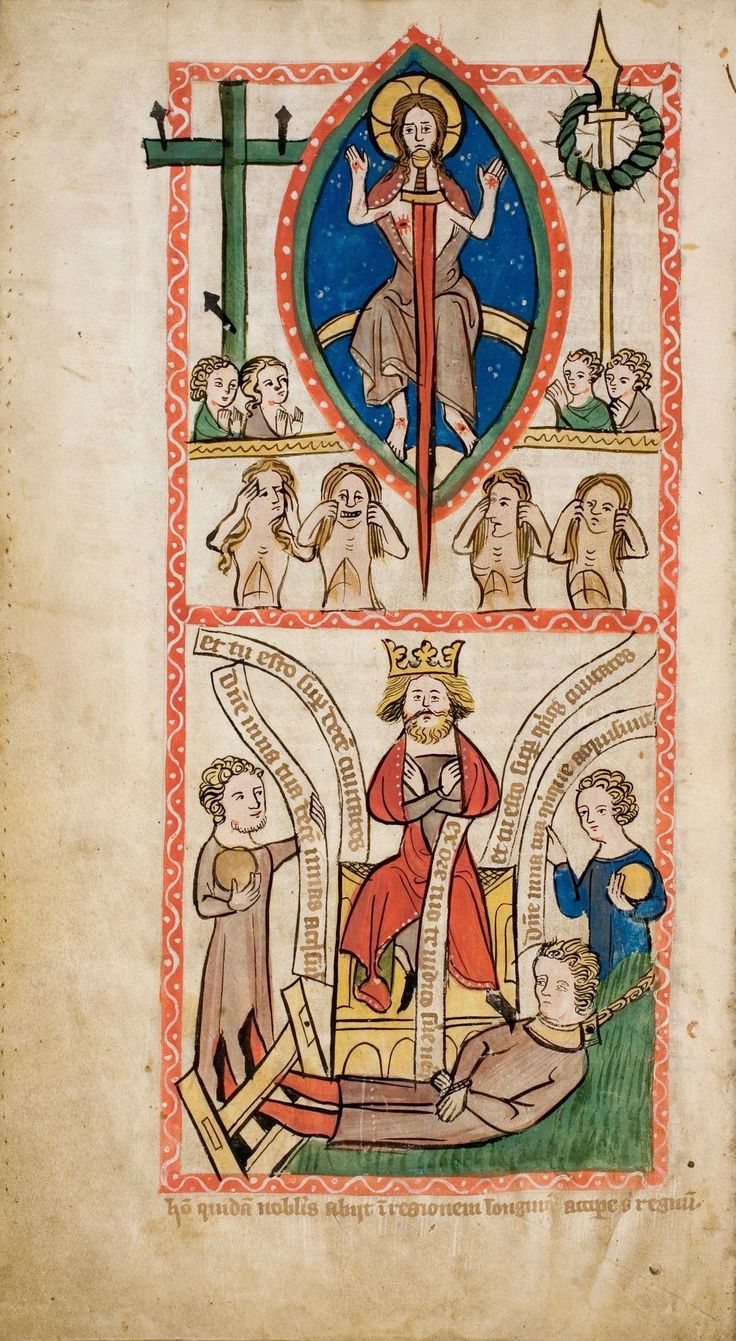
Parable of the Talents, Speculum Humanae Salvationis, c. 1360 Artist Unidentified, Universitäts- und Landesbibliothek Darmstadt Manuscript illumination, Darmstadt, Germany
Please bring a plate for tonight as we farewell Sophie Bird after Mass! Sophie is moving to Launceston to join the rest of her family now that she has finished her Year 12 exams. Sophie and her family have made a wonderful contribution to our local church through their many years of altar serving and helping with preparation for Mass. Thank you, Sophie, for all your years of service – we will miss you!
But while God takes away, He also gives back in plenty! So today we unexpectedly welcome nine new members: young men from East Timor on the Pacific Nations Seasonal Workers’ Program. Bem-vindos! Gil, Thomas and the team will be working at Jason Neave’s farm in Carabooda for the next six months. Please give them your hospitality to make their stay here easier!
This brings me to the theme of this Sunday’s readings: the Parable of the Talents. The more we share our faith (invest our talents), the more our faith grows (talents at compound interest)! Awful warning: if we keep our faith to ourselves, we are likely to lose it! Similarly, the more we share God’s Divine Mercy, the more we are likely to receive it with interest. And so on. Listen to Fr Robert Barron’s explanation here:
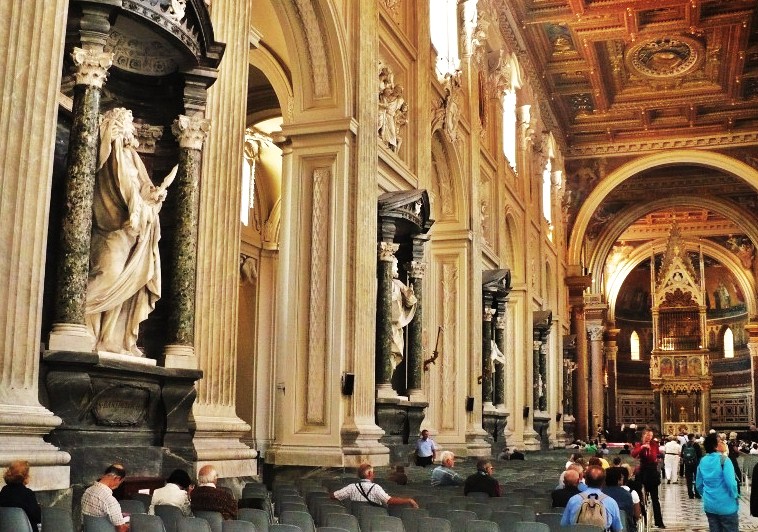
Archbasilica of St John Lateran (San Giovanni in Laterano), part of the nave with statues of the twelve apostles, in front of the baldacchino (canopy) over the altar containing the heads of Sts Peter and Paul. The papal cathedra is in the apse beyond.
To us in Australia, it may seem a bit strange to have a feast to celebrate the dedication of a Church in Rome. But let’s not be superficial.
If we want to understand this feast we need to be attentive to the meaning of church buildings, says Fr Robert Barron. Click on the links below to listen:
Additional material here:
Fast facts about St John Lateran:
St John Lateran is the oldest of all the Roman Basilicas.
It is the mother church of all Catholics. The dedication plaque describes the church as: Omnium urbis et orbis ecclesiarum mater, et caput or, “of all the churches of the city and the world, the mother and head”.
Enclosed inside the stone and marble altar, is an ancient wooden altar which tradition says is the altar used by St Peter when he was leader of the Church in Rome. It was brought by Constantine and Sylvester from the church of Santa Pudenziana which was built in 140-155 A.D. during the pontificate of the 10th pope, Pius I. Santa Pudenziana is the oldest place of Christian worship in Rome, and was the residence of the Pope prior to the move to the Lateran.
Inside the canopy above the altar are reliquaries containing the heads of the Apostles Peter and Paul. Paul was beheaded around the years 64-67.
It was consecrated in 324 A.D. by the 33rd Pope, St Sylvester I.
In the apse of the church is the cathedra of the bishop of Rome, that is the teaching chair of our spiritual father, the Pope.
The land was donated by Constantine to the then bishop of Rome, the 32nd Pope Miltiades who presided over the Lateran Synod in 313, which declared Donatism to be a heresy. (The Donatists held that people who had fallen away from the faith during the persecution of Diocletian, could not be forgiven and go on to become priests dispensing valid sacraments.)
The name Lateran comes from the land which was owned by the noble Imperial Roman family of the Laterani.
Finally, it is important to remember that it is the original dedication of this church to Christ the Saviour that we are celebrating on 9th November. St John the Baptist and St John the Evangelist are co-patrons of the cathedral.
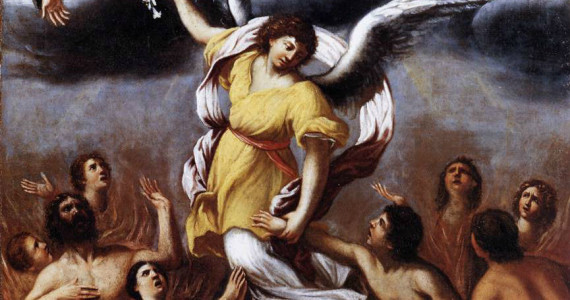
An angel frees the souls from Purgatory (detail), Ludovico Caracci, 1610, oil on canvas, Pinacoteca Vaticana
The Solemnities of All Saints (1 Nov) and All Souls (2 Nov) are particularly poignant to me this year.
I lost my husband to cancer in March, and I remember thinking, as I said goodbye to his body, that Chemistry and Biology could only go a certain way to explaining what had happened. The essence of Bill, his irrepressible cheerfulness and zest for life, his forgetfulness of self, his ridiculous jokes, his kindness and generosity, the way he would give a chirpy greeting to everyone he passed – in short, those elements which made up his transcendent soul – had moved on, and all that was left behind was merely a shell.
As Fr Barron says in his homily,
We are more than our bodies, more than our memories, more than our imagination, more than our senses. There is a mysterious spiritual capacity within us. That’s what the church calls the soul.
Click here to listen:
Fr Barron also has a beautiful take on All Saints’ Day here:
The takeaway message is that once you surrender your life to Christ, you find your deepest self. The saints are those people who have surrendered their lives to God so completely, that they have lit up the world around them with God’s love. Yes, the saints are heroes and role models but they are also still alive, and they are our spiritual friends – and we can ask them to pray for us and act on our behalf (think of St Therese of Lisieux – ‘I will spend my heaven doing good upon earth.’)
Don’t forget Fr Augustine will join with other Northern suburbs’ priests to celebrate Mass for All Souls at the Chapel at Pinnaroo Memorial Park, Whitfords Avenue on 2 November at 2.30 p.m. We particularly remember our former parishioner, Veronica (Ronnie) Spratling, who died on 29 October in Victoria. Our condolences to all the Spratling family.
I have also written a list of deceased members of our parish in the intentions section of the Newsletter. If I have left anyone out, please email me and I will add them to our November list.
Did you know the Catholic Church had a role in the revolutionary operation which allowed a paralysed man to walk again? The paralysed man, Darek Fidyka from Poland, had had his spinal cord completely severed in a stabbing injury. In 2012, Alan Mackay Sim, director of the Adult Stem Cell Research Centre at Griffith University extracted olfactory ensheathing cells, thought to be derived from stem cells, from a [different] patient’s nose and injected them into his spinal cord, establishing the safety of the procedure.
Brisbane ear, nose and throat specialist Chris Perry, who extracted the stem cells in the trial, said Professor Mackay-Sim’s work with adult stem cells had been a vital element in the international collaboration. He said the Catholic Church, under George Pell, had donated $50,000 to the research to encourage alternatives to embryonic stem cells. “Unlike embryonic stem cells, which can trigger tumours in some cases, adult stem cells grow in a controlled fashion after they are injected,” Dr Perry said.
As you know, embryonic stem cell research involves the destruction of tiny humans (known as blastocysts at this stage of life, but don’t be fooled – they’re still unique human individuals). The Catholic Church has long spoken out against this exploitation of the helpless and sought to encourage research in adult stem cells instead. Numerous advances have been made in the field of adult stem cell technologies, including the regrowing of a woman’s trachea and the growth of a retina for potential transplant.
In fact, the Church regularly offers $100,000 grants for adult stem cell research – Parkinson’s disease (2003), regeneration of skin after severe burns (2005), treatment of stroke victims (2007), regeneration of normal blood function for cancer sufferers (2009) and improving the success of tissue transplantation (2011).
Australian Christian Lobby Conference
Please pray for the Australian Christian Lobby which this week holds its annual conference in Canberra. It has come under renewed attack over recent weeks. When I read Lyle’s article, I was somewhat bemused that some individuals think the Church is full of hate!
Prayer: Almighty God, we pray that through the work of the ACL, the truth about the beauty of genuine marriage – faithful and fruitful – will be upheld in Australia. We pray that all politicians present will be able to see that
there is no biological complementarity in same-sex relationships
children have a right to live with their biological mother and father and not be treated as commodities for other people’s self-centred fulfilment
We pray, however, that all statements will be issued with due respect for people of differing views and uphold these statements from the Catechism:
The union of man and woman in marriage is a way of imitating in the flesh the Creator’s generosity and fecundity: “Therefore a man leaves his father and his mother and cleaves to his wife, and they become one flesh.”121 All human generations proceed from this union. (2335)
[Homosexual persons] must be accepted with respect, compassion, and sensitivity. Every sign of unjust discrimination in their regard should be avoided. These persons are called to fulfill God’s will in their lives and, if they are Christians, to unite to the sacrifice of the Lord’s Cross the difficulties they may encounter from their condition. (2358)
Homosexual persons are called to chastity. By the virtues of self-mastery that teach them inner freedom, at times by the support of disinterested friendship, by prayer and sacramental grace, they can and should gradually and resolutely approach Christian perfection. (2359)
Good democracies rely on understanding this relationship correctly. As an example, look at the logical inconsistencies in Barack Obama’s views on abortion, compared to, say, his views on slavery:
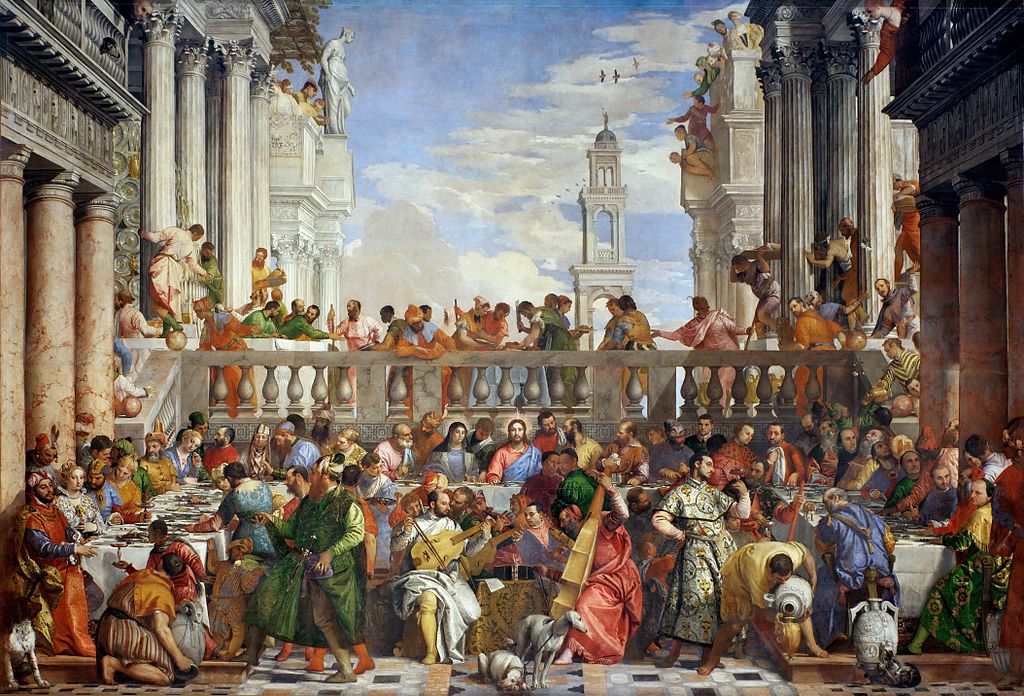
We’re asked the question, “How do we respond to God’s invitation to join him?” Do we trash the invitation (after all, we might mistake it for another bit of spam) or realise what it is and respond with joy? Click on the image to listen to Fr Barron explain …
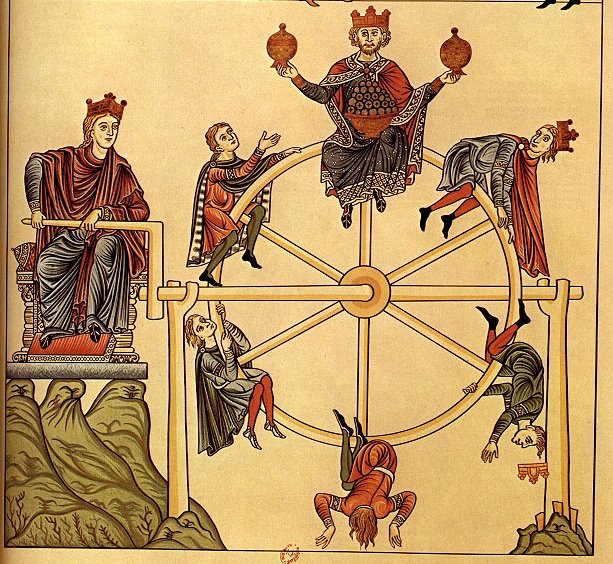
If you’re wondering about the picture I’ve used as our feature for this week, do listen to Fr Robert Barron’s homily (see link above), where he explains the thought behind the medieval wheel of fortune. By the way, this picture is from the Hortus Deliciarum, the first encyclopedia written and illustrated by a woman, Herrad of Landsberg, 12th Century Abbess of Hohenburg Abbey (Mont Sainte-Odile). Just another example of the great achievements of women in the Catholic Church!







 Catholic in Yanchep