Catholic in Yanchep

Go out into the deep.


Leave a comment

The Solemnity of Mary, Mother of God | How Mary helps us to understand Jesus

immaculate-conception-piero-di-cosimo-830x511

The Immaculate Conception, Piero di Cosimo, c. 1500, oil on panel, Uffizi, Florence.

At the ecumenical Bible Study group I attend, we steer very carefully away from any discussion of the Early Church Councils.  If I sail too close to these shores, the usual protestation is, “But where is it in the Bible?” My answer is, “The decisions of the Church Councils are overflowing with quotes from the Bible.  What Church Councils are attempting is the correct interpretation of Scripture.  Just like a geometry theorem, each teaching has to proceed from previous teachings derived from Holy Scripture using deductive logic, without contradicting the previous steps.”

Take for example the First Council of Ephesus.  This was sparked by a popular devotion to the Virgin Mary, which called her “Theotokos” (Θεοτόκος) or God-bearer.  “You can’t say that!” objected one of the factions, led by Nestorius, Archbishop of Constantinople.  “You have to say “Christotokos” (Χριστοτόκος), i.e. Christ-bearer.  Essentially, the argument was not really about who Mary was, but about who Christ was.

This may seem a little arcane, but it makes a huge difference to our understanding of Christ.  Already at the Council of Nicaea in AD 325, it had been affirmed that Jesus was fully divine and of the same essence as the Father (Homoousios, Greek: ὁμοούσιος).   But now the question was whether Christ had one nature or two, one personhood or two, and so forth.

If one drew it as a punnet square, like a problem in genetics, one could visualise the different options like this.  During the 5th century there were a variety of theories milling around, but only one was correct.
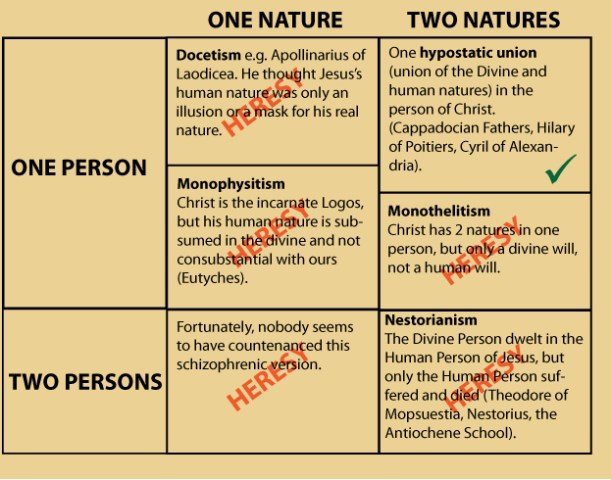
nature-person-christology

What on earth do we mean by these words, “nature” and “person”?

Nature (physis, Greek: φύσις) refers to the kind of ‘being’ He is, divine or human.

Person (hypostasis, Greek: ὑπόστασις) refers to an entity or individual reality.

To put it more concretely, these were the different positions on the interpretation of Christ’s death:
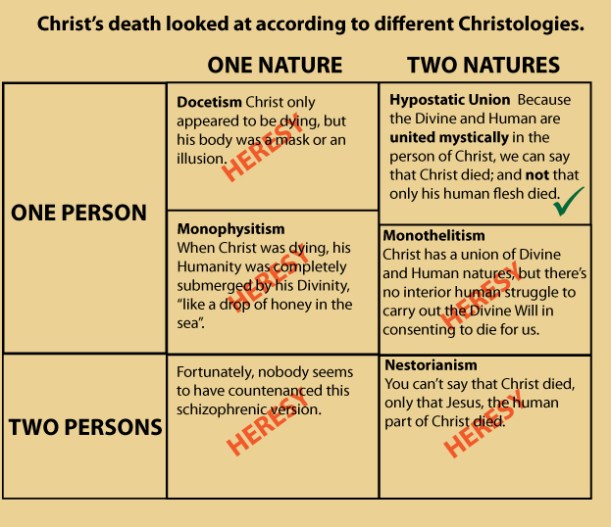
nature-person-christology-examples

So, at the Council of Ephesus, Cyril of Alexandria and Nestorius faced off against each other (well, sort of; actually Nestorius neglected to show up to answer the charges made against him).  And the argument, in summary went like this:

Cyril:

We too ought to follow these words and these teachings and consider what is meant by saying that the Word from God took flesh and became man. For we do not say that the nature of the Word was changed and became flesh, nor that he was turned into a whole man made of body and soul. Rather do we claim that the Word in an unspeakable, inconceivable manner united to himself hypostatically flesh enlivened by a rational soul, and so became man and was called son of man, not by God’s will alone or good pleasure, nor by the assumption of a person alone. Rather did two different natures come together to form a unity, and from both arose one Christ, one Son. It was not as though the distinctness of the natures was destroyed by the union, but divinity and humanity together made perfect for us one Lord and one Christ, together marvellously and mysteriously combining to form a unity. So he who existed and was begotten of the Father before all ages is also said to have been begotten according to the flesh of a woman, without the divine nature either beginning to exist in the holy virgin, or needing of itself a second begetting after that from his Father. 

In a similar way we say that he suffered and rose again, not that the Word of God suffered blows or piercing with nails or any other wounds in his own nature (for the divine, being without a body, is incapable of suffering), but because the body which became his own suffered these things, he is said to have suffered them for us. For he was without suffering, while his body suffered. Something similar is true of his dying. For by nature the Word of God is of itself immortal and incorruptible and life and life-giving, but since on the other hand his own body by God’s grace, as the apostle says, tasted death for all, the Word is said to have suffered death for us, not as if he himself had experienced death as far as his own nature was concerned (it would be sheer lunacy to say or to think that), but because, as I have just said, his flesh tasted death. So too, when his flesh was raised to life, we refer to this again as his resurrection, not as though he had fallen into corruption—God forbid—but because his body had been raised again.

[As Brother Michael, MICM summarises it, “The crux of the argument of the Alexandrian bishop is that if the person who died for us on Calvary was not God, then, indeed, we may despair; for then we have not been redeemed, since no mere man could have paid such a price.”]

To this, Nestorius replied with glorious self-righteousness:

Nestorius sends greeting in the Lord to the most religious and reverend fellow-minister Cyril. I pass over the insults against us contained in your extraordinary letter. They will, I think, be cured by my patience and by the answer which events will offer in the course of time …

… For when he was about to mention the death, to prevent anyone supposing that God the Word suffered, he says “Christ”, which is a title that expresses in one person both the impassible and the passible natures, in order that Christ might be called without impropriety both impassible and passible;  impassible in godhead, passible in the nature of his body…Ten thousand other expressions witness to the human race that they should not think that it was the godhead of the Son that was recently killed but the flesh which was joined to the nature of the godhead.
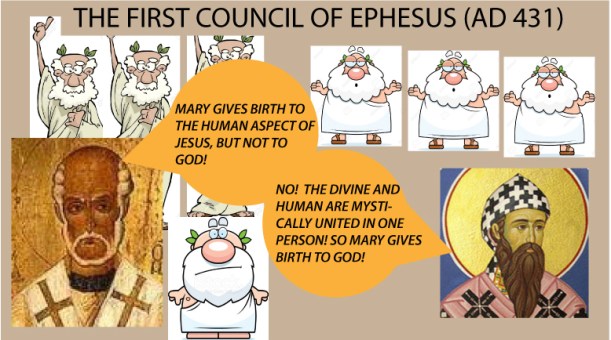
christologyAfter much argy-bargy between the parties, including a situation where John of Antioch and his team from the Antiochene School arrived and proceeded to set up a rival synod, Nestorius’s teachings were condemned by the Council.


We have found him out thinking and speaking in an impious fashion, from his letters, from his writings that have been read out, and from the things that he has recently said in this metropolis which have been witnessed to by others; and as a result we have been compelled of necessity both by
—the canons and by
—the letter of our most holy father and fellow servant Celestine, bishop of the church of the Romans, to issue this sad condemnation against him, though we do so with many tears.

Our lord Jesus Christ, who has been blasphemed by him, has determined through this most holy synod that the same Nestorius should be stripped of his episcopal dignity and removed from the college of priests.

The Coptic Acts of the Council of Ephesus tell us that there was great rejoicing in the streets:

… gathered outside the church doors, in enthusiastic anticipation of the assembly’s decision, was what seemed to be the entire population of Ephesus. As soon as the news of what was decided leaked through the portals, the rejoicing was so unparalleled that no historian has failed to report it. The whole city became as though sun-lit with torches, and devotional pageantry exploded in the streets. (Source)

Another win for the people!  They had instinctively known that Mary was worthy of veneration as Mother of God!  And how much more wholesome that they were rejoicing about the Theotokos than yelling, as in Acts 19:28 “Great is Diana of the Ephesians!”

Finally, two years later, Cyril and John of Antioch reconciled and declared a common formula:

We confess, then, our lord Jesus Christ, the only begotten Son of God perfect God and perfect man of a rational soul and a body, begotten before all ages from the Father in his godhead, the same in the last days, for us and for our salvation, born of Mary the virgin, according to his humanity, one and the same consubstantial with the Father in godhead and consubstantial with us in humanity, for a union of two natures took place. Therefore we confess one Christ, one Son, one Lord. According to this understanding of the unconfused union, we confess the holy virgin to be the mother of God because God the Word took flesh and became man and from his very conception united to himself the temple he took from her.

And Nestorius, poor chap, was exiled to upper Egypt, where he died in obscurity.

So we see how the early Church, in thinking about Mary, was led to understand the Nature and Personhood of Christ more precisely.  My ecumenical Bible Study group is a little nervous that thinking about the role of Mary might diminish Christ in some way.  The reverse is true – she always leads us to a greater understanding of Christ.

Leave a comment

A blessed Christmas to all!

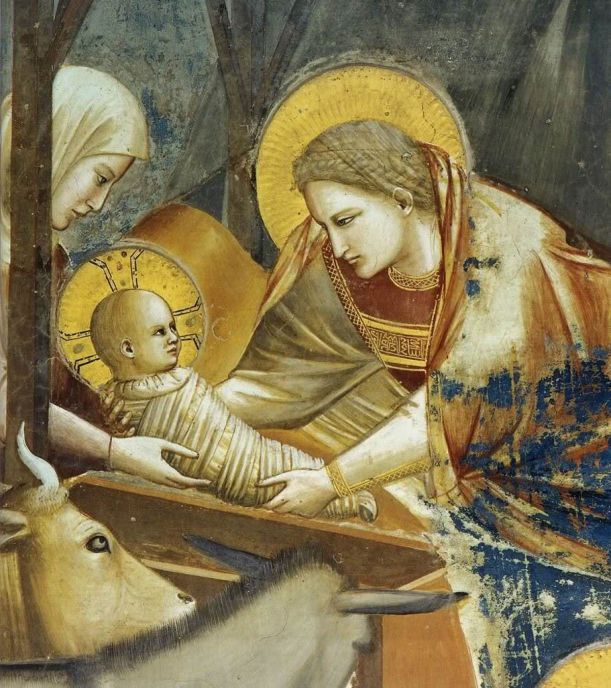
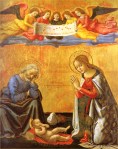
giotto-di-bondone-no.-17-scenes-from-the-life-of-christ-1.-nativity-birth-of-jesus-detail

No. 17, Scenes from the Life of Christ – Nativity: Birth of Jesus, Giotto di Bondone (1304-1306), Scrovegni Chapel, Padua, Veneto, Italy.

Wishing all of my online followers (especially those in Yanchep-Two Rocks) a most blessed, peaceful and joyful Christmas!  God became flesh out of love for us – so that, attaching ourselves to Him, we might come to share in his glory.  I pray for all of you, that Christ will make himself increasingly known to you, that you can share more and more in his divine life and love.

At the time appointed by God, the only Son of the Father, the eternal Word, that is, the Word and substantial Image of the Father, became incarnate; without losing his divine nature he has assumed human nature. (CCC 479)

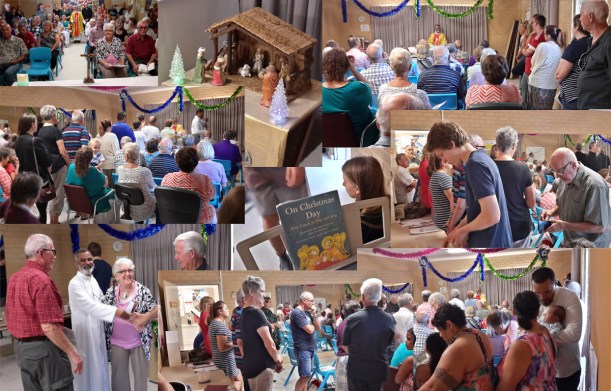
It was so beautiful to be able to celebrate the birth of Christ our Saviour with a large crowd at the Yanchep Community Centre last night!  As Fr Augustine said, there was no room in Bethlehem for the Saviour, and there was little room to sit down in the Community Centre.  Please pray that we will be able to find a permanent, larger venue for our Church, and please pray that we can finally have a Pastoral Council to raise funds to do so!  Thank you to all those who joined us for Mass!christmas-2016-collage

I have to go and cook a turkey now, so if you would like some extra reflections on Christmas, I will leave you with these links:


Leave a comment

Wise Men follow the sign

christmas-mass-signA big shout out to Max Fraser of Two Rocks who made this wonderful sign for our Christmas Mass!  Thanks Cathie and Max for installing this on the corner of Marmion Avenue.  So good to see everyone pitching in and helping.

1 Comment

Christmas Mass Times 2016

The Yanchep Christmas Mass will be at 6 p.m. on Christmas Eve, 24th December at the Yanchep Community Centre in Lagoon Drive.  The next closest Mass venue is at St Andrew’s Clarkson and their Mass times are here.

Guilderton Christmas Mass will be at the usual 8 a.m.

Lancelin Christmas Mass will be at 10 a.m.


Leave a comment

Alone at Christmas? We’ll adopt you for the day!

christmas-group-therapyIf you know anyone in our local area who doesn’t look forward to Christmas because it reminds them of their sadness, let them know that they can join us for lunch!  Perhaps they have lost a loved one.  Perhaps their family isn’t speaking to them.  Or perhaps they are far away from their friends and relations.


Whatever the reason is for their loneliness, they need to know that God loves them with a tender love and wants to reach out to them to share his abundant joy.

All you need to bring is a plate of salad or dessert, and a “Secret Santa” to the value of no more than $10.  Call 0400 660 337 to book a place!


Leave a comment

4th Sunday of Advent, Year A | The Virgin will conceive

ghent-altarpiece-virgin

The Virgin Mary, Retable de l’agneau mystique (the Wedding Feast of the Lamb) detail, 1430-32, Jan Van Eyck, Ghent Altarpiece, Saint Bavo Cathedral, Ghent, Belgium.

Some of my Facebook friends like to joke about people who believe that a virgin can conceive a child – and a male child at that!   Not even parthenogenesis is capable of that.

If God is God, then I’m not sure how mere humans can define what he is capable of doing.  (But I suspect that they think they’re God, which is an even more unfortunate delusion.) Having a planet capable of supporting life is miraculous enough.  Dr Hugh Ross has compiled a list of 322 variables showing the probability of their ‘just happening’ to be the correct value to support life.  He comes up with a probability for the occurrence of all of these parameters simultaneously of approximately 10 -388.

In The Goldilocks Enigma, Paul Davies describes how “many different aspects of the cosmos, from the properties of the humble carbon atom to the speed of light, seem tailor-made to produce life.”

Some physicists solve the enigma of the fine-tuned universe by saying that of course we live in a multiverse – our universe just so happens to have the cosmological and other dimensionless physical constants at the right value for the support of life.  All the rest are duds, it’s just that at present we haven’t figured out how to detect them.  To me this is about as likely as a virgin birth.  Oh, but wait.  We’re not supposed to believe in things that are that unlikely.

So apparently it’s OK to believe in something as unlikely as a multiverse, but not OK to believe in a virgin birth.

As for me, I’ll keep praying the Rosary, because the gentle and obedient Virgin has been such a help and companion, leading me into a deeper communion with her Son.  And no matter how much some – not all – philosophers try to avoid the possibility of miracles, there’s nothing that has the power to teach like the everyday surprise of effectual prayer.

For some great reflections on today’s readings, try these:
Dr John Bergsma: Letting God In
Bishop Robert Barron: History is going somewhere, and it rhymes
Father Ted Tyler, parish priest of Upper Blue Mountains, diocese of Parramatta, has compiled an e-book of reflections for every day of Year A and you can download it here.

Today’s readings:
Word format: year-a-advent-4th-sunday-2016
Pdf format: year-a-advent-4th-sunday-2016


2 Comments

3rd Sunday of Advent, Year A | Jesus Christ: Go where the evidence leads

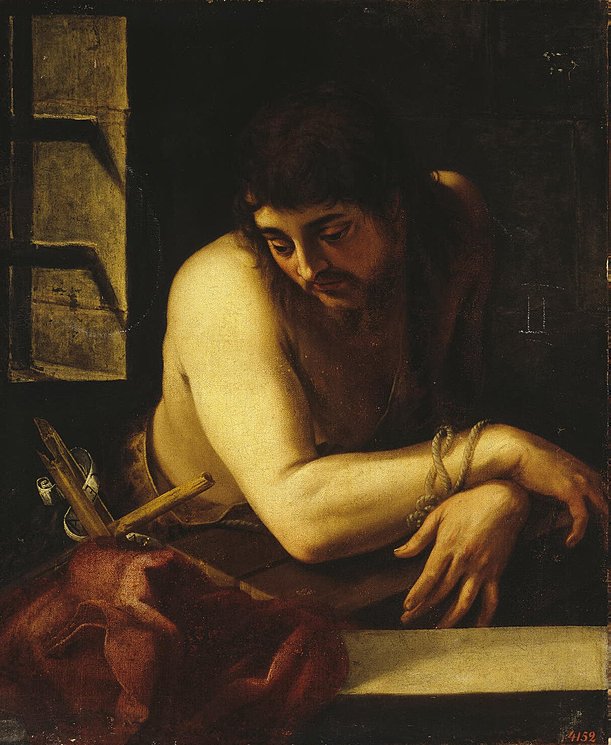
st-john-the-baptist-in-the-prison-navarette

St John the Baptist in Prison, Juan Fernández de Navarrette, 1565-70, Oil on canvas, 80 x 72 cm, The Hermitage, St. Petersburg, Russia.

In today’s Gospel, John the Baptist has been flung into prison, because he has dared to say that King Herod’s marriage to his brother’s wife is adulterous.   Persecution has a way of throwing one’s mind into turmoil and confusion.  It’s reassuring to know that even a person as courageous and committed to his mission as John, is now attacked by doubts about whether he has interpreted his task correctly – or indeed whether Jesus has interpreted his task correctly!  He sends his disciples to ask Jesus, “Are you the one who is to come, or are we to expect someone else?”

This makes us wonder: what was the nature of the long-awaited Messiah that the Jews were expecting?  Was it a King who would bring about the restoration of Israel and liberation from the Roman occupation, or were they expecting God Himself to arrive – or was it a bit of both?

We know that swirling through the air of first century Judaism was a fever of expectation.  That is why ‘all of Judaea’ (Mt 3:5) had been so willing to go out to the desert to see John the Baptist and prepare the way of the Lord.  What made the Jews so convinced about the timing of the coming of the Messiah?

According to the prophecy in the book of Daniel, the kingdom that would be ushered in by the Messiah – the Anointed One – would arrive in the midst of the fourth empire after the Babylonian deportation.  In Daniel’s prophecy the empires are represented by the parts of a statue.

The head of this statue was of fine gold, its chest and arms were of silver, its belly and thighs of bronze, its legs of iron, its feet part iron, part clay.  While you were gazing, a stone broke away, untouched by any hand, and struck the statue, struck its feet of iron and clay and shattered them.  Then, iron and clay, bronze, silver and gold, all broke into pieces as fine as chaff on the threshing-floor in summer … and the stone that struck the statue grew into a great mountain, filling the whole world.  (Dan 2:31-36)

These four empires were, successively, golden-headed Babylon, silver-chested Medo-Persia, bronze-thighed Greece and finally, in 63 BC, with Pompey’s capture of Jerusalem, iron-legged Rome marched into the Middle East.  And it is into the Roman Empire that Christ comes, proclaiming the Kingdom.  Yes, the Roman soldiers were clad in iron, but God has a way of using small stones to bring down giants, and the Jews remembered their history.

Not only that, but the Jews could even calculate the approximate time the Messiah was expected.  This is why small communities of Jews such as the Essenes of Qumran had set themselves apart, purifying themselves to hasten the coming of the Messiah.

Daniel 9:25 prophesies:

Know this, then, and understand:
From the time there went out this message:
“Return and rebuild Jerusalem”
to the coming of an Anointed Prince, seven weeks and sixty-two weeks …

The message that the prophecy refers to, is the rebuilding of Jerusalem after the Babylonian exile.  You can calculate the dates if you understand that the weeks are “weeks of years”, i.e. seven year periods.  Then the seven weeks and sixty-two weeks add up to 69 weeks of years, i.e. 69 x 7 = 483 years.  Jerusalem’s walls were restored by Nehemiah in about the fourth decade of the fifth century BC, “the twentieth year of the reign of Artaxerxes” (Ne 2:1; 5:14).  So, if we use the Babylonian method of reckoning years as 360 days, we arrive at the coming of the “Anointed Prince”, just about at the time of the beginning of Jesus’ public ministry in AD 28.

In this fever of expectation, we have John asking in today’s Gospel, “Are you the one who is to come?”

And Jesus says, “Go back and tell John what you hear and see; the blind see again, and the lame walk, lepers are cleansed, and the deaf hear, and the dead are raised to life and the Good News is proclaimed to the poor; and happy is the man who does not lose faith in me” (Mt 11:4-5).

Jesus is saying, “Look at the evidence!  Look at how I am not only doing miraculous things, but simultaneously fulfilling the prophecy of Isaiah 35!”

In fact if we read the chapters prior to this, Matthew has just spent the whole of chapters 8 and 9 preparing us for this point by describing a series of miracles that Jesus has performed:

The blind see Cure of the two blind men (Mt 9:27)
The lame walk The centurion’s servant (Mt 8:7); The paralytic (Mt 9:2)
The lepers are cleansed The man with the skin-disease (Mt 8:2)
The deaf hear The dumb demoniac (Mt 9:32)
The dead are raised to life Jairus’s daughter (Mt 9:24)

The fact that these miracles occurred long ago, is no reason for them to be deemed unconvincing or just fables.  Jesus’ miracles are well attested even by non-Christians such as Josephus, who said “For he was one who performed surprising deeds” (Jewish Antiquities, 18.3.3 §63).  Then there’s the Babylonian Talmud, (a Jewish text and therefore not pro-Christian), which described Jesus thus, “He is going to be stoned, because he practiced sorcery” (Babylonian Talmud, Sanhedrin 43a).  That is, he did things that are, humanly speaking, impossible.

If you’re interested in other ways Jesus fulfills prophecy, Taylor Marshall has come up with a comprehensive list in his book, The Crucified Rabbi.  There’s a list here: prophecies-fulfilled-by-jesus-christ.

I realise now that I haven’t really answered my original question, which was about whether the expected Messiah was understood to be divine.  In fact, he was, and if you want more on this, please read Brant Pitre’s, The Case for Jesus.  (I have a copy of this and The Crucified Rabbi if any of you would like to borrow them.)

In this science-obsessed age, it’s a wonder that more people don’t bother to ‘go where the evidence leads’ where Jesus is concerned.  Blessed indeed are those who do not find Him a cause of falling.

Today’s readings:
Word format: year-a-advent-3rd-sunday-2016
Pdf format: year-a-advent-3rd-sunday-2016


1 Comment

2nd Sunday of Advent | Filled with the knowledge of the Lord

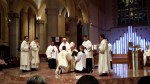
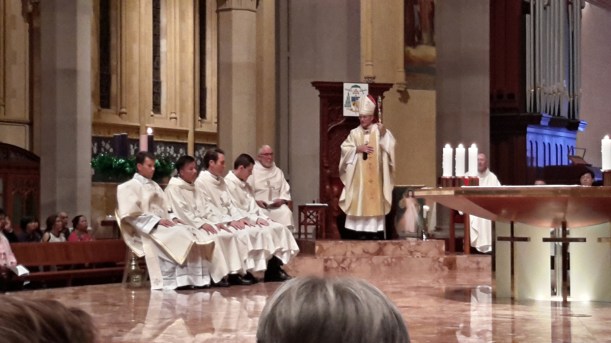
It’s such an encouragement to the faithful when we see young men willing to step up and give themselves to the priesthood.  Last night I had the joy of attending the ordination to the diaconate of four young men from the Perth Archdiocese.  Many of you will know Mariusz Grzech who has been serving at our ‘parent’ parish of St Andrew’s, Clarkson, for the past year (if you didn’t know, Yanchep was part of St Andrew’s parish from 1994 until about 2001).  Ordained with him were Konrad Gagatek, Joseph Laundy and Tung Vu, whom you can read more about here.  I thought that I’d share with you some photos from the Ordination Mass …

This first photo shows the Promise of the Elect, where the Deacons make various promises about their new role (discharging the office of Deacon with ‘humble charity’, proclaiming the faith in word and deed, remaining celibate, deepening their prayer lives – especially by praying the Liturgy of the Hours – and conforming their lives to the example of Christ).

promise-of-the-elect-1

Promise of the Elect

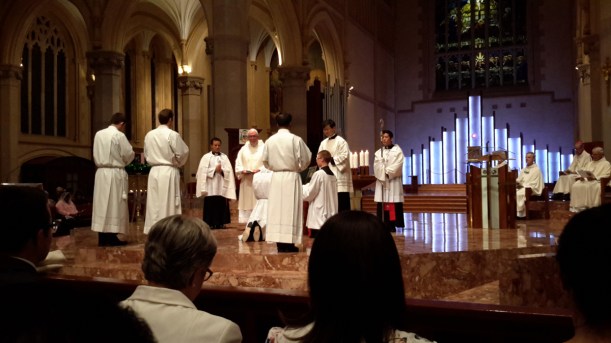
The Deacons lie prostrate to receive the Lord’s blessing while our prayers fly to heaven in the soaring, otherworldly Litany of Supplication.  (You can view this on the Record’s FB page.)

litany-of-supplication

The Litany of Supplication

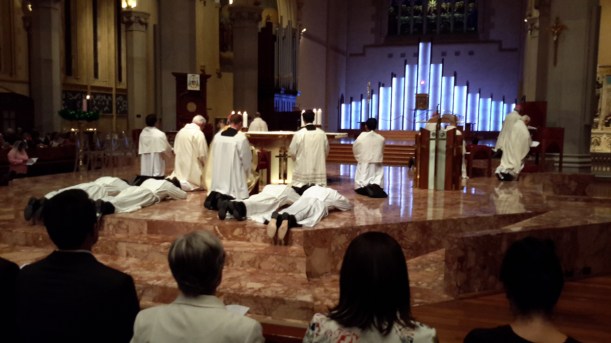
Next comes the Prayer of Ordination and the Laying on of Hands, where we bring to mind those first seven Deacons, appointed in similar fashion in Acts 6:1-7.  This prayer has some beautiful words …

Send forth upon them, Lord, we pray,
the Holy Spirit,
that they may be strengthened
by the gift of your sevenfold grace …

May there abound in them every Gospel virtue
unfeigned love,
concern for the sick and poor,
unassuming authority,
the purity of innocence
and the observance of spiritual discipline.

(Excuse the blurriness of this photo, but my hands are not as steady as they used to be, I didn’t want to use a camera because of the shutter noise, and tablets are notoriously wobbly for still shots!)

laying-on-of-hands

The laying on of hands and the Prayer of Ordination

The Deacons are vested by their nominated priests, assisted by their families, with the Diaconal Stole and Dalmatic.  Here Mariusz is helped by Fr Conor Steadman and his brothers.  If you’re interested in the history of church vestments there is quite a nice article here, with illustrations, which calls the Dalmatic a garment with ‘festive origins’.

investiture-of-diaconal-stole

Investiture of the Diaconal Stole and Dalmatic

The Deacons receive the Book of the Gospels from Archbishop Costelloe.

Receive the Gospel of Christ,
whose herald you have become.
Believe what you read,
Teach what you believe,
and practice what you teach.

… says it all, really.

handing-on-of-the-book-of-the-gospels-2

Handing on of the Book of the Gospels

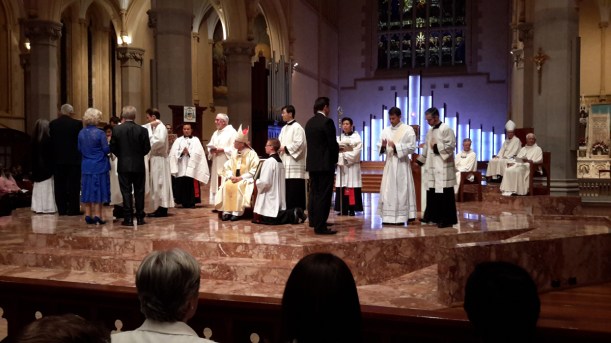
Here the Archbishop makes his final address, where he conveys the Deacons’ messages of thanks to their families and all who have helped them get to this point.

final-address-bishop-timothy-costelloe

Final address from Archbishop Timothy Costelloe to the new Deacons, from left Mariusz Grzech, Tung Vu, Joseph Laundy and Konrad Gagatek.

This morning, it being the first Saturday of the month, I made the trip down to Clarkson and was pleased to be able to hear Mariusz’s first homily – which as a Deacon, he is now able to deliver. Appropriately enough, the Gospel was about asking the Lord of the harvest ‘to send labourers to the harvest’ (funny how God does that!)  It also happened to be the memorial of St Francis Xavier, the most effective evangelist in history.  So Mariusz’s homily was about St Francis Xavier, and also about our own role in mission – we don’t have to go overseas to go on mission – our mission field is Australia, our mission field is Perth, our mission field is our own Parish, our mission field is our family.

I must say I was pleased to hear it, as this blog is part of what I see as my mission … to whoever might read it.  For example, what I write here is shared to my profiles on various social media platforms, one of them being LinkedIn.  Now LinkedIn connects me with all my contacts in my capacity as Company Director.  And LinkedIn is telling me that 30 of my business associates read my entry for last week, the First Sunday of Advent (and that’s not including FB or other platforms).  I find this quite extraordinary – I have no idea who they are, but those people are quietly discovering the way prayer makes a difference in my life – and the Holy Spirit is waiting to invade, with his powerful presence, the lives of any of them who might be open to Him.  Only this week, I discovered an extraordinary coincidence between a prayer uttered fourteen years ago, and the results now bearing fruit (but I will have to save that story for another time.)  It’s a shame that many people are afraid to talk about their faith today (because we receive so much ridicule from secularists), but if we don’t toughen up and become unafraid to admit to following Christ, how will other people hear the kerygma – the message of the Gospel and the gift of eternal life?

Almost forgot … here is the Mass leaflet for today.

Today’s readings

Word format:year-a-advent-2nd-sunday-2016

Pdf format: year-a-advent-2nd-sunday-2016


Leave a comment

First Sunday of Advent, Year A | Prayer and Promptings

saint-michel-daiguilhe-chapel

Chapelle Saint Michel d’Aiguilhe, (Chapel of St Michael of the Needle), Le Puy-en-Velay, Auvergne, France.

Last week I said I would talk more about how God speaks to us.  This is one of the fascinating aspects of Christianity, because it is primarily in Christianity (and to some extent Judaism) that God presents Himself to us as a loving Father, who pays us the unexpected compliment of desiring communion with us, his children.

Once, we dive into Christianity with minds and hearts obedient and open to receiving, then God can start having a conversation with us.  ‘Conversation’ is my word of choice, because it conveys better the trust and openness required for spiritual progress.  Prayer is much more than petitioning for things. That conflicted genius, Oscar Wilde, once said: “Prayer must never be answered: if it is, it ceases to be prayer and becomes correspondence.”  No doubt this facetiousness was Wilde enjoying the sound of his own voice.  For my part, prayer actually is largely correspondence:  I like to write down my prayers, often in front of The Blessed Sacrament, and re-read them a year later to see how God has directed me.   As I get older, I am increasingly on the receiving end of an impression that God is steering me almost despite myself.  Perhaps Wilde was alluding to the fact that prayer is not an activity directed at someone who is an equal, but rather someone infinitely higher than ourselves, whose ways are not our ways.

Often God’s promptings come in the form of a ‘still, small voice’.  I’m not talking about the usual stream of consciousness that we all experience as a background to our thoughts; neither am I talking about a voice that seems to come from some other, as in schizophrenia, but rather an inner suggestion which comes with a certain insistence and often makes me respond, in turn, ‘Oh, that’s just ridiculous!’ to, eventually, ‘Well, if you think that’s possible, maybe I should try it and see where it leads.’

It is this ongoing conversation with a loving Father that helps me navigate through my day.  Sometimes He answers my prayers before they’ve even arrived fully formed on my lips.  Yet when the answers come, I am struck by how appropriate they are to what I might have prayed if only I had got around to it.  Just this week, by way of a small example, I have been thinking about my misgivings concerning a study we are about to do at Bible Study on Prayer and Prosperity, and God has answered my concerns with a randomly selected podcast from John Bergsma on “The Upside-Down Kingdom”.

Another incident this week seemed a clear example of a ‘steering’.  On Friday, I went to Adoration at St Andrew’s Church as usual between 3 and 4 p.m.  I was all set to leave, but everyone else had made off and I was the only one left.  Fortunately I wasn’t in a hurry –  I had had some space freed up by what I thought was my decision (and now believe was a prompting from God) on the previous day to take advantage of a free offer and do my shopping online.  Just as well I stayed, for suddenly the church was invaded by a riot of St Vincent de Paul workers, unloading 43 newly-packed Christmas hampers for the needy.  I’m sure they were doing the Lord’s work, but they were completely oblivious to the presence of Christ exposed on the altar, and chattered in loud voices as they debated whether they should store the hampers in this corner or over there, with one woman even wanting to walk across the sanctuary.  Suddenly, I felt as if Jesus (on the altar) and I were two people in possession of a secret: and the secret was that the Lord of the Universe was physically present in the room and no-one knew it!  It was as if the Queen of England had arrived incognito to dinner, and everyone at the table thought she was the woman brought in to do the washing up.  Strangely, this experience gave me a heightened awareness of Jesus’ real presence in the Monstrance, perhaps in the same way that one becomes even more convinced of the Divinity of Christ when a stupid or thoughtless person uses His name with great disrespect.  I spent the rest of my time at Adoration just enjoying the Companionship of the Holy One and not leaving him alone and disregarded on the altar.

Then there’s the sort of prayer that is ‘asking for stuff’.  Well, God is such a loving and trustworthy Father that he will not give us anything that isn’t good for us (unless, paradoxically, he wants to teach us that it’s not good for us).  (He has done this a few times in my life!  Ouch!)  Very often, God doesn’t give us what we ask for straight away.  Often we get an answer only after quite a journey of improvement.  This is one of the reasons I like praying to ‘Our Lady, Undoer of Knots’.  She helps us undo one snag at a time.  I had quite a dramatic demonstration of this when I was praying for reconciliation in the family of a Christian couple I know whose son was refusing to talk to them.  Now, the father was actually someone who had divorced and remarried (something the Lord clearly calls adultery).  Anyway, when I took this situation to Our Lady, Undoer of Knots, the first thing that happened (in the same week!) was that the father’s first wife died suddenly.  It seemed to me that what God was saying to him was, ‘Your adulterous situation is blocking your prayers for reconciliation.  Perhaps now you can have another look at what you did, and first come to me with a repentant heart before you pray about your son.’  Interestingly, it was at the first wife’s funeral that the opportunity arose for this family to resume some conversation with each other, and things have been moving along, knot by knot, ever since.

For a more dramatic example of God’s roundabout methods of answering prayer, let’s go back to Oscar Wilde.  His poem E. tenebris was written in 1881, when he was only 27, long before his troubles and his trial.

Come down, O Christ, and help me! reach thy hand
For I am drowning in a stormier sea
Than Simon on thy lake of Galilee:
The wineof life is spilt upon the sand,
My heart is as some famine-murdered land
Whence all good things have perished utterly,
And well I know my soul in Hell must lie
If I this night before God’s throne should stand.
‘He sleeps perchance, or rideth to the chase,
Like Baal, when his prophets howled that name
From morn to noon on Carmel’s smitten height.’
Nay, peace, I shall behold before the night,
The feet of brass, the robe more white than flame,
The wounded hands, the weary human face.

Sure enough, if this was a prayer, God took Wilde seriously, and after a tortuous journey involving his trial, imprisonment, exile in France, impoverishment and finally being struck down with meningitis, Wilde came back 19 years later to the faith he had toyed with throughout his life.  In the words of the Passionist priest, Father Cuthbert Dunne, who attended him on his deathbed,

As the voiture rolled through the dark streets that wintry night, the sad story of Oscar Wilde was in part repeated to me… Robert Ross knelt by the bedside, assisting me as best he could while I administered conditional baptism, and afterwards answering the responses while I gave Extreme Unction to the prostrate man and recited the prayers for the dying. As the man was in a semi-comatose condition, I did not venture to administer the Holy Viaticum; still I must add that he could be roused and was roused from this state in my presence. When roused, he gave signs of being inwardly conscious… Indeed I was fully satisfied that he understood me when told that I was about to receive him into the Catholic Church and gave him the Last Sacraments… And when I repeated close to his ear the Holy Names, the Acts of Contrition, Faith, Hope and Charity, with acts of humble resignation to the Will of God, he tried all through to say the words after me. (Wikipedia)

How wonderful are the words of Isaiah in today’s first reading, for approaching prayer according to the heart of God:

Come, let us go up to the mountain of the Lord,
to the Temple of the God of Jacob
that he may teach us his ways
so that we may walk in his paths …

Today’s readings

Word format: year-a-advent-first-sunday-2016
Pdf format: year-a-advent-first-sunday-2016


Leave a comment

Christ the King, Year C | Who is king of your universe?

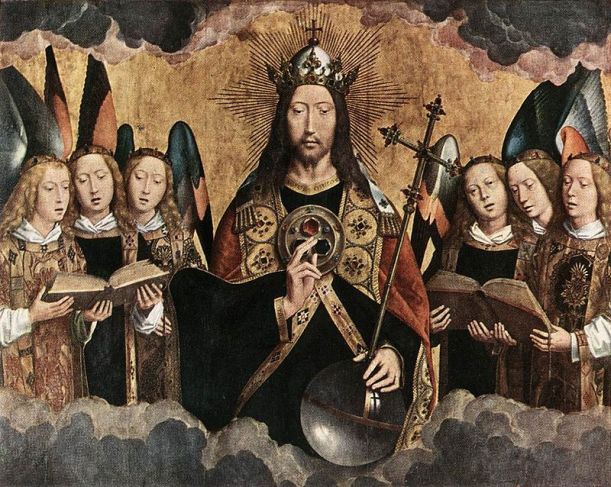
Hans_Memling_-_Christ_Surrounded_by_Musician_Angels_-Christ the King

Christ surrounded by Musician Angels, Hans Memling (c.1480), Royal Museum of Fine Arts, Antwerp, Belgium.

I have a friend, Will, who, as an agnostic, is a great gift to me.  At this stage of his life Will is not one iota interested in God; however, talking to him provides me with an opportunity to understand how atheists and agnostics think.  So last weekend, I asked him about his current view of reality:  to what extent did it include the possibility of God existing?

He answered that as it was impossible to prove God exists, my question was meaningless.

Setting aside whether his assertion is correct (I think it isn’t – but will explain that in another post, or you can read this book), I asked him if he had ever tried the experiential approach and bothered to get his answer straight from the horse’s mouth, so to speak, and ask God if He exists.

No, Will replied.  For if he asks God whether He exists, he is introducing observer bias into the equation, since the question assumes that there is a God to ask whether he exists.  What Will is referring to is a form of confirmation bias, which Wikipedia describes as a “tendency to search for, interpret, favour, and recall information in a way that confirms one’s pre-existing beliefs or hypotheses, while giving disproportionately less consideration to alternative possibilities.”

That’s not really the case, I replied.  You see, the question of whether God exists is too important not to address.  It’s about ultimate truth, and what we believe about ultimate truth becomes the frame of reference for everything else in our lives.  Take, for example, an atheist like Friedrich Nietzsche who said this: ‘All superior men who were irresistibly drawn to throw off the yoke of any kind of morality and to frame new laws had, if they were not actually mad, no alternative but to make themselves or pretend to be mad’.  The last eleven years of his life were a descent into madness.  (What a surprise.)  Contrast this with someone like St Thérèse of Lisieux: ‘Miss no single opportunity of making some small sacrifice, here by a smiling look, there by a kindly word; always doing the smallest right and doing it all for love.’  Which one of these people do you think had the better understanding of the truth?

So, I said to Will, regarding the question of whether God exists, we have these possibilities:

  1. God does not exist and eo ipso does not want to establish a relationship with us.
  2. God exists and does not want to establish a relationship with us.
  3. God exists and wants to establish a relationship with us.

But what you are saying, Will, is that there are only two options regarding these possibilities:

  1. God does not exist and I can ask him if he exists until I am blue in the face, but because he doesn’t exist he won’t answer me.
  2. God may exist, but I can’t ask him whether he exists, because asking the question a priori introduces confirmation bias (according to Will, anyway).

This seems an extraordinarily poor strategy in the game of life.  Because if God exists, I have left myself no apparent way of discovering Him! In fact, the way Will has designed his schema is itself the most perfect example of a confirmation bias for the negative proposition!  Hypocrisy, anyone?  Accusing others of confirmation bias while exemplifying it oneself?

Anyway, I disagree that asking a question of a hypothetical God introduces confirmation bias.  There are various ways we can ask a question to introduce confirmation bias or otherwise.

For example, one could have negative confirmation bias if one worded the question this way:

“Hypothetical God, to determine if you exist (and I am reasonably sure you don’t), I will throw this ten dollar note into the air, and if you sweep it up into the air like Elijah’s chariot, I will believe you exist, but if it falls back to earth, then I will continue to believe you are non-existent.”

… or one could have positive confirmation bias if one phrased one’s question using a scenario which has every likelihood of being fulfilled:

“Hypothetical God, to determine if you exist (and it would be nice if you did), please give me a sign of your presence.   If you are truly present, perhaps, er, perhaps you could give me this sign: let me have a day of great blessing tomorrow.”

You can’t use as your dependent (responding) variable something which is reasonably likely to occur anyway.

So how could one word a question without introducing confirmation bias?

This is Peter Kreeft’s version:

“[Hypothetical] God, I don’t know whether you exist or not. Maybe I’m praying to nobody, but maybe I’m praying to you. So if you are really there, please let me know somehow, because I do want to know. I want only the Truth, whatever it is. If you are the Truth, here I am, ready and willing to follow you wherever you lead.”

Now Will would probably say this version has too much confirmation bias in it, because it already uses words like ‘praying’ – which has religious overtones.  Not only that, but it contains no variable which is measurable or falsifiable.  Also it adds on certain consequences – he says he will follow wherever God leads.  That’s enough to prevent an atheist from approaching the question at all.  For an atheist would say, “Hang on a minute, I only said I was prepared to find out if God exists, I didn’t say I would follow him if he does!”

Perhaps this could be a more scientifically neutral version:

“Hypothetical God (HG), I need to phrase this question as if I am not talking to you, because by appearing to be talking to you, I am introducing confirmation bias.  Therefore, let HG be a possibility.  If HG exists, and HG wants me to know HG exists, HG will presumably let me know in no uncertain terms.  I reserve the right to refuse to respond to HG, should HG’s presence become apparent.”

Something we haven’t discussed yet is what [hypothetical] God might have to say about the Scientific Method as a way of approaching Him.  Would God even bother to answer someone who has the audacity to approach Him in a way that objectifies Him?   Where is the love?  As an analogy, imagine an adopted son who wanted to find out who his birth mother was, but only wanted to know if she was alive and had no intention of meeting and getting to know her.  If the birth mother came to find out that her son was asking questions with this attitude and not with a genuine desire to get to know her, would there be any point in responding?  Would she not be hurt?  In the same vein, isn’t treating God like a science experiment just plain rude?  Well, this is where it might get interesting.  God is a God of surprises, and he doesn’t avoid painful situations (witness the crucifixion).  What’s more, he knows the inmost working of our hearts.  He always responds in the way that is most appropriate for the particular soul.  If He sees that the soul in question would make progress if He responds, then respond He will.  But if he sees that the soul who is half-heartedly seeking him needs more character formation before his heart is in the right place to receive an answer, then he will no doubt first give him some character-building experiences in his life.

There’s a whole lot more to be said on exactly how we hear God and how God speaks to us, but I’ll have to save that for another post.

Readings for Christ the King

Word format: year-c-christ-the-king-2016

Pdf format: year-c-christ-the-king-2016