Catholic in Yanchep

Go out into the deep.

Ascension of Jesus


Leave a comment

Ascension Sunday |Why did Jesus have to leave after his resurrection? Or did he …

Ascension of Jesus

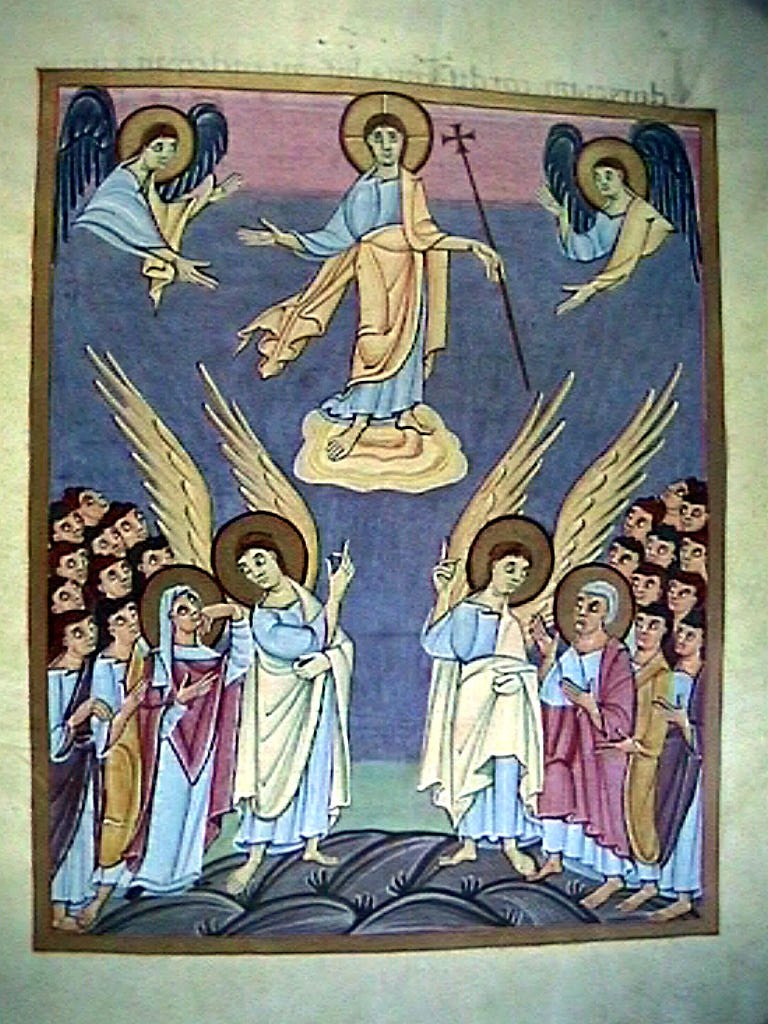
The Ascension,
a page from the Gospel Lectionary portion of the Bamberg Apocalypse, 11th century Staatsbibliothek, MS A. II. 42, Bamberg, Germany.

Before we discuss this question, let’s get the housekeeping out of the way.  Today’s Mass readings (Australia) can be downloaded here:

Word format: Year B Ascension

Pdf format: Year B Ascension

So why did Jesus have to leave his disciples after appearing to them for forty days after his resurrection?  From Fr Barron:

The key to understanding both the meaning and significance of this feast is a recovery of the Jewish sense of heaven and earth. In regard to “heaven” and “earth,” most of us are, whether we know it or not, Greek in our thought patterns. By this I meant that we tend to set up—in the manner of the ancient Greek philosophers—a rather sharp dichotomy between the material and the spiritual, between the realm of appearance and the realm of true reality, between the fleeting earth and the permanent heaven. And if we’re spiritually minded, we tend to think of salvation as an escape from this world—this vale of tears—to a disembodied state called “heaven.” The problem is that these convictions have far more to do with Plato than with the Bible.

Biblical cosmology is not fundamentally dualistic. It speaks indeed of “heaven” and “earth,” but it sees these two realms as interacting and interpenetrating fields of force. Heaven, the arena of God and the angels, touches upon and calls out to earth, the arena of humans, animals, plants, and planets. On the Biblical reading, salvation, therefore, is a matter of the meeting of heaven and earth, so that God might reign as thoroughly here below as he does on high. Jesus’ great prayer, which is constantly on the lips of Christians, is distinctively Jewish in inspiration: “Thy kingdom come, thy will be done, on earth as it is in heaven.” Notice please that this is decidedly not a prayer that we might escape from the earth, but rather that earth and heaven might come together. The Lord’s prayer recapitulates and raises to a new level precisely what the prophet Isaiah anticipated: “the knowledge of the Lord will fill the earth, as the water covers the sea.”   Continue reading here.

Or if you prefer video:

Listen to the homily for today here.


Leave a comment

6th Sunday of Easter | Is God using you to advance his plan?

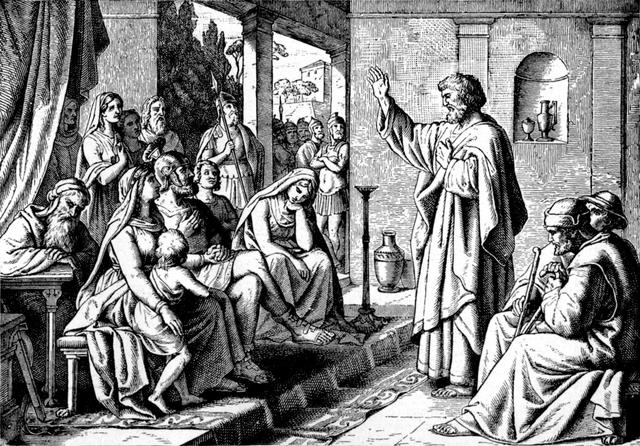
Peter in the house of Cornelius, 19th century, woodcut, artist unknown.

Peter in the house of Cornelius, 19th century, woodcut, artist unknown.

Who was Cornelius?  Our first reading drops us right into the middle of a story without giving us the background.  Cornelius was a Roman Centurion whom God used to commence his work among the gentiles.  What made Cornelius so suitable for this work?  Notice that he filled the criteria of loving God and loving neighbour: “He and all his family were devout and God-fearing; he gave generously to those in need and prayed to God regularly.”  He was the sort of person God could use to advance His plan for salvation.  So God does two things at the same time:

1.  He intervenes dramatically in Cornelius’s life by sending an angel to ask him to fetch the Apostle Peter from Joppa (a distance of about 50 km).

One day at about three in the afternoon he had a vision. He distinctly saw an angel of God, who came to him and said, “Cornelius!”  Cornelius stared at him in fear. “What is it, Lord?” he asked.  The angel answered, “Your prayers and gifts to the poor have come up as a memorial offering before God. Now send men to Joppa to bring back a man named Simon who is called Peter. He is staying with Simon the tanner, whose house is by the sea.”

Notice that Cornelius is obedient.  He doesn’t suspect he’s having hallucinations and douse himself with anti-psychotics.  No, he sends a ‘devout soldier’ and two of his servants straight off to Joppa to carry out God’s wishes.

2. He intervenes dramatically in Peter’s life by giving him a vision too:

About noon the following day as they were on their journey and approaching the city, Peter went up on the roof to pray. 10 He became hungry and wanted something to eat, and while the meal was being prepared, he fell into a trance.  He saw heaven opened and something like a large sheet being let down to earth by its four corners. 12 It contained all kinds of four-footed animals, as well as reptiles and birds. 13 Then a voice told him, “Get up, Peter. Kill and eat.”  14 “Surely not, Lord!” Peter replied. “I have never eaten anything impure or unclean.”  15 The voice spoke to him a second time, “Do not call anything impure that God has made clean.”

We can’t comprehend how shocking this must have been to Peter.  Orthodox Jews take very seriously God’s instructions about food – the dietary laws of Leviticus and Deuteronomy, revealed to them under the Old Covenant (the Jewish Kashrut or כַּשְׁרוּת).  In fact, for Peter to take God seriously, God has to give him the same vision three times.

It is the conjunction of these two key events that lead to the conversion of the Gentiles.

17 While Peter was wondering about the meaning of the vision, the men sent by Cornelius found out where Simon’s house was and stopped at the gate. 18 They called out, asking if Simon who was known as Peter was staying there.  19 While Peter was still thinking about the vision, the Spirit said to him, “Simon, three men are looking for you. 20 So get up and go downstairs. Do not hesitate to go with them, for I have sent them.”  21 Peter went down and said to the men, “I’m the one you’re looking for. Why have you come?”  22 The men replied, “We have come from Cornelius the centurion. He is a righteous and God-fearing man, who is respected by all the Jewish people. A holy angel told him to ask you to come to his house so that he could hear what you have to say.” 23 Then Peter invited the men into the house to be his guests.

What follows is recounted in our first reading today (see below).  Notice that it is through Peter, the one whom Jesus asked in John 21 to feed his sheep,  that the authority comes to convert Gentiles.  It is through Peter, our first Papa (Pope), that we hear:

‘Could anyone refuse the water of baptism to these people, now they have received the Holy Spirit just as much as we have?

We can’t just make up our own rules, or follow the prevailing rules of the culture.  If we want to be obedient to God, we need to be attentive to the voice of Peter today.  And we need to pray for our Papa, that the Holy Spirit will continue to guide him in leading the flock.  So getting back to our original question, “Is God using you to advance His plan?”, what can we say?  If you want to help the Lord advance his plan, I would suggest these four things:

  1. Tell him you are open to Him, that you want him to teach you, that you want to unite yourself with His will.
  2. Like Cornelius, spend time in prayer every day, talking to God as if he is your best friend, and spending at least as much time in silence, letting God fill your heart and soul with His thoughts.
  3. Like Cornelius, avoid hypocrisy, by being generous to those in need.
  4. Listen to the voice of our Papa, Pope Francis, the steward whom Jesus has placed over his earthly flock.

Today’s readings:

Word format: Year B Easter 6th Sunday 2015

Pdf format: Year B Easter 6th Sunday 2015

For more thoughts on today’s readings listen here to how God chooses you.


Leave a comment

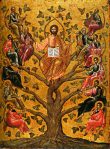
5th Sunday of Easter, Year B | I am the vine, you are the branches

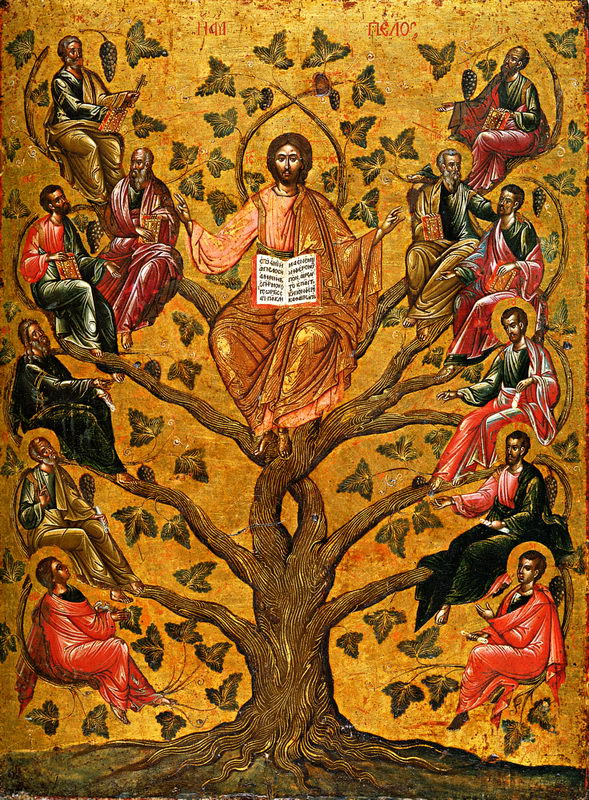
Christ the True Vine, icon, 16th century, Лоза Истинная (Виноградная лоза), Byzantine and Christian Museum, Athens.

Christ the True Vine, icon, 16th century, Лоза Истинная (Виноградная лоза), Byzantine and Christian Museum, Athens.

Today’s Readings:

Word format: Year B Easter 5th Sunday 2015

Pdf format: Year B Easter 5th Sunday 2015

“I am the vine, you are the branches.”  What does this mean for our relationship with Christ, the incarnate God?

Jesus is not simply an inspiring teacher to whom we listen. He is a force in which we participate, a body in which we are cells and molecules, a river in which we swim.  (Fr Robert Barron)

In today’s Gospel, Jesus says

Make your home in me, as I make mine in you.

This means we have to immerse ourselves in his Word, and constantly invite the Holy Spirit to invade our minds with His thoughts.  If we do this, suddenly we find that the whole orientation of our life changes.  We start to desire what God desires as our minds become moulded and grafted onto God’s.  We want to fit in with his Divine Plan, instead of dictating to him what we think his Divine Plan ought to be.

Anyone who does not remain in me
is like a branch that has been thrown away —
he withers; these branches are collected
and thrown on the fire, and they are burnt.

Our culture today would interpret the above words of Jesus as being ‘judgmental’ and not at all ‘inclusive’.   How can God create us, just to throw us away?  God in fact doesn’t want to throw us away.  That is why he is asking us to listen to him, to remain in him, because if we in our arrogance, ignorance or laziness don’t even take time to do those things, we will end up throwing ourselves away.  Everything we do is a choice – closer to him or further away from him.  Here’s Fr Barron again, in a 2009 article titled ‘What the Hell‘:

Now rocks, trees, planets, animals, and stars respond to the divine love just by being what they are. But God made human beings in his own image and likeness, which is to say, he endowed them with mind and will and thereby invited them to respond to his love, not simply by the goodness of their being but by the integrity of their freedom. He wanted them to have the opportunity to participate personally in the love that he is. But this freedom carried with it, necessarily, a shadow, namely, the possibility of abuse. We who have been made in God’s image, can decide not to live in accord with that image; we who have been invited to answer God’s love with our love can answer it instead with resistance. To stand athwart the divine love, to run counter to the image of God within us, to turn away from the sun that shines on us whether we like it or not, is to suffer. It is like a furnace; it is a kind of torture; it is to be in a place of tears and the gnashing of teeth. I’m purposely using imagery for Hell here, because the definitive state of this resistance to God, the final No to God from the depths of one’s being, is precisely what the church means by Hell. And perhaps now we can begin to see why this doctrine hasn’t a thing to do with God “sending” anyone to a terrible place or “condemning” anyone to an eternal prison. As C.S. Lewis put it, “the door to Hell is always locked from the inside,” for it is always our perverse freedom, and not the divine choice, that locks us away from God. Lewis offered another extremely helpful point of clarification when he said that the love of God lights up the fires of Hell. He meant that the suffering of Hell is caused by the very same power that produces the delight of Heaven, namely, the love that God simply is. The difference between Heaven and Hell is a function of our freedom: in the first case, it opens itself to God, and in the second case, it turns away from God. A homey image might help. There are two people at the same party. One is caught up in the joy, rhythm, music, and laughter of the gathering, and he’s having the time of his life; the other, sunk in moody self-regard, resenting the joy of those around him, sulks in irritation, tortured by the very exuberance of the party itself.

Of course, if we follow God only because we are frightened by threats of Hell, our faith is pretty weak.  Why is it that we’re so bad at describing the joy of the abundant living we receive from God?  This is something that Christians need to become better at – and perhaps we should spend more of our time describing the joyful answers to prayer that we receive, the Evangelii Gaudium and the ecstasy of a life of intense prayer.

If you remain in me and my words remain in you,
you may ask what you will and you shall get it.

When a soul aligned with Him in obedience and love asks for a favour, God will satisfy the deepest longings his or her heart.  What are your hearts deepest longings, and do they fit in with God’s Word?


Leave a comment

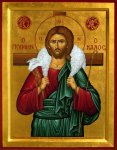
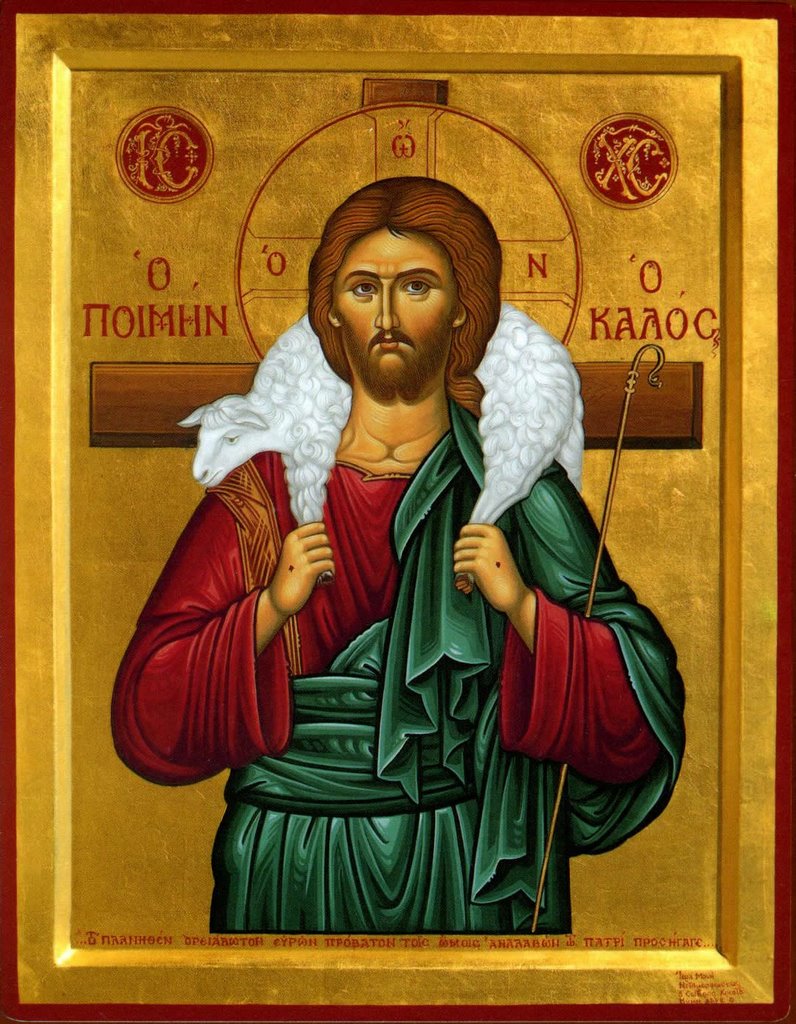
4th Sunday of Easter, Year B | Anzac Day and the Good Shepherd who lays down his life for his sheep

The Good Shepherd, Greek Orthodox Byzantine Icon, egg tempera on wood panel.

The Good Shepherd, Greek Orthodox Byzantine Icon, egg tempera on wood panel.

Today’s Mass readings:

Word format: Year B Easter 4th Sunday 2015

Pdf format: Year B Easter 4th Sunday 2015

This year Anzac Day is celebrated on the same weekend as Good Shepherd Sunday, the 4th Sunday of Easter.  Every year, the crowds attending Anzac Day ceremonies get bigger.   It is as if we humans instinctively understand sacrifice, our hearts know that sacrifice is crucial to salvation and we need to honour those who have made sacrifices in the service of others.  The Christian understanding of redemptive suffering adds value to our interpretation of the Anzac sacrifice.

Dom Carrigan CSSR draws some parallels between Easter and Anzac Day here:

Easter and Anzac Day are inextricably intertwined. Anzac Day always falls in the Easter season. They have marked differences, yet have much in common.

Both deal with suffering, sacrifice and death. At Gallipoli in Turkey, thousands of soldiers on both sides suffered terribly and died for their causes. At Calvary, Jesus, the Word of God- become-man, suffered terribly and died on a cross as a sacrifice for the world.

At Gallipoli, the Australian and New Zealand troops rejoiced that they were going to war. They wanted to test themselves internationally on the battlefield. At Calvary, Jesus prayed in the Garden of Gethsemane that the ‘cup’ of suffering would be taken from him. Yet each faced the future with courage and conviction.

At Gallipoli, there were tens of thousands of soldiers and, in general, a tremendous spirit of mateship. At Calvary, Jesus was deserted by his own disciples (except for a few, mainly women) and felt completely abandoned.

At Gallipoli the soldiers had rifles, bayonets, guns, as well as other instruments of war to wound and to kill. At Calvary, Jesus was defenceless. He had even told Peter to put away his sword (John 18:11).

Gallipoli was a military defeat, yet it was regarded as a victory for the Anzac spirit as well as for the brilliant way Australian Brigadier-General Brudenell White organised the withdrawal of the troops. It was feared in Britain that they would ‘lose 25,000 men and many guns’ in the withdrawal (FitzSimons, Gallipoli p. 616).  In fact, unbelievably, there were no fatalities in the withdrawal.

Calvary was seen as a defeat for Jesus and his followers. Instead it turned out to be the necessary way to his victory. Jesus had said to the two disciples on the road to Emmaus, “Was it not ordained that the Christ should suffer and so enter into his glory?” (Luke 24:26).

This year there will be celebrations greater than ever, both at Gallipoli and around Australia and New Zealand, because of the Anzac centenary. At Easter, millions of Christians will celebrate the triumph of Jesus over sin and evil and death.

In today’s Gospel, Jesus says,

I am the good shepherd:
the good shepherd is one
who lays down his life for his sheep.
The hired man, since he is not the shepherd
and the sheep do not belong to him,
abandons the sheep and runs away
as soon as he sees a wolf coming,
and then the wolf attacks and scatters the sheep;
this is because he is only a hired man
and has no concern for the sheep.

I am the good shepherd;
I know my own and my own know me,
just as the Father knows me and I know the Father;
and I lay down my life for my sheep.

To understand more about the purpose of Jesus’ death and suffering, read on at The Sacred Page, where Dr John Bergsma goes in deep with today’s readings.  In fact it is Yeshua of Nazareth, Jesus the Christ, the ultimate sacrifice, the cornerstone rejected by the builders, who is the key to our salvation.  He knows us personally, and those who are seeking the truth will recognise his voice and he will speak to their hearts.  For some extra thoughts on Jesus knowing and loving you personally in the light of today’s readings, listen here.


1 Comment

3rd Sunday of Easter, Year B | They stood there dumbfounded

The Resurrection, showing Christ raising Adam and Eve, Greek Orthodox Byzantine Icon, egg tempera on wood panel.

The Resurrection, showing Christ raising Adam and Eve, Greek Orthodox Byzantine Icon, egg tempera on wood panel.

Why do people change their minds?  In today’s readings the apostles are dumbfounded to realise that Jesus’ resurrection is right here, right now and not at some vague time ‘at the end of the age’.  Matt Nelson writes about the reasons atheists change their minds about God and and more specifically, about Christ.  An extract from his latest article:

The Word of God is living. It has power beyond human comprehension because it is “God-breathed.” God speaks to man in many ways; but especially through prayer and the reading of the inspired Scriptures. When curiosity (or even interest) of non-believers leads to experimentation with prayer or reading the Bible the results can be shocking, as many converts attest.

One former atheist who was profoundly affected by prayer and the Scriptures is author Devin Rose. On his blog, he describes the role that God’s Word played in his gradual conversion process from atheism to Christianity:

“I began praying, saying, “God, you know I do not believe in you, but I am in trouble and need help. If you are real, help me.” I started reading the Bible to learn about what Christianity said…”

Once Rose began to read the Scriptures and talk to God, even as a skeptic, he found himself overwhelmed by something very real:

“Still, I persevered. I kept reading the Bible, asking my roommate questions about what I was reading, and praying. Then, slowly, and amazingly, my faith grew and it eventually threatened to whelm my many doubts and unbelief.”

And the rest was history for the now rising Catholic apologist and author of The Protestant’s Dilemma.

Similarly, renowned sci-fi author John C. Wright distinctly recalls a prayer he said as an adamant atheist:

“I prayed. ‘Dear God, I know… that you do not exist. Nonetheless, as a scholar, I am forced to entertain the hypothetical possibility that I am mistaken. So just in case I am mistaken, please reveal yourself to me in some fashion that will prove your case. If you do not answer, I can safely assume that either you do not care whether I believe in you, or that you have no power to produce evidence to persuade me…If you do not exist, this prayer is merely words in the air, and I lose nothing but a bit of my dignity. Thanking you in advance for your kind cooperation in this matter, John Wright.’”

Wright soon received the answer (and effect) he did not expect:

“Something from beyond the reach of time and space, more fundamental than reality, reached across the universe and broke into my soul and changed me…I was altered down to the root of my being…It was like falling in love.”

Wright was welcomed into the Catholic Church at Easter in 2008.

Read more here.

Today’s readings:

Word format: Year B Easter 3rd Sunday 2015

Pdf format: Year B Easter 3rd Sunday 2015

And for a scripture study on today’s readings go to Dr Michael Barber’s commentary here.


1 Comment

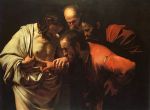
2nd Sunday of Easter, Year B | Does God’s Divine Mercy mean you don’t have to do anything to be saved?

The Incredulity of St Thomas, Caravaggio, (1602), oil on canvas, Sanssouci Palace, Potsdam, Germany.

The Incredulity of St Thomas, Caravaggio, (1602), oil on canvas, Sanssouci Palace, Potsdam, Germany.

This Sunday is the Divine Mercy Sunday, and Pope Francis is about to convoke a Jubilee of Divine Mercy starting on 8th December.  A jubilee year is a time of joy and universal pardon (see Leviticus 25).  Does this mean we are all going to be pardoned without our cooperation?  Let’s remember what St Augustine said:

“He was handed over for our offenses, and He rose again for our justification (19).” What does this mean, “for our justification”? So that He might justify us; so that He might make us just. You will be a work of God, not only because you are a man, but also because you are just. For it is better that you be just than that you be a man. If God made you a man, and you made yourself just, something you were doing would be better than what God did. But God made you without any cooperation on your part. For you did not lend your consent so that god could make you. How could you have consented, when you did not exist? But he who made you without your consent does not justify you without your consent. He made you without your knowledge, but He does not justify you without you willing it.” (Sermon 169, 13, ca. 391-430 A.D.)

To quote Billy Kwan in The Year of Living Dangerously, “What then, must we do?” To understand what you need to do, listen to Fr Barron’s homily here.  It’s not enough just to be ‘a nice person’.  Or as Dietrich Bonhoeffer said,

Cheap grace is the preaching of forgiveness without requiring repentance, baptism without church discipline. Communion without confession. Cheap grace is grace without discipleship, grace without the cross, grace without Jesus Christ. (The Cost of Discipleship)

Today’s readings can be downloaded here:

Word format: Year B Easter 2nd Sunday 2015

Pdf format: Year B Easter 2nd Sunday 2015


Leave a comment

Holy Week: Palm Sunday, Year B | Yeshua, name above all names

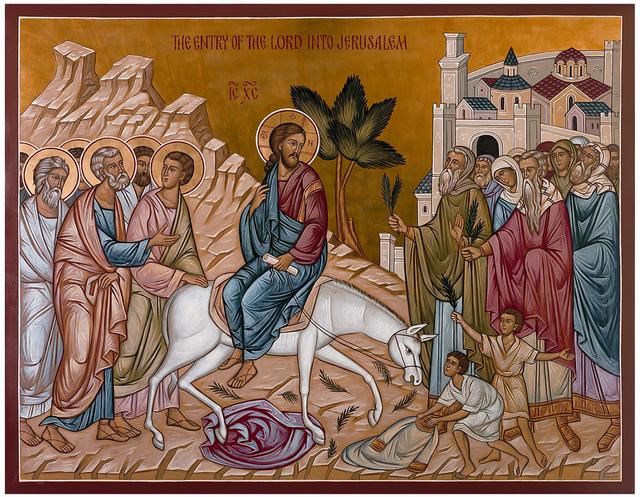
Jesus' Entry into Jerusalem

The Entry of The Lord into Jerusalem

“One day I will do something that will change the system and everyone will then know my name and remember me.”  These are reported to be the words of Andreas Lubitz to his former girlfriend, prior to committing mass murder by deliberately crashing an Airbus A320 into the French Alps this week.  His action is currently being described in the news media as a case of depression.  But depressed people don’t generally commit murder on a grand scale.  On the other hand, people under the influence of Satan do.  Let’s remember who the real enemy is.  And remember that the best way to counter evil is prayer.

Lubitz wanted to elevate his own name.  In contrast, we read in today’s reading from Paul’s letter to the Philippians , how Jesus:

 … humbled himself,
becoming obedient to the point of death,
even death on a cross.
Because of this, God greatly exalted him
and bestowed on him the name
which is above every name,
that at the name of Jesus
every knee should bend,
of those in heaven and on earth and under the earth,
and every tongue confess that
Jesus Christ is Lord,
to the glory of God the Father.

John Bergsma has a beautiful commentary on this reading over at The Sacred Page.

This famous passage—often thought to be a early Christian hymn or creed that St. Paul is quoting—gives an outline of the whole Gospel.  Jesus did not see “equality with God as something to be seized,” using the Greek word harpagmon, from a root harpazo, “to snatch or seize, often quickly or violently.”  Jesus is thus a contrast with the Greco-Roman mythical hero Prometheus, who ascended to the realm of the gods and “snatched” fire, bringing it back to man in an effort to attain equality with the divine.  So Prometheus has always stood as an icon of rebellion against God or the gods, and a worldview that imagines the divine as opposed to or limiting the human.  In this worldview, humanity is liberated and fulfilled at the expense of the divine; the realm of God must be rolled back to make way for the kingdom of man.  This spirit continues to animate the New Atheist movement in our own day (with their flagship publisher, Prometheus Books), which is more a miso-theistic (God-hating) cultural force than an a-theistic (no-God) one.

In contrast to Prometheus, Jesus does not conceive of the relationship between God and man as one of antagonism, in which the divine nature must be violently “snatched” from the Divinity.  Jesus empties himself of the glory of his divinity in order to descend to the status of creature, of “slave.”  Crucifixion was the form of execution mandated for slaves; citizens could not be crucified.  Having taken on human nature, he submits to the death of slaves: “even death on a cross.”  But paradoxically, this great act of self-giving love shows the glory of Jesus and the glory of God.  Truly, a God who would so empty himself out of love is greater, more lovable, more worthy of worship, than a God who will not give of himself. The cross is the glory of our God.  So God the Father bestows on Jesus “the Name which is above every name”, so that at the Name of Jesus, “every knee should bend.”  St. Paul probably has in mind here the ancient ritual of the Day of Atonement (Yom Kippur), on which, according to the Mishnah, the High Priest would exit the Holy of Holies after making atonement for Israel and pronounce the priestly blessing of Numbers 6 upon the gathered worshipers.  This was the one day a year (apparently) when the Divine Name YHWH was pronounced audibly, and each time the assembly heard the name pronounced, they dropped to the ground in prostration.  The name of “Jesus” is now heir to the glory of the divine name YHWH.  In the Name of Jesus we now find salvation.  Thus, in the Catholic tradition we bow the head at the Name of Jesus and celebrate the Feast Day of the Most Holy Name of Jesus (Jan 3), for which our present text is an optional Second Reading.

Unlike the New Atheists, the Jesus and his disciples do not regard the divine-human relationship as one of antagonism where goods are “snatched” from each other, but a relationship of communion, love, and self-gift.  The human is not exalted at the expense of the divine; rather, human and divine are exalted together.  God and man are mutually glorified by loving each other.  Humanity becomes more human by becoming more divine.  Divinization also humanizes.

Today is the beginning of Holy Week, where we follow Jesus from his final entry into Jerusalem to his Resurrection.  This year we have the narration from the Gospel of Mark.  You can download a 12 page Mass booklet for the Palm Sunday Procession and Mass here:

Word format: Year B Palm Passion Sunday

Pdf format: Year B Palm Passion Sunday


Leave a comment

Fifth Sunday of Lent, Year B | Attuning Ourselves to the Divine Will

Adoration of the Trinity (Landauer Altarpiece), Albrecht Dürer, 1511, oil on poplar panel, Kunst-historisches Museum, Vienna.

Adoration of the Trinity (Landauer Altarpiece), Albrecht Dürer, 1511, oil on poplar panel, Kunst-historisches Museum, Vienna.

In one of my posts on Facebook last week, a comment was made that our religion was ‘repressive’ (referring to my support for traditional marriage).  By that, the speaker meant ‘how dare you tell other people how to behave’!  (The people who say these sorts of things are usually, by the way, advocates of free speech.)  Actually, the Church doesn’t tell ‘other people’ how to behave.  It tells its members how to behave, and it is the job of these members (the faithful) to advocate for best practice in the public square, for the good of society.  It is also the job of the faithful to bring up their children to follow the good, the true and the beautiful and to repress (yes, repress – or suppress, if you want to be less Freudian) its baser desires: selfishness, unfaithfulness, dishonesty, disobedience, pride, lust, envy, and so on.

In today’s Readings from Hebrews and the Gospel of John, we see Jesus wrestling with the natural desire not to die (i.e. repressing this desire), versus obedience to the Divine plan:

During his life on earth, Christ offered up prayer and entreaty, aloud and in silent tears, to the one who had the power to save him out of death, and he submitted so humbly that his prayer was heard. Although he was Son, he learnt to obey through suffering; but having been made perfect, he became for all who obey him the source of eternal salvation. (Heb 5:7-9)

and again in today’s Gospel:

‘Now my soul is troubled.
What shall I say:
Father, save me from this hour?
But it was for this very reason
that I have come to this hour.
Father, glorify your name!’ (Jn 12:27-28)

In Jesus of Nazareth, Vol. 2, Pope Benedict discusses the troubled soul of Jesus:

The great Byzantine theologian Maximus the Confessor (d. 662) formulated an answer to this question [on the relationship between Jesus’ humanity and divinity] by struggling to understand Jesus’ prayer on the Mount of Olives. Maximus is first and foremost a determined opponent of monotheletism: Jesus’ human nature is not amputated through union with the Logos; it remains complete. And the will is part of human nature. This irreducible duality of human and divine willing in Jesus must not, however, be understood to imply the schizophrenia of a dual personality. Nature and person must be seen in the mode of existence proper to each. In other words: in Jesus the “natural will” of the human nature is present, but there is only one “personal will”, which draws the “natural will” into itself. And this is possible without annihilating the specifically human element, because the human will, as created by God, is ordered to the divine will. In becoming attuned to the divine will, it experiences its fulfillment, not its annihilation. Maximus says in this regard that the human will, by virtue of creation, tends toward synergy (working together) with the divine will, but that through sin, opposition takes the place of synergy: man, whose will attains fulfillment through becoming attuned to God’s will, now has the sense that his freedom is compromised by God’s will. He regards consenting to God’s will, not as his opportunity to become fully himself, but as a threat to his freedom against which he rebels.

The drama of the Mount of Olives lies in the fact that Jesus draws man’s natural will away from opposition and back toward synergy, and in so doing he restores man’s true greatness. In Jesus’ natural human will, the sum total of human nature’s resistance to God is, as it were, present within Jesus himself. The obstinacy of us all, the whole of our opposition to God is present, and in his struggle, Jesus elevates our recalcitrant nature to become its real self.

The question for each of us is: do we experience God as a threat to our freedom, or do we desire God so much that we happily allow him to use our freedom for his purposes, and in so doing, achieve true self-fulfilment?

Mass readings for today …
Word format: Year B Lent 5th Sunday 2015

Pdf format: Year B Lent 5th Sunday 2015

Other resources:

  1. Listen to Fr Barron’s homily for today.
  2. Scripture study for this weekend.


Leave a comment

4th Sunday of Lent | Why do so many prefer darkness to light?

The Crucifixion, Isenheim Altarpiece, centre panel, Matthias Grünewald, 1512-1516, chapel of the Hospital of Saint Anthony, Isenheim, Germany, c. 1510-15, oil on wood, 9' 9 1/2" x 10' 9" Unterlinden Museum, Colmar, France.

The Crucifixion, Isenheim Altarpiece, centre panel, Matthias Grünewald, 1512-1516, chapel of the Hospital of Saint Anthony, Isenheim, Germany, c. 1510-15, oil on wood, 9′ 9 1/2″ x 10′ 9″ Unterlinden Museum, Colmar, France.

This week we saw the tragic death of 18 year old Australian suicide bomber, Jake Bilardi.  In a blog post from January 13, Bilardi says, “And that is where I sit today, waiting for my turn to stand before Allah (azza wa’jal) and dreaming of sitting amongst the best of His creation in His Jannah, the width of which is greater than the width of the heavens and the Earth.’’

How sad that in his search for God, he found the wrong one.  Carolyn Moynahan, in her article, Why do kids desert the West to fight with Isis, written well before Jake’s death, hits the nail on the head in her analysis.  And as Greg Sheridan says in his article in The Australian, “how long can the West live off the moral capital of religious conviction that it is now abandoning? The West is the only part of humanity abandoning religious belief. Can societies in which there is no overarching idea beyond the individual compete successfully in the long run?”

In our readings today, John invites us to turn to the right God while there is still time:

For God sent his Son into the world not to condemn the world,
but so that through him the world might be saved.
No one who believes in him will be condemned;
but whoever refuses to believe is condemned already

Of course, Westerners are likely to balk at the word ‘condemned’.  But of course it’s not God who condemns you, it’s your refusal to seek him that does.

Download today’s readings here:

Word format: Year B Lent 4th Sunday 2015

Pdf format: Year B Lent 4th Sunday 2015

To understand  how God can be both merciful and yet allow people to be condemned, read the homily from Sacerdos.  And listen to Fr Barron explain God’s tender mercy here.

Click-here-to-listen


Leave a comment

3rd Sunday of Lent, Year B | Jesus, the Embodiment of the Law

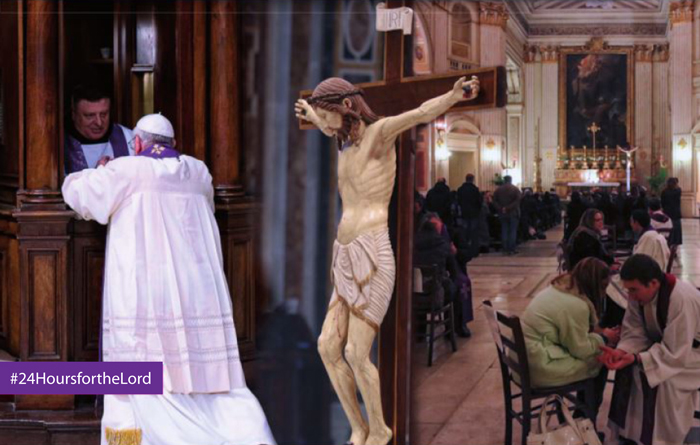
Pope Francis, Penance and Reconciliation during 24 Hours for the Lord

Pope Francis, Penance / Reconciliation during 24 Hours for the Lord

Are The Ten Commandments still relevant for us?  I have friends who claim the Bible is nothing special – just a man-made unenlightened compilation of Bronze Age writings, and certainly not inspired by the Holy Spirit.  If that were the case, Jesus would not fulfil so many prophecies from the Old Testament.  In today’s Gospel, for example, we see Jesus fulfilling prophecies from Isaiah 56:6-7, Jeremiah 7:1-11 and Malachi 3:1-3, to name only a few.

Mass Readings Word format: Year B Lent 3rd Sunday 2015

Mass Readings Pdf format: Year B Lent 3rd Sunday 2015

John Bergsma gives a great analysis of the readings here.

I have to conclude that my friends who denigrate the Bible are too used to thinking of themselves as ‘good people’ and find it too confronting to consider themselves as sinners, so they are compelled to ‘shoot the messenger’.  Getting down to practicalities, Pope Francis has called all Christians to make 13th and 14th March “24 Hours for the Lord”.  He wants us to go to Adoration, examine our consciences (take some time about this – perhaps spend an hour in Adoration asking the Lord to reveal your sins to you) and receive the sacrament of penance / reconciliation / confession during this time.  To prepare for this, why not listen to Fr Barron’s homily on the Ten Commandments here:

Click-here-to-listen


and do a thorough examination of conscience.  You can download these as a guide:

Word format: Confession and Examination of Conscience

Pdf format: Confession and Examination of Conscience

By the way, these lists of sins are not exhaustive – they are just meant as a guide.  If you take time to examine yourself and listen to the Holy Spirit, you’ll find many imperfections that aren’t even on the list.

For those of you in the Perth Northern Suburbs, you can attend 24 hours for the Lord events here:

  • Joondalup Holy Spirit Chapel: Adoration and Confession from 00h00 (midnight) Friday until midnight Saturday.  Mass: 12:10 Friday.   Please put your name on the adoration roster in the front porch.
  • Our Lady of the Mission, Whitfords: Exposition of the Blessed Sacrament: Friday 09.30 a.m. to 7.00 p.m., Mass Friday 9 a.m, Saturday 08.30.  Confession: Saturday 12.00 to 13:00and 17:30 – 18:00.
  • St Simon Peter, Ocean Reef: Blessed Sacrament Adoration Friday 9:00 to 18:50.  Mass: Friday 19:00, Saturday 8:30, Reconciliation: Friday 18:30-18:50, Saturday 17:00-17:45.
  • St Andrew’s, Clarkson: Mass: Friday and Saturday 08:00, Reconciliation: Saturday 17:00 to 17:30, Exposition of the Blessed Sacrament and Benediction: Friday 15:00 to 17:00.

Wishing you joy and grace this Lent!