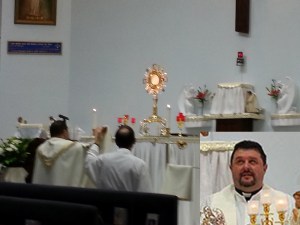
Have you ever had the experience of God sending you to exactly the right person at exactly the right time? Fr Bogoni was someone God placed in my life in answer to prayer. Living in the far Northern suburbs of Perth, I never had much occasion to attend All Saints Chapel in Allendale Square, and so I had never met this remarkable priest.
But in September of 2013, my husband, Bill, was diagnosed with only six months to live because of secondary lung cancer. My most distressing thought was not that he was going to die (though that was distressing enough), but that he was to all appearances going to die without the benefit of the sacraments. I was overcome by the thought that if Bill died without seeking the mercy of God through the Sacrament of Penance, and then receiving the Bread of Life through Holy Communion, he might not make it to heaven (no matter how good, kind and generous he had been in life). Yes, I know – everyone thinks I make God sound so unkind if I suggest that a person might forfeit heaven by not aligning himself with Christ. But I think eternal separation from God is a very real risk, and that is why Jesus warns about hell so many times.
It happened that the previous eighteen months had been such an unfortunate series of events that I was beginning to wonder if we were under some sort of curse:
my daughter rolled her car – she survived but the car was a write-off
Bill was diagnosed with oesophageal cancer
someone collided with Bill’s car while it was innocently parked outside our house
my daughter had appendicitis with major complications
Bill developed thrombocytopenia after his operation (unrelated to the cancer) and required a splenectomy
Bill was then hospitalised with a bowel blockage (unrelated to the cancer and the thrombocytopenia)
Bill developed gastric dumping syndrome so that he was continually exhausted
Bill’s fishing friend drowned right next to him while they were diving at their cray pots
my daughter rolled the car that had replaced the first car – another write-off
Bill was diagnosed with secondary lung cancer
Little wonder, then, that after reading An Exorcist tells his Story by Fr Gabriele Amorth, I started wondering if we needed an exorcist and not just a healer. So I phoned up the Perth Archdiocese and asked if we had one. The dear lady at the office said, her voice dropping to a hushed whisper, that there was someone who normally dealt with ‘those sort of things’ and gave me the contact details for Fr Tiziano Bogoni. So I wrote him a long letter and asked him if he had any thoughts on our series of unfortunate events.
I didn’t hear from him for several days, and thought that he had probably decided I was a nutter. But then I received a text: “Ave Maria. Deirdre my apologies I forgot to say Fr Bogoni asked me to give you his mobile no in case you need to contact him while he’s away until 30th Nov. Many thanks and God bless, Margaret, All Saints Chapel.”
Thus began a period when Fr Bogoni became my spiritual director and helped me navigate Bill through his last months. And what a beautiful and unexpected chapel it was, hidden away among offices and corporate suites, with prominent place being given to Adoration of the Blessed Sacrament throughout office hours, Holy Mass and Rosary twice a day as well as daily Divine Mercy devotions, and the cheerful statues of saints surrounding us with their comforting protection on all sides.
I told him how Bill found Catholicism really difficult as a result of his experience of physical abuse at the Catholic school of his youth. I explained that it was impossible except by the grace of God to get Bill to want to come back to Mass or spend time examining his conscience. He said, “See if you can get him to come and talk to me. I will give him a Life Confession. That’s a confession for those who have been away from the Church for decades and find normal Confession too much of a challenge. I’ll read out a list of sins, and all he has to do is say ‘yes’ or ‘no’. Keep it simple.”
And of course, he gave me a strict schedule of prayer as well as a recommended course of reading.
It was something of a miracle that Bill eventually agreed to go (I asked for it as my Christmas present). And after this he started attending Mass with us and receiving the Holy Eucharist. Not only did Father Bogoni hear Bill’s confession, but he also drove all the way to Two Rocks, despite his crowded schedule, to give Bill the Last Rites and bless our house. (And, by the way, he said there was no evidence whatsoever of demonic activity.) I can only assume all the difficulties we had experienced were God’s way of driving us in the direction of someone who would help Bill end his life in a right relationship with God.
Fr Bogoni died last week, suddenly at the age of 51, with a Rosary in his hand. How fitting that God should choose to take him suddenly, just like the way he would burst in suddenly through the chapel door as he went about his busy pastoral duties, in those sandals that flap-flapped across the floor. And how fitting that God should take him home on the feast of Divine Mercy. I was going to say, ‘his work done’, but no, I can see him being even more busy in Heaven, still interceding for those souls he helped so much on earth.
So thank you, Fr Bogoni. Thank you for seeing what needed to be done, and doing it. May God give you a great reward, good and faithful servant! And please say hello to Bill while you’re there!
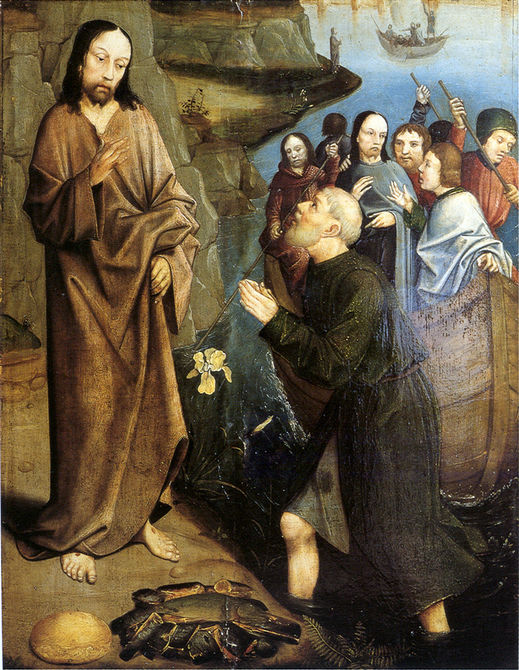
The Third Appearance of Christ, Dieric Bouts, 1415-1475, private collection.
I love this first reading we have today from Acts, chapter 5. The high priest says, “We gave you a formal warning not to preach in this name and what have you done? You have filled Jerusalem with your teaching!” How it reminds me of today, when so many people want to silence the Word of God. As Greg Sheridan says in The Australian, there is a real danger that in the near future “our often counter-productive human rights bureaucracies will deem it an offence for people to propound traditional Christian teaching.” Similarly, articles by Angela Shanahan and Caroline Overington have shown how universities are now discriminating against faith-based groups on the basis of inclusivity. Ironic, isn’t it?
And in reply, Peter and the apostles say, “Obedience to God comes before obedience to men.” In a nutshell, that’s what Jesus wants when he is asked, “What shall I do to inherit eternal life?” And he answers, “You shall love the Lord your God with all your heart and with all your soul and with all your strength and with all your mind, and your neighbour as yourself” (Luke: 10:25-27).
In the tradition of filling the world with Christ’s teaching, Pope Francis, the Shepherd of the Church, has released his new exhortation, Amoris Laetitia – “The Joy of Love”, which is about the joy to be found in authentic families joined by love. Do yourself a favour and ignore the newspaper headlines which want to put their own spin on this document, and read the original here.
The Incredulity of St Thomas, Caravaggio, (1602), oil on canvas, Sanssouci Palace, Potsdam, Germany.
If there really is a God in charge of the Universe, and a personal God at that, he would want to let us know, right? Well, it turns out that he has, but you have to have a humble heart that is open to persuasion in order to be convinced. There is a fascinating series of coincidences of dates associated with The Apparitions at Fatima, the Divine Mercy devotions, Pope St John Paul II and now most recently, the death of Mother Angelica. God gives us these clues because he knows how much we tend to be like Doubting Thomas in the gospel reading for today …
13th May and other thirteens
I’ll start with 13th May 1917, when the Virgin Mary appeared to Lucia, Jacinta and Francisco, three peasant children from Fatima in Portugal. There were a total of six apparitions, one on the 13th of each month from May to October that year. (The August apparition was on 15 August, the Feast of the Assumption of Mary.) About 70,000 people were present for the final apparition, and many supernatural phenomena, including the Miracle of the Sun, were observed. But the point of the appearance of the Virgin Mary was to encourage penance and prayer, especially the rosary, a meditation on events in the lives of Jesus and Mary.
13th May 1917 also just happened to be the date when Pope Pius XII, then Eugenio Pacelli, received his episcopal ordination. It was he who subsequently formally defined the ancient belief in the Virgin Mary’s Assumption, and he himself confirmed that he had witnessed the Miracle of the Sun several times in 1950, the year he proclaimed this dogma.
Meanwhile, in Poland …
Meanwhile in Poland, Sr Faustina (1905-1938), a Christian mystic, began to experience apparitions of Christ. She recorded her conversations with him in diaries over several years. It was February 1931 when he first appeared to her as King of Divine Mercy. Over the course of the apparitions, he asked her to have a painting made showing him with red and white rays emanating from his heart and instructed her to promote prayer through the Divine Mercy Chaplet, whose purposes were threefold: to obtain mercy, to trust in Christ’s mercy and to show mercy to others. Sr Faustina died of suspected tuberculosis at the age of 33, one year before Hitler invaded Poland, and for some time the Divine Mercy Devotions were destined to remain mostly hidden from the wider world.
Fast forwarding to World War 2, Karol Wojtyla, the future Polish Pope John Paul II, was told about the Divine Mercy Devotions by a classmate in the seminary he attended secretly in Krakow (the Communist government had attempted to eradicate religion from society) . He began to visit the grave of Sr. Faustina at the Convent of the Sisters of Our Lady of Mercy on his way home from night shift at the Solvay Chemical Plant.
There’s a long and fascinating story of how devotion to the Divine Mercy was banned and went underground for several decades, but to cut to the chase, Karol Wojtyla involved himself in collecting information about Sr Faustina’s life and in removing the prohibition that had been placed on her diaries. Six months after he had achieved this, he was elected Pope. The message of Divine Mercy was still close to his heart, and his second encyclical, Dives in Misericordia (Rich in Mercy), published in November 1980, was a reflection on God’s superabundant mercy and a plea for Christians to implore God’s mercy on the sinfulness of mankind.
Only six months later, on 13th May 1981, an assassination attempt was made on Pope John Paul II. He survived four shots from a 9 mm Browning fired at him by the Turk, Mehmet Ali Agca. Multiple perforations of his colon and small intestine caused him to lose three quarters of his blood before he was stabilized after five hours of surgery. But by October of that year he was back at work. In his audience address of 7 October 1981 (The Feast of the Holy Rosary) he said:
Today it has been granted me, after a long interruption, to resume the general audiences which have become one of the fundamental forms of pastoral service of the Bishop of Rome.
The last time, the pilgrims who came to Rome gathered for such an audience on 13 May. However, it could not take place. Everyone knows why …
Today, after an interval of five months, beginning this meeting so dear to me and to you, I cannot help referring to the day of 13 May.
… Could I forget that the event in St Peter’s Square took place on the day and at the hour when the first appearance of the Mother of Christ to the poor little peasants has been remembered for over sixty years at Fatima in Portugal? For, in everything that happened to me on that very day, I felt that extraordinary motherly protection and care, which turned out to be stronger than the deadly bullet.
Today is the memorial of Our Lady of the Holy Rosary. The whole month of October is the Month of the Rosary. Now that nearly five months later it has been granted me to meet you again at the Wednesday audience, dear brothers and sisters, I want these first words that I address to you to be words of gratitude, love and deep trust, just as the Holy Rosary is and always remains a prayer of gratitude, love and trustful request: the prayer of the Mother of the Church.
But even while Pope John Paul II was recovering from this attack, another milestone was unfolding in the history of the Church.
Broadcasting to the World
August 15th 1981 (yes, the Feast of the Assumption, again!) heralded the first broadcast from the Eternal Word Catholic Television Network (EWTN), an initiative of Mother Mary Angelica of the Annunciation, a Franciscan nun. Mother Angelica, who died last week on Easter Sunday, was known for the great suffering she endured throughout her life, her radical trust in Jesus, her no-nonsense style and her orthodoxy. Born Rita Rizzo, she was the only child of Italian-American immigrants who divorced when she was six years old; her father had abandoned the family when she was very young, and her mother struggled with chronic depression. She remembered her childhood as a constant battle to keep food on the table. But instead of thinking God had abandoned her, she developed an intense prayer life and her love of Jesus bore fruit in many miracles, which are amply described in Raymond Arroyo’s biography. EWTN has now grown to be the largest global religious media network, with a viewership of 250 million homes, not including those who watch it streamed online. You could say that God used EWTN to promote devotion to both the Divine Mercy Chaplet and the Holy Rosary – these are on its schedule every day of the week.
Not only that, but God organised things so that EWTN took off in the midst of the period when the Holy Father was undergoing a recovery from an attempted assassination. One could almost say that the Holy Father was required to undergo a great suffering himself in order for fruit to come forth elsewhere in the church. In similar fashion, according to Michael Warsaw, the CEO of EWTN, the network’s reach exploded most markedly in the 14 years since Mother Angelica suffered a debilitating stroke on Christmas Eve 2001. She had spoken many times of the redemptive power of uniting one’s sufferings to the Lord and had written a book on the subject, The Healing Power of Suffering (1977).
So how else did God orchestrate a new focus on his Divine Mercy? In April 2000, Sr Faustina became the first saint of the new millennium, when Pope John Paul II officially designated the 2nd Sunday of Easter as Divine Mercy Sunday and canonized her on that day. A year later, the Pope was diagnosed with Parkinson’s disease, and now began his time of deteriorating health and preparation to meet the Lord. He had achieved so much during his period as Pope: one of the chief forces behind the downfall of Communism in Eastern Europe, inspirational on the Theology of the Body, and tenacious in defending both faith and reason and bringing unity in the Church. His funeral was reportedly the single largest gathering of Heads of State in history with more than four million mourners gathered in Vatican City. So what time did God choose for his death? It was just after the Mass of the Vigil of the 2nd Sunday of Easter or Divine Mercy Sunday for 2005 had been celebrated in his room.
Only two months previously, the last of the Fatima visionaries was taken to heaven. Sr Lucia was 97 years old and yes, the date was another of the series of thirteens connected with the Fatima apparitions: 13th February2005.
And what of Mother Angelica, the woman who brought Catholic teaching to the world through her television network? How wonderful that God chose the day of her death as Easter Sunday, the most important day of the year for Christians.
Mother began to cry out early in the morning from the pain that she was having. She had a fracture in her bones because of the length of time she had been bedridden. They said you could hear it down the hallways, that she was crying out on Good Friday from what she was going through. These two people said to me she has excruciating pain. Well, do you know where that word ‘excruciating’ comes from? ‘Ex’, from, ‘cruce’, from the cross. Excruciating pain. After the 3 o’clock hour arrived on Good Friday she was more calm, she was more peaceful.
On Easter Sunday, Fr Wolfe was called again to her bedside.
I anointed her, did the litany for the dying, gave her the apostolic pardon that the church grants to someone who is dying, and the sisters prayed their divine office around her bed – the morning prayers.
At 10:30 Father Paschal offered Mass in her room and she received the precious blood, Viaticum, the food for her journey. The precious blood by which we have been saved. All of us have been saved by the precious blood of Jesus…., a drop or two of the precious blood, into her mouth.
It was in the afternoon that Father Miguel and I went to her bed at the hour of mercy, at 3 o’clock. We had just finished praying the divine mercy chaplet. We all continued to pray silently around her bed. Then it was shortly before 5 p.m. that she went to the Father’s house. She breathed her last.
Not only was it Easter Sunday, but as Fr Mitch Pacwa reported, it was also the Feast of the Annunciation in the Maronite Rite, and Mother Angelica had taken as her title, the name, Mother Mary Angelica of the Annunciation. And then, look at the year which God chose for her to die: she could have had another stroke at any old time in the last fourteen years, but she died in the year which Pope Francis has proclaimed as the Jubilee Year of Mercy, a time for all of us to say to him, “Jesus, I trust in you”. And, by the way, Pope Francis was ordained on 13 December 1969 and became Pope on 13 March 2013 and announced the Jubilee Year of Mercy on 13 March 2015.
I like to think of God as the creator of a glorious symphony, bringing in one part here, while another fades into the background after performing its virtuoso piece, making different voices interweave and coalesce into the climax of a harmonious chorus, while the instrumental section repeats an ostinato pattern underneath. In this last century we have seen the Holy Rosary, Divine Mercy, the Assumption and all those fabulous thirteens appear and reappear as motifs for our enjoyment and encouragement as we participate in the great symphony of the life of the Church.
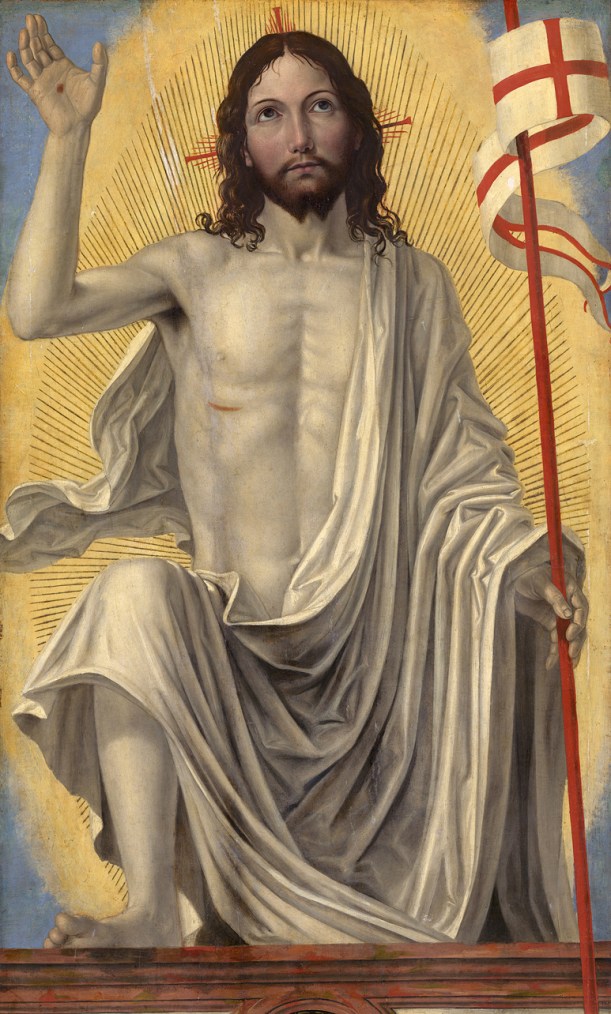
Christ Risen from the Tomb, Ambrogio Bergognone (c. 1470-1523), Samual H. Kress Collection, National Gallery of Art, Washington
A very Happy Easter to you all! Two messages today:
First Mark Shea: “The Resurrection did not happen in cloud-cuckoo land, Olympus, Shangrila or Once Upon a Time. It happened in a particular place locatable by GPS, on a particular morning during the rule of a minor Roman procurator named Pontius Pilate. A real physical body that had been buried on Friday evening was no longer there on Sunday morning because something beyond human language happened and it stopped being an it and resumed being He. The disciples who witnessed the Risen Christ struggle to describe the experience in human language and are ultimately stymied by the attempt. He is real, can be touched, can eat food, and is heard not “in the heart” but with the physical ear. He is not a ghost, yet can appear and disappear at will. He is capable of tearing a piece of bread it two, but also of vanishing from sight. Nor is he a hallucination since a) you don’t hallucinate someone you desperate want to see and then not recognize him on three occasions; b) nobody thought he was going to rise from the dead; and c) mass hallucinations don’t happen and are only invoked as a last ditch effort to explain away the Resurrection. Occam’s Razor says “The Resurrection actually happened and the Christian explanation is the actual one. Not that Christians understand it any more than anybody else. It’s just that they’ve abandoned all the other explanations as super lame.”
The resurrection of Jesus from the dead is the be-all and the end-all of the Christian faith. If Jesus didn’t rise from the dead, all bishops, priests, and Christian ministers should go home and get honest jobs, and all the Christian faithful should leave their churches immediately. As Paul himself put it: “If Jesus is not raised from the dead, our preaching is in vain and we are the most pitiable of men.” It’s no good, of course, trying to explain the resurrection away or rationalize it as a myth, a symbol, or an inner subjective experience. None of that does justice to the novelty and sheer strangeness of the Biblical message. It comes down finally to this: if Jesus was not raised from death, Christianity is a fraud and a joke; if he did rise from death, then Christianity is the fullness of God’s revelation, and Jesus must be the absolute center of our lives. There is no third option.
I want to explore, very briefly, a handful of lessons that follow from the disquieting fact of the Resurrection. First, this world is not it. What I mean is that this world is not all that there is. We live our lives with the reasonable assumption that the natural world as we’ve come to know it through the sciences and discern it through common sense is the final framework of our lives and activities. Everything (quite literally, everything) takes place within the theater of our ordinary experience. And one of the most powerful and frightening features of the common-sense world is death. Every living thing dies and stays dead. Indeed, everything in the universe, scientists tell us, comes into being and then fades away permanently.
But what if this is not in fact the case? What if the laws of nature are not as iron-clad as we thought? What if death and dissolution did not have the final say? What if, through God’s power and according to his providence, a “new heavens and a new earth” were being born? The resurrection of Jesus from the dead shows as definitively as possible that God is up to something greater than we had imagined or thought possible. And therefore we don’t have to live as though death were our master and as though nihilism were the only coherent point of view. After he had encountered the risen Christ, Paul could even taunt death: “Where is your sting?” In light of the resurrection, we can, in fact, begin to see this world as a place of gestation, growth and maturation toward something higher, more permanent, more splendid.
Here’s a second lesson derived from the resurrection: the tyrants know that their time is up. Remember that the cross was Rome’s way of asserting its authority. Roman authorities declared that if you run afoul of our system, we will torture you to death in the most excruciating (ex cruce, from the cross) way possible and then we will leave your body to waste away be devoured by the beasts of the field. The threat of violence is how tyrants up and down the centuries have always asserted their authority. Might makes right. The crucified Jesus appeared to anyone who was witnessing the awful events on Calvary to be one more affirmation of this principle: Caesar always wins in the end. But when Jesus was raised from the dead through the power of the Holy Spirit, the first Christians knew that Caesar’s days were numbered. Jesus had taken the worst that the world could throw at him and he returned, alive and triumphant. They knew that the Lord of the world was no longer Caesar, but rather someone whom Caesar had killed but whom God had raised from death. This is why the risen Christ has been the inspiration for resistance movements up and down the centuries. In our own time we saw how deftly John Paul II wielded the power of the cross in Communist Poland. Though he had no nuclear weapons or tanks or mighty armies, John Paul had the power of the resurrection, and that proved strong enough to bring down one of the most imposing empires in the history of the world. Once again, the faculty lounge interpretation of resurrection as a subjective event or a mere symbol is exactly what the tyrants of the world want, for it poses no real threat to them.
The third great lesson of the resurrection is that the path of salvation has been opened to everyone. Paul told us that “though he was in the form of God, Jesus did not deem equality with God something to be grasped. Rather he emptied himself and took the form of slave…accepting even death, death on a cross.” In a word, Jesus went all the way down, journeying into pain, despair, alienation, even godforsakenness. He went as far as you can go away from the Father. Why? In order to reach all of those who had wandered from God. Then, in light of the resurrection, the first Christians came to know that, even as we run as fast as we can away from the Father, all the way to godforsakenness, we are running into the arms of the Son. The opening up of the divine life allows everyone free access to the divine mercy. And this is why the Lord himself could say, “When the Son of Man is lifted up, he will draw all people to himself,” and why Paul could assert in 1 Corinthians, “When everything is subjected to him, then the Son himself will also be subjected to the one who subjected everything to him, so that God may be all in all.” The resurrection shows that Christ can gather back to the Father everyone whom he has embraced through his suffering love.
So on Easter Sunday, let us not domesticate the still stunning and disturbing message of resurrection. Rather, let us allow it to unnerve us, change us, set us on fire.
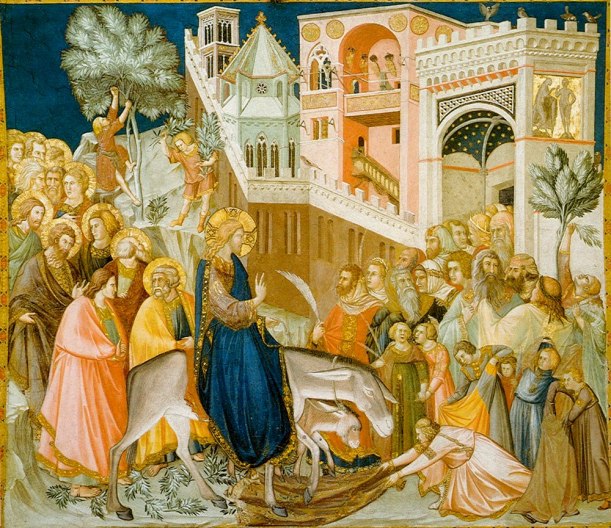
Entry into Jerusalem, Pietro Lorenzetti, 1320, Southern Transept of Lower Basilica of San Francesco, Assisi, Italy.
This Sunday our readings swing from the cheering crowds waving palm branches as Jesus enters Jerusalem to the angry mob shouting “Crucify him!” We can learn a lot about how to cope with life’s ups and downs from seeing how Jesus behaves throughout the Passion Narrative. What does God want from us? Only to be faithful to him, to cooperate with him. When we do that, God can use us in amazing ways and change our lives from dreary to hope-filled!
Bishop Robert Barron shares some thoughts for this Sunday on the opening Gospel in today’s Liturgy in his talk, The Master has need of you.
For more on today’s readings watch here:
Don’t forget to watch Part 2 as well (available on Youtube), and for some extra reflections for Holy Week, try John Bergsma’s Jesus Cheered, Then Killed.
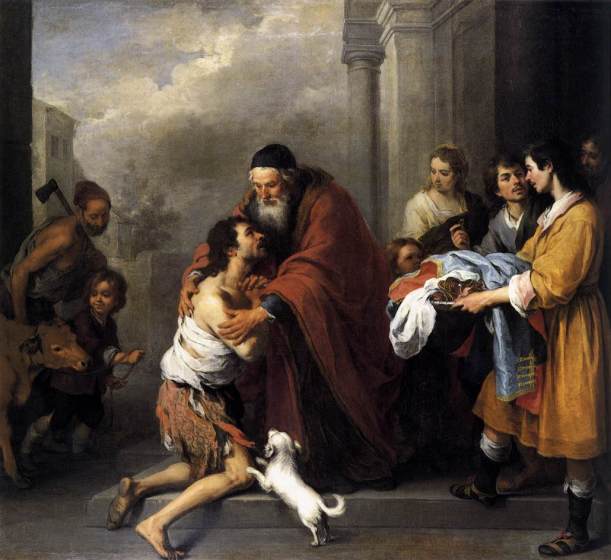
The Return of the Prodigal Son, 1667-1670, Bartolomé Esteban Murillo, oil on canvas, National Gallery of Art, Washington.
Thoughts of my dear mother, who passed away during the week, are filling my mind as I reflect on this Sunday’s readings. And the readings are particularly fitting, for they give us an inkling of what Heaven is like for those who seek the mercy of God.
The first reading tracks the Israelites, finally entering the Promised Land. They have been a stubborn lot, and it’s taken them years in the wilderness to get there. Not so different from our life journeys, maybe. As John Bergsma says, “the land of Canaan is a symbol and type of heaven, the new life in God’s presence.”
The manna in the wilderness is a type of the Eucharist, the bread from heaven which sustains us through our journey in the “desert” of this present life. Yet the Eucharist will not remain forever; when we enter into God’s presence in the life to come, the Eucharist will pass away as we feed on the direct vision of God. So, in today’s Reading, we see that the manna ceases when the people enter into the promised inheritance and begin to eat the fruit of the land itself. The sacrament passes away as the direct reality is experienced. It will be “a whole new world.”
The Gospel reading, the Parable of the Prodigal Son, shows us how much we will need to change our mindset to be fit for heaven – hence Purgatory, that final bit of ‘burning away the straw’ (1 Cor. 3:15) before joining the happy company of angels and saints. John Bergsma again:
On another level, this Parable shows us two ways of living: the “new world” or “new creation” of the Father (into which the younger son enters), and the “old world”/”old creation” of the older son.
The older son operates by a “tit for tat” or “quid pro quo” mentality, focused on earned material reward for one’s own self-centered enjoyment. He serves his Father because he expects to benefit from the service one day. He is not animated by love, either for his Father or for his brother. When the younger son returns, he is not “my brother,” but “this son of yours!”
The Father, on the other hand, operates in a whole new world. There is not some ledger book for accounting past rights and wrongs, so that each son gets exactly the punishment or reward that pertains precisely to his performance. The Father’s attitude is marked by love, by free sharing, and a desire for familial communion. The younger son insults him by demanding his inheritance while the Father is still alive, which is as much as saying, “To me, you are as good as dead.” He shames the family name by living a profligate lifestyle and ultimately descending into poverty and degradation, working for Gentiles (Jews did not raise pigs) feeding unclean animals (pigs.). All this is overlooked out of love, and the Father runs to meet the son (a breach of social custom) and hardly lets him recite his pre-planned speech before ordering the preparations of a feast.
The Father shows love to the older son, too, coming out of the feast to “plead” with him to come in and share the joy. He also does not withhold generosity from him: “son, all that I have is yours.” He does not make some mental or material division between his goods and those of his sons. They are family. They share a common home.
Living in the “new creation” of Christ means operating by the Father’s “logic” of love, forgiveness, and familial communion, both in our relationship to God and our relationships with others, both with those who seek reconciliation with us (the younger son) and with those who do not want reconciliation (the older son).
As long as we operate by a “quid pro quo” logic with God and with others, we are living in the old world. Because he wants us to live in the new world, Jesus commands us to pray daily, “forgive us our debts, as we ourselves have forgiven all our debtors.” Freely accepting forgiveness from God, and freely dispensing forgiveness to all around, is the lifestyle of the new creation.
How wonderful it will be to be part of God’s heavenly family. And that we can already start living in it now by giving and receiving forgiveness.
How beautiful it was to be able to pray the Divine Mercy prayer together with my mother before she died – and that she died in the Year of Mercy. How beautiful it was that my mother, though she was suffering, waited for me to arrive from Australia and spend time with her before she went to join the Lord. How beautiful it has been to experience so much kindness from our friends and relations during the last few days. How beautiful it was to hear the Nazareth House nurses singing to us on the night my mother died. How beautiful it has been to think about the joy we children shared through our childhood as a result of our dear mother’s faith. That’s a foretaste of heaven.
The Vine Dresser and the Fig Tree, James Tissot (1836-1902), The Brooklyn Museum, New York.
We have three very interesting readings today which deal with different aspects of God.
The first reading shows us God’s revelation of himself to the Jews as a God who is utterly different from the pagan idea of God (or, for that matter, the Buddhist or Hindu idea of God). Bishop Barron explains this eloquently in his commentary on Why the Burning Bush is Such Good News.
The Gospel reading presents one of the ‘hard sayings’ of Jesus and discusses the question of whether the evils that befall men are punishments for sin. Jesus is telling us that we all need a metanoia (change of heart) as – get this –none of us is worthy to stand in the presence of God. Brant Pitre discusses this here:
And the second reading continues the theme of non-complacency: “the man who thinks he is safe must be careful that he does not fall.” How different from our usual thinking: “I’m all right, you’re all right.” If only we had a greater consciousness of the absolute goodness, otherness and power of God, we would have more holy fear or fear of the Lord, something that is regarded by many as weakness, when it is actually wisdom. My old school motto (St Cyprian’s, Cape Town) was Sapientiae Timor Domini Initium or The Fear of the Lord is the Beginning of Wisdom. Who are we to tell God that he has no right to judge us?
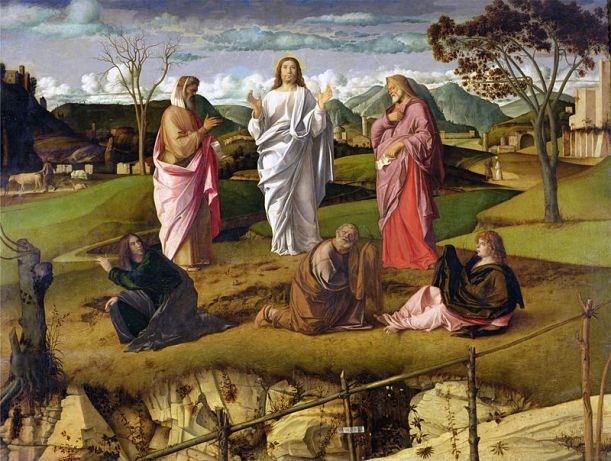
The Transfiguration, Giovanni Bellini, c.1480, Oil on panel, Museo di Capodimonti, Naples.
Do you know anyone who is depressed or without hope? We all experience hard times – disappointment in others, the death of a loved one, failure in our career, a difficult childhood – but God can help us to be resilient through these times and see past them. In today’s Gospel, we see how those disciples who are closest to the Lord experience a foretaste of the glory of Heaven. They don’t fully understand the event they have just witnessed until after Jesus’ death and resurrection, but by witnessing Jesus’ glory, they are strengthened for the hard times ahead. If I have one piece of advice for those who struggle with depression, I would say, “Get close to the Lord.” Read the Gospels, talk to God as if he is present with you every moment – and He will strengthen you for your journey, often in unpredictable ways – and quite possibly remove those trials which are too great for you to bear. Just ask him!
If you’re looking for an uplifting commentary on our mystical consciousness and how we are helped by having a sense of God’s purpose for our lives, listen to Bishop Robert Barron’s homily for today on The Glorified Body.
If you’re more interested in a Bible Study perspective on these readings, try these:
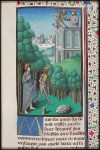
Two of the Temptations of Jesus in the Desert by Satan and Jesus served by the Angels, Maitre François, 1475, miniature, from St Augustine’s “La Cité de Dieu”; manuscript MMW 10 A 11; Koninklijke Bibliotheek, The Hague.
The First Sunday of Lent focuses us on one of the key features of our Lenten journey: finding self-knowledge and working out how to make God the centre of your life. Try these:
Bible Scholar, Dr Brant Pitre, on the readings for the First Sunday of Lent.
In other news, on Friday, 12 February, Pope Francis and Patriarch Kirill of Russia met in Cuba. This is the first time the head of the Catholic Church has met the head of the Russian Orthodox Church since the Great Schism of 1054! Pope Francis and Patriarch Kirill have issued a Joint Declaration. Read and observe how the Holy Spirit is working in the Church today.

 Have you ever had the experience of God sending you to exactly the right person at exactly the right time? Fr Bogoni was someone God placed in my life in answer to prayer. Living in the far Northern suburbs of Perth, I never had much occasion to attend All Saints Chapel in Allendale Square, and so I had never met this remarkable priest.





 Catholic in Yanchep