Catholic in Yanchep

Go out into the deep.


1 Comment

Cardinal Arthur Roche, Pope Francis and the drive to delegitimise the Traditional Latin Mass

In this document, I want to trace the recent history of the movement first to permit, and then to prohibit the celebration of the Usus Antiquior or the Traditional Latin Mass. I was prompted to write this because of a conversation with a friend regarding the motivations and decisions of the people involved in the suppression of the TLM.

On 7 July, 2007, Pope Benedict released an Apostolic Letter, Summorum Pontificum, which permitted the use of the 1962 Roman Missal in continuity with the ancient tradition of the Church.

In it the Pope says, “The Roman Missal promulgated by Pope Paul VI is the ordinary expression of the lex orandi (rule of prayer) of the Catholic Church of the Latin rite.  The Roman Missal promulgated by Saint Pius V and revised by Blessed John XXIII is nonetheless to be considered an extraordinary expression of the same lex orandi of the Church and duly honoured for its venerable and ancient usage.  These two expressions of the Church’s lex orandi will in no way lead to a division in the Church’s lex credendi (rule of faith); for they are two usages of the one Roman rite.

It is therefore permitted to celebrate the Sacrifice of the Mass following the typical edition of the Roman Missal, which was promulgated by Blessed John XXIII in 1962 and never abrogated, as an extraordinary form of the Church’s Liturgy.” 

https://www.vatican.va/content/benedict-xvi/en/motu_proprio/documents/hf_ben-xvi_motu-proprio_20070707_summorum-pontificum.html

Pope Benedict said later: “What earlier generations held as sacred, remains sacred and great for us too, and it cannot be all of a sudden entirely forbidden or even considered harmful.”

Shortly afterwards, Bishop Arthur Roche, who is now the Prefect of the Dicastery for Divine Worship and the Discipline of the Sacraments, but at that time was Bishop of Leeds (2004-2012), issued a highly idiosyncratic interpretation of Summorum Pontificum, which seemed intended to restrict the rite beyond what was required by Pope Benedict’s apostolic letter.  Fr Zuhlsdorf examined and critiqued it here:

Fr Ray Blake commented too. https://marymagdalen.blogspot.com/2007/10/bishop-of-leeds-on-motu-proprio.html

This was also picked up by Catholic World Report, which described it as a hermeneutic of rupture.
https://www.catholicworldreport.com/2023/02/13/liturgical-double-standards-and-the-hermeneutic-of-rupture/

Despite the fact that Bishop Roche had misinterpreted his document, Pope Benedict appointed him as Secretary to the Congregation for Divine Worship and Discipline of the Sacraments (CDW, now the DDW) on 26 June 2012.  Perhaps Pope Benedict was unaware of +Roche’s previous overreach, or he was impressed with the good work Roche had previously carried out with the ICEL, the International Commission on English in the Liturgy.

By 28 February 2013, Pope Benedict had resigned, and Pope Francis was soon to take his place.  It soon became evident that +Roche was determined to defend and support Pope Francis in whatever direction he led, even if it conflicted with previous Church tradition and practice.  For example, on 29 January 2016, Archbishop Roche went out of his way to explain Pope Francis’s decision to include women in foot-washing on Holy Thursday, obscuring its interpretation as being about the Institution of the Priesthood.  Did he make misleading statements to the press regarding the CDW’s consultation on this which the Prefect of the CDW (Cardinal Sarah), out of respect, declined to comment on in public, although it was clear he disagreed with the Pope?
https://www.ncregister.com/news/archbishop-roche-popes-foot-washing-change-is-a-return-to-tradition

After this public display of loyalty to him, Pope Francis asked +Roche in December 2016 to chair an informal commission to review Liturgiam Authenticam, the CDW’s 2001 document on faithful translations into the vernacular of liturgical texts and Holy Scripture.  Sandro Magister writes: “The objective of the review is not “the correction of the degenerations of the post-conciliar liturgical reform — meaning that ‘reform of the reform’ which is Cardinal Sarah’s dream — but the exact opposite: the demolition of one of the walls of resistance against the excesses of the post-conciliar liturgists.

https://www.ncregister.com/blog/vatican-tight-lipped-about-papal-review-of-new-liturgical-translations

Moving ahead with his liturgical review, Pope Francis released a motu proprio, Magnum Principium, on 9 September, 2017, which transfers the responsibility for translations into the vernacular to local bishops’ conferences and away from the CDW/DDW.   Note that “Cardinal Robert Sarah, [i.e. +Roche’s boss] prefect of the Congregation for Divine Worship, was not consulted for the motu proprio.”

The Motu Proprio did away with Pope John Paul II’s Vox Clara, the CDW commission which previously vetted English Translations.

https://www.ncregister.com/news/pope-francis-apostolic-letter-draws-mixed-reaction

+Roche authored the commentary accompanying the motu proprio. In the meantime, Cardinal Sarah, the prefect of the CDW, was sidelined.

https://press.vatican.va/content/salastampa/en/bollettino/pubblico/2017/09/09/170909a.html

In an unusual move, but to no-one’s surprise, Cardinal Sarah’s resignation from the CDW was announced on 21 February 2021. Knowing what we now know, it is remarkable that The Pillar was able to write this just three years ago: “there is little evidence in the last seven years that the liturgy is a subject which much exercises the pope, one way or another.”

https://www.pillarcatholic.com/p/the-strange-case-of-cardinal-sarah

Shortly afterwards, on 27 May 2021, +Roche was promoted from Secretary to Prefect of the CDW/DDW.

By June 2021, rumours were circulating that Pope Francis was about to overturn Pope Benedict’s Summorum Pontificum.

Quote: “And Abp. Roche, new Prefect of the Congregation for Divine Worship, explained, while laughing, to those responsible for [some] seminaries in Rome and members of the Curia, all English-speaking: “Summorum Pontificum is practically dead! We will give back to the bishops power on this matter, but particularly not to conservative bishops.” 

The rumours were proved correct! On 16 July, 2021, Pope Francis issued a motu proprio, Traditionis Custodes, restricting celebration of the Tridentine Mass.
Key points:

  • Individual priests were no longer authorised to say the 1962 Mass without the approval of the Diocesan Bishop and the approval of the Holy See.
  • The Mass of Paul VI was declared the “unique expression” of the lex orandi of the Roman Rite.

Pope Francis justified his decision by saying that he was only trying to unify the Church.
“An opportunity offered by St. John Paul II and, with even greater magnanimity, by Benedict XVI, intended to recover the unity of an ecclesial body with diverse liturgical sensibilities, was exploited to widen the gaps, reinforce the divergences, and encourage disagreements that injure the Church, block her path, and expose her to the peril of division.”

https://www.vatican.va/content/francesco/en/letters/2021/documents/20210716-lettera-vescovi-liturgia.html

In response, Catholics who loved a reverent, faithful Mass expressed their shock and dismay!

Some examples:

https://www.catholicculture.org/commentary/backward-logic-traditionis-custodes

The Pillar went on to describe how Traditionis Custodes would foster division in the Church.
https://www.pillarcatholic.com/p/traditionis-custodes-and-unhelpful?utm_source=%2Fsearch%2Ftraditionis%2520custodes&utm_medium=reader2

On 4 August 2021, The Pillar published a conversation between Cardinal Nichols and Archbishop Roche.  “In a letter to Cardinal Nichols, Vatican liturgy chief Archbishop Arthur Roche [erroneously] says that the Traditional Latin Mass was “abrogated by Pope Saint Paul VI.” Benedict XVI had written in his letter to the world’s bishops in 2007 that the pre-conciliar liturgy was “never juridically abrogated.””

https://www.pillarcatholic.com/p/traditionis-custodes-a-timeline?utm_source=%2Fsearch%2Ftraditionis%2520custodes&utm_medium=reader2

Copies of the letters from Cardinal Nichols and Cardinal Roche are able to be read here: https://gloria.tv/post/myjxBqYSuxVF1Yr1wBF2gSxgz

The Vatican, too, was receiving Dubia from dioceses around the world and responded on 21 December 2021, in a Responsa ad Dubia to eleven questions regarding certain provisions of Traditionis Custodes.

https://press.vatican.va/content/salastampa/it/bollettino/pubblico/2021/12/18/0860/01814.html#ing

 Cardinal Roche said, “The first aim is to continue ‘in the constant search for ecclesial communion’ which is expressed by recognizing in the liturgical books promulgated by the Popes Saint Paul VI and Saint John Paul II, in conformity with the decrees of the Second Vatican Council, the unique expression of the lex orandi of the Roman Rite. This is the direction in which we wish to move, and this is the meaning of the responses we publish here. Every prescribed norm has always the sole purpose of preserving the gift of ecclesial communion by walking together, with conviction of mind and heart, in the direction indicated by the Holy Father.”

Edward Pentin interviewed and challenged Cardinal Roche on various points the next day.  It seems clear that many of Roche’s answers are disingenuous and have no consideration for Catholics who love the usus antiquior, without rejecting the documents of Vatican II.
https://www.ncregister.com/interview/archbishop-roche-on-traditionis-custodes-and-its-guidelines-the-liturgical-possibilities-are-in-place

Still in defensive mode, Pope Francis on 29 June 2022, released an apostolic letter, Desiderio Desideravi, explaining why he had to clamp down on the Mass variously known as the Mass of the Ages, the Usus Antiquior, the Tridentine Mass or the Traditional Latin Mass.
https://www.vatican.va/content/francesco/en/apost_letters/documents/20220629-lettera-ap-desiderio-desideravi.html
He says, “For this reason we cannot go back to that ritual form which the Council fathers, cum Petro et sub Petro [with Peter and under Peter], felt the need to reform, approving, under the guidance of the Holy Spirit and following their conscience as pastors, the principles from which was born the reform,” he writes.

“The holy pontiffs St. Paul VI and St. John Paul II, approving the reformed liturgical books ex decreto Sacrosancti Œcumenici Concilii Vaticani II [by decree of Vatican II], have guaranteed the fidelity of the reform of the Council. For this reason I wrote Traditionis custodes, so that the Church may lift up, in the variety of so many languages, one and the same prayer capable of expressing her unity.”

“I do not see how it is possible to say that one recognizes the validity of the Council — though it amazes me that a Catholic might presume not to do so — and at the same time not accept the liturgical reform born out of Sacrosanctum Concilium, a document that expresses the reality of the Liturgy intimately joined to the vision of Church so admirably described in Lumen gentium. For this reason, as I already expressed in my letter to all the bishops, I have felt it my duty to affirm that “The liturgical books promulgated by Saint Paul VI and Saint John Paul II, in conformity with the decrees of Vatican Council II, are the unique expression of the lex orandi of the Roman Rite.”

Traditionally-minded Catholics responded by critiquing Desiderio Desideravi.  In a series of richly informative articles, José Antonio Ureta set about explaining what the Traditional Latin Mass liturgy is intended to convey to the faithful.

Part 1.  https://onepeterfive.com/primacy-adoration/

Part 2. https://onepeterfive.com/removing-centrality-redemptive-passion/

Part 3. https://onepeterfive.com/sacrifice-calvary-memorial-presence/

As a sign of appreciation for being continually supportive of the Holy Father’s program, on 13 July 2022, Archbishop Roche was named a member of the Dicastery for Bishops – the Dicastery involved in the appointment of new bishops.  In the following month (27 August), he joined 19 other bishops in being created a Cardinal Deacon of the church and therefore eligible to vote at the next conclave. 

Among the newly elevated Cardinals were some from “the peripheries” who represented Pope Francis’s outreach to dioceses far distant from Rome, but also others who are indicative of Pope Francis’s thinking on doctrinal issues, for example, Cardinal McElroy.

One must not be naive about the statements emanating from Cardinal McElroy:

  • Blessings of same-sex couples are a “great move toward decentralization”.
  • At the LA REC: “We have witnessed the reality that bishops of various parts of the world have made rapidly divergent decisions about the acceptability of such blessings in their countries, based substantially on cultural and pastoral factors, as well as neocolonialism.”
    “It is “distressing,” the prelate said, that opposition to Fiducia has focused “overwhelmingly on blessing those in same-sex relationships” compared to people in heterosexual relationships that might not be considered “ecclesially valid.”
    “McElroy also blamed opposition to such blessings on “an enduring animus among far too many towards LGBT persons.””
    https://angelusnews.com/local/california/mcelroy-congress-decentralization/
  • Support for changing Church Doctrine: https://www.pillarcatholic.com/p/cardinal-mcelroy-pope-francis-and-the-synod
  • “The cardinal argued that Catholics living in sexual relationships which defy the doctrinal teaching of the Church should not be precluded from receiving Holy Communion.”

Hmmm.

On 11 February, 2023, Canon Lawyer, J.D. Flynn wrote in The Pillar about Cardinal Roche’s manipulation of power, and that Roche was overstepping his authority in denying bishops their canonical right to dispense of the restrictions in TC.
https://www.pillarcatholic.com/p/roches-gamble-and-the-vatican-law-of-power?utm_source=%2Fsearch%2Ftraditionis%2520custodes&utm_medium=reader2

Ten days later, Roche erupted with a response to The Pillar’s article – a Papal Rescript, apparently approved by the Pope the previous day.
https://www.vatican.va/roman_curia/congregations/ccdds/documents/rc_con_ccdds_doc_20230220_rescriptum-traditioniscustodes_en.html

The Pillar responded:
https://www.pillarcatholic.com/p/does-roches-rescript-dispense-with-vatican-ii?utm_source=%2Fsearch%2Ftraditionis%2520custodes&utm_medium=reader2

“The rescript followed letters sent from Cardinal Roche to several U.S. bishops, in which he sought to argue that the power to issue the dispensation regarding parish church buildings was reserved to his dicastery already, under the norms of Traditionis — despite the general legal prerogative of diocesan bishops to dispense from universal laws, unless the power is explicitly reserved to Rome.”

So much for decentralisation.

On 19 March, 2023, Cardinal Roche was interviewed on BBC Radio 4 about the Traditional Mass.

BBC Radio 4 Interviewer: “Cardinal Arthur Roche who is overseeing the restrictions, says it’s not Latin that’s the problem, but the old theology the old Mass embodies.  With the less participation by the congregation, and the priest with his back to them for most of the service. “

Cardinal Roche: “You know the theology of the Church has changed. Whereas before the priest represented, at a distance, all the people.  They were channelled as it were through this person who alone celebrated the Mass.  It is not only the Priest who celebrates the liturgy, but also those who are baptised with him.  And that is an enormous statement to make.”

It is rather shocking that the Prefect of the DDW should make such a statement.  He is completely incorrect of course.

Joseph Shaw, President of the UK Latin Mass Society, examined the interview and Cardinal Roche’s comments here.  I recommend reading the whole of the linked article.

“I find myself, here, and not for the first time, defending the words of the Second Vatican Council against an interpretation which would impute to them theological novelties incompatible with the perennial teaching of the Church. It’s beyond the scope of this article to do the same thing for everything the Council said, but at least on this important issue, of the manner in which the faithful participate in the Mass, Austen Ivereigh should note that I am not the one criticising Vatican II. It is Cardinal Roche, by implication, who seems to be casting it as introducing an historical rupture into the teaching of the Church.”

Leave a comment

3rd Sunday of Easter, Year C | Obedience to God comes before obedience to men

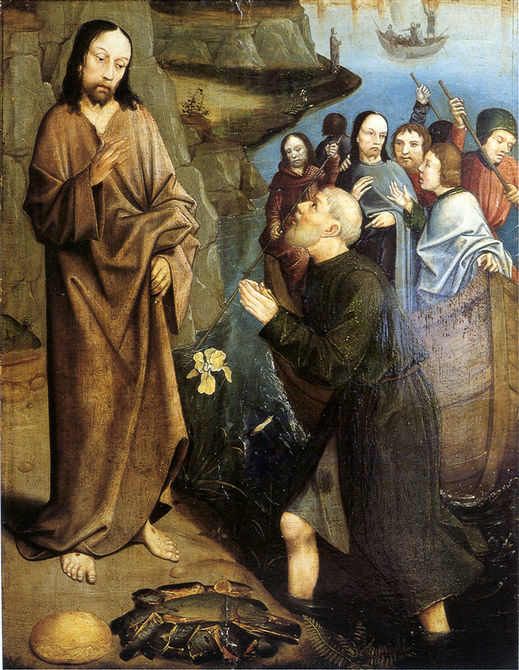
Bouts_Miraculous catch of Fish

The Third Appearance of Christ, Dieric Bouts, 1415-1475, private collection.

I love this first reading we have today from Acts, chapter 5.  The high priest says, “We gave you a formal warning not to preach in this name and what have you done?  You have filled Jerusalem with your teaching!”  How it reminds me of today, when so many people want to silence the Word of God.  As Greg Sheridan says in The Australian, there is a real danger that in the near future “our often counter-­productive human rights bureaucracies will deem it an offence for people to propound traditional Christian teaching.”  Similarly, articles by Angela Shanahan and Caroline Overington have shown how universities are now discriminating against faith-based groups on the basis of inclusivity.  Ironic, isn’t it?

Where Uni Inclusivity means, ‘Get your beliefs out of here.’

Sydney Uni Catholic Society Faces Ban for Catholic-only Board

And in reply, Peter and the apostles say, “Obedience to God comes before obedience to men.”  In a nutshell, that’s what Jesus wants when he is asked, “What shall I do to inherit eternal life?”  And he answers, “You shall love the Lord your God with all your heart and with all your soul and with all your strength and with all your mind, and your neighbour as yourself” (Luke: 10:25-27).

In the tradition of filling the world with Christ’s teaching, Pope Francis, the Shepherd of the Church, has released his new exhortation, Amoris Laetitia – “The Joy of Love”, which is about the joy to be found in authentic families joined by love.  Do yourself a favour and ignore the newspaper headlines which want to put their own spin on this document, and read the original here.

For more on today’s readings, watch Brant Pitre’s commentary:

https://www.youtube.com/watch?v=1mGpZaPdT9A

Today’s readings

Word format:Year C Easter 3rd Sunday 2016

Pdf format: Year C Easter 3rd Sunday 2016


Leave a comment

First Sunday of Lent, Year C |Christ in the Desert

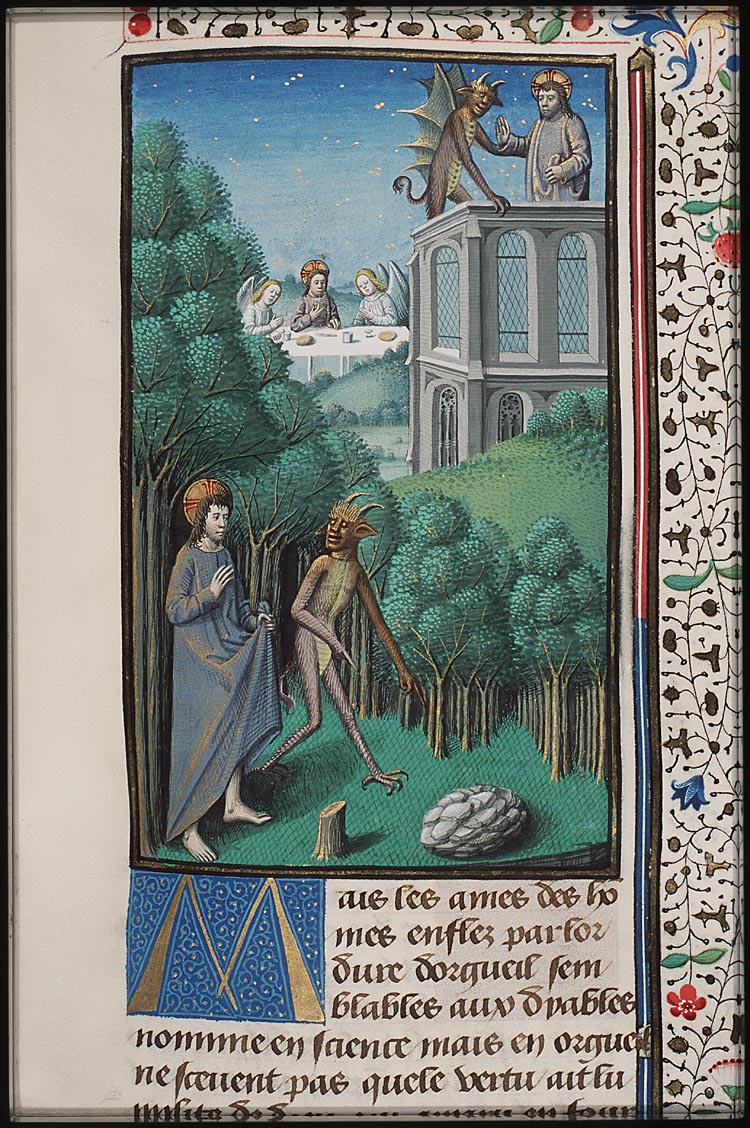
Temptation in the Desert Maitre Francois

Two of the Temptations of Jesus in the Desert by Satan and Jesus served by the Angels, Maitre François, 1475, miniature, from St Augustine’s “La Cité de Dieu”; manuscript MMW 10 A 11; Koninklijke Bibliotheek, The Hague.

The First Sunday of Lent focuses us on one of the key features of our Lenten journey: finding self-knowledge and working out how to make God the centre of your life.  Try these:

Bishop Robert Barron on “Three Questions from the Desert“.

Bible Scholar, Dr John Bergsma, on “The Temptations of Jesus“.

Bible Scholar, Dr Brant Pitre, on the readings for the First Sunday of Lent.

https://www.youtube.com/watch?v=Tg1rDbm4Kfw

In other news, on Friday, 12 February, Pope Francis and Patriarch Kirill of Russia met in Cuba. This is the first time the head of the Catholic Church has met the head of the Russian Orthodox Church since the Great Schism of 1054!  Pope Francis and Patriarch Kirill have issued a Joint Declaration. Read and observe how the Holy Spirit is working in the Church today.

Today’s readings:

Word format: Year C 5th Sunday 2016

Pdf format: Year C Lent 1st Sunday 2016


Leave a comment

3rd Sunday in Ordinary Time, Year C |Repent! What me? How dare you.

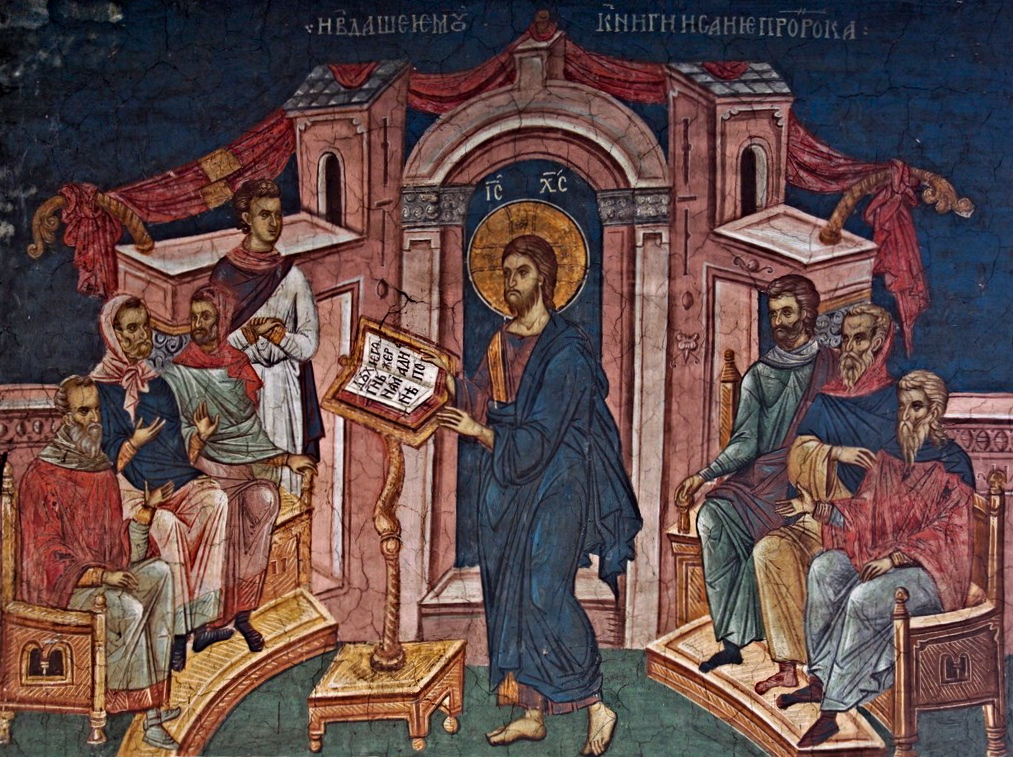
Christ in Synagogue

Christ preaching in the synagogue, fresco, ca 1350, Visoki Decani Monastery, Kosovo, Serbia.

Funny how the world seems to divide itself into two camps: those who are open to repentance and those who are closed.  Pope Francis talks about this in his new book, The Name of God is Mercy, which he has published to coincide with the Jubilee Year of Mercy.  In our Gospel Reading today, Jesus is also proclaiming a Jubilee Year: “He has sent me … to proclaim the Lord’s year of favour.”

On the one hand we have Jeffrey Tayler in Salon Magazine excoriating the Pope for – oh no!  – having the audacity to write a book.   I add my comments in red:

Not two weeks into the new year, the frocked and beanied capo dei capi of the Catholic Church, Pope Francis, chose to impose upon humanity this a book of his own authorship, “The Name of God Is Mercy.” [That’s just stupid.  You might as well say that anyone who writes anything is imposing it on humanity.  The Pope isn’t forcing anyone to read it.  Are you suggesting that anything the Pope writes should be put on the List of Forbidden Books?]  The title alone should have given reviewers cause to dispatch the tome, unopened, straight into the waste bin. “Mercy?” From a purportedly omnipotent Lord who chose to sire a kid whom He subjected to ghastly tortures culminating in execution? [1.  God didn’t “choose to sire a kid” as if God (the Father) preceded Jesus.  Jesus co-exists eternally as the ‘Son’ of God.  Son just happens to be the best word we have to describe the relationship between the First and Second Persons of the Trinity.  If you’re going to criticise the Bible, at least criticise an intelligent interpretation of it.  2.  God the Father did not subject the Son to anything.  Read the Gospels and you will see that it was humans who killed Jesus.  And it was out of love for us that Jesus paid the debt that we owed God for our sins.]  Who battered and abused poor Job on a whim? [Hello-o, read the text!  It was Satan who abused Job, not God.]  Who ordered a patriarch to knife his own long-awaited son? [You’re missing the point.  The story of Abraham and Isaac is about Trust and Obedience. If you bothered to read the whole story, God actually tells Abraham not to sacrifice his son.]  The name of God, were God to exist, would be anything but mercy.  [Sigh.  Can this writer not hear his own vitriolic tone?  He could be describing himself when he talks about ‘lack of mercy.’  But then that’s hypocrisy for you.]

On the other hand, what does Pope Francis actually say?

The Church condemns sin because it has to relay the truth: ‘this is a sin’. But at the same time, it embraces the sinner who recognises himself as such, it welcomes him, it speaks to him of the infinite mercy of God. Jesus forgave even those who crucified and scorned him.  To follow the way of the Lord, the Church is called on to dispense its mercy over all those who recognise themselves as sinners, who assume responsibility for the evil they have committed, and who feel in need of forgiveness. The Church does not exist to condemn people, but to bring about an encounter with the visceral love of God’s mercy.  I often say that in order for this to happen, it is necessary to go out: to go out from the churches and the parishes, to go outside and look for people where they live, where they suffer, and where they hope. I like to use the image of a field hospital to describe this “Church that goes forth”. It exists where there is combat. It is not a solid structure with all the equipment where people go to receive treatment for both small and large infirmities. It is a mobile structure that offers first aid and immediate care, so that its soldiers do not die.  It is a place for urgent care, not a place to see a specialist. I hope that the Jubilee [The Holy Year of Mercy] will serve to reveal the Church’s deeply maternal and merciful side, a Church that goes forth toward those who are “wounded,” who are in need of an attentive ear, understanding, forgiveness, and love.

But to receive mercy, one has to realise that one is a sinner in the first place.  Pope Francis continues:

Corruption is the sin which, rather than being recognised as such and rendering us humble, is elevated to a system; it becomes a mental habit, a way of living. We no longer feel the need for forgiveness and mercy, but we justify ourselves and our behaviours. Jesus says to his disciples: even if your brother offends you seven times a day, and seven times a day he returns to you to ask for forgiveness, forgive him. The repentant sinner, who sins again and again because of his weakness, will find forgiveness if he acknowledges his need for mercy. The corrupt man is the one who sins but does not repent, who sins and pretends to be Christian, and it is this double life that is scandalous. The corrupt man does not know humility, he does not consider himself in need of help, he leads a double life. We must not accept the state of corruption as if it were just another sin. Even though corruption is often identified with sin, in fact they are two distinct realities, albeit interconnected.  Sin, especially if repeated, can lead to corruption, not quantitatively — in the sense that a certain number of sins makes a person corrupt — but rather qualitatively: habits are formed that limit one’s capacity for love and create a false sense of self-sufficiency.  The corrupt man tires of asking for forgiveness and ends up believing that he doesn’t need to ask for it any more. We don’t become corrupt people overnight. It is a long, slippery slope that cannot be identified simply as a series of sins. One may be a great sinner and never fall into corruption if hearts feel their own weakness. That small opening allows the strength of God to enter.  When a sinner recognises himself as such, he admits in some way that what he was attached to, or clings to, is false. The corrupt man hides what he considers his true treasure, but which really makes him a slave and masks his vice with good manners, always managing to keep up appearances.

In the reading for today from Nehemiah, the people of Israel are overcome with repentance.

For the people were all in tears as they listened to the words of the Law.

They realise how far from the Lord they have been, and are overwhelmed with sorrow when this knowledge comes upon them.  But Ezra tells them, “Do not be sad: the joy of the Lord is your stronghold.”  It is only after we experience that metanoia, that we can participate in the Jubilee that flows out of it.

Prayer: Father God, help us to avoid the pride that makes us justify our self-sufficiency.  Help us to develop habits of humility and self-examination.  Help us to turn towards you daily and find peace and communion with you.

For a scripture study on today’s readings – including the historical background – read Dr John Bergsma’s commentary at The Sacred Page.

Bishop Barron takes this from a different angle – the importance of building our religious identity – in Walls and Bridges.

Also watch scripture scholar, Dr Brant Pitre’s Youtube video on this Sunday’s readings:

https://www.youtube.com/watch?v=wv3Pqfyxp1A

Today’s readings:

Word format: Year C 3rd Sunday 2016

Pdf format: Year C 3rd Sunday 2016


1 Comment

26th Sunday in Ordinary Time, Year B | Pope Francis the Crafty

Read in the light of Pope Francis’s addresses to the UN and the US Congress, our Gospel for today encourages us to see the bigger picture.  The Gospel of Mark (9:38-43) tells us, “Anyone who is not against us is for us.”  So let’s not condemn the world, but give it a chance to be ‘for us’.

Today’s readings:

Word format:Year B 26th Sunday 2015

Pdf format:Year B 26th Sunday 2015

Pope Francis has been much in the news this week, and there’s an interesting article on him by Daniel Burke for CNN.  In it, he quotes from Rev. Angel Rossi, whom Pope Francis has referred to as his ‘spiritual son’.  He describes Pope Francis in these words:

He is humble but confident, a disciplined rule-breaker. He is quiet but freely speaks his mind. He is deeply spiritual, but crafty — a cross between a desert saint and a shrewd politician. He is a man of power and action, who spends a great deal of time in prayer and contemplation.

I like that word ‘crafty’, not in the sense of underhandedly sneaky, but in the Biblical sense of:

Behold, I am sending you out as sheep in the midst of wolves, so be wise as serpents and innocent as doves (Matthew 10:16)

Let us be in no doubt that we are in a war, but the war is not against humans.  The war is against the devil and his evil army, who delight in human dysfunction and want to drag us all down to hell.  No doubt, Pope Francis has been meditating on his primary responsibility, that is winning souls for Christ. He has to be both ‘crafty’ and ‘wise’ about it.  Some Catholic commentators have been bemoaning the fact that Pope Francis has not spoken out sufficiently clearly on the evils of our time.  But like Jesus in today’s Gospel, Pope Francis’s tactics involve  some PSYOP – Psychological Operations; he wants to ‘hearts-and-minds’ the people, in the language of military strategy used in various conflicts (the Malayan Emergency and the Vietnam and  Iraq Wars come to mind).

Pope Francis understands people’s psychology.  In current American society, the people on the right of politics think they have the monopoly on God (I’m thinking pro-life and pro-traditional marriage causes).  Pope Francis sees the need for connecting with the left as well where he can find points that fit in with Catholic social teaching (migrants, the environment, the death penalty).  He knows that if he spends his time appearing like a member of the GOP, a swathe of people on the left won’t hear his core message. Not only that, but he knows no-one will listen to him if his personal behaviour contradicts what he is preaching.  Everyone loves to poke fun at a hypocrite.  So first he tries to remove the splinter from his own eye by avoiding ostentation in his choices of housing, transport and clothing, and in his willingness to embrace the disfigured, the homeless and the weak.

Pope Francis is trying to weave a positive narrative of human dignity, the solidarity of all humans, subsidiarity and the common good.  He deliberately uses subtle and hope-filled language, so that nobody could accuse him of being hateful.  Here are some quotes from the speech to US congress, showing how carefully The Holy Father chooses his words (I have added my plainspeak in red).

A political society endures when it seeks, as a vocation, to satisfy common needs by stimulating the growth of all its members, especially those in situations of greater vulnerability or risk. Legislative activity is always based on care for the people.

Moses provides us with a good synthesis of your work: you are asked to protect, by means of the law, the image and likeness fashioned by God on every human face.  (Subtext: Don’t forget the unborn, like those babies exploited by Planned Parenthood.)

I also want to dialogue with all those young people who are working to realize their great and noble aspirations, who are not led astray by facile proposals, and who face difficult situations, often as a result of immaturity on the part of many adults.  (Subtext: children caught up in broken families, whose parents are not willing to make personal sacrifices but put their own selfish desires first )

Building a future of freedom requires love of the common good and cooperation in a spirit of subsidiarity and solidarity. (Subtext: Beware the mob who gangs up on any portion of society or who seek to remove religious freedoms.)

A delicate balance is required to combat violence perpetrated in the name of a religion, an ideology or an economic system, while also safeguarding religious freedom, intellectual freedom and individual freedoms(Hint to Obama: please safeguard the religious freedom of those who oppose your Obamacare package, like the Little Sisters of the Poor.)

The contemporary world, with its open wounds which affect so many of our brothers and sisters, demands that we confront every form of polarization which would divide it into these two camps. We know that in the attempt to be freed of the enemy without, we can be tempted to feed the enemy within. To imitate the hatred and violence of tyrants and murderers is the best way to take their place.  (Subtext: let’s be careful that the language we use is always charitable)

 The challenges facing us today call for a renewal of that spirit of cooperation, which has accomplished so much good throughout the history of the United States. The complexity, the gravity and the urgency of these challenges demand that we pool our resources and talents, and resolve to support one another, with respect for our differences and our convictions of conscience. (Subtext: do not make laws that interfere with freedom of conscience!)

In this land, the various religious denominations have greatly contributed to building and strengthening society. It is important that today, as in the past, the voice of faith continue to be heard, for it is a voice of fraternity and love, which tries to bring out the best in each person and in each society.  (Subtext: religion isn’t something that should be restricted to the private domain, as some atheists would prefer.)

Politics is, instead, an expression of our compelling need to live as one, in order to build as one the greatest common good: that of a community which sacrifices particular interests in order to share, in justice and peace, its goods, its interests, its social life.  (Subtext: we need to sacrifice our selfishness to achieve what is best for society as a whole … for example, lying about and changing the meaning of marriage will only bring grief and more dysfunction to future generations.)

Building a nation calls us to recognize that we must constantly relate to others, rejecting a mindset of hostility in order to adopt one of reciprocal subsidiarity, in a constant effort to do our best. (Play nicely, children!)

We must not be taken aback by their numbers, but rather view them as persons, seeing their faces and listening to their stories, trying to respond as best we can to their situation. To respond in a way which is always humane, just and fraternal. We need to avoid a common temptation nowadays: to discard whatever proves troublesome.  (Subtext: don’t be afraid of migrants and that they will rob you of your comfort.  Figure out a way to cater for them.)

In a word, if we want security, let us give security; if we want life, let us give life; if we want opportunities, let us provide opportunities. The yardstick we use for others will be the yardstick which time will use for us. The Golden Rule also reminds us of our responsibility to protect and defend human life at every stage of its development.  (Subtext: No abortion, no euthanasia!)

In Laudato Si’, I call for a courageous and responsible effort to “redirect our steps” (ibid., 61), and to avert the most serious effects of the environmental deterioration caused by human activity.  (Subtext: The environmentalists have a point!  We need to care for God’s creation.)

It is my wish that throughout my visit the family should be a recurrent theme. How essential the family has been to the building of this country! And how worthy it remains of our support and encouragement! Yet I cannot hide my concern for the family, which is threatened, perhaps as never before, from within and without. Fundamental relationships are being called into question, as is the very basis of marriage and the family. I can only reiterate the importance and, above all, the richness and the beauty of family life.  (And he said this without mentioning divorce, contraception or homosexual acts.  Take note, Catholics, on how to promote the beauty of the family without sounding scornful of others.)

I would like to call attention to those family members who are the most vulnerable, the young. For many of them, a future filled with countless possibilities beckons, yet so many others seem disoriented and aimless, trapped in a hopeless maze of violence, abuse and despair. Their problems are our problems. We cannot avoid them. We need to face them together, to talk about them and to seek effective solutions rather than getting bogged down in discussions. At the risk of oversimplifying, we might say that we live in a culture which pressures young people not to start a family, because they lack possibilities for the future. Yet this same culture presents others with so many options that they too are dissuaded from starting a family.  (Subtext: People who live without the joy of the Gospel become trapped in a life of meaninglessness and despair.  Let us help them to recover the truth!)

Let us pray for all Catholics to be able to transmit the joy of the Gospel!  And for a scripture study on today’s readings, read Dr John Bergsma’s commentary.


Leave a comment

Easter | The Resurrection of Jesus Christ: Myth or Reality?

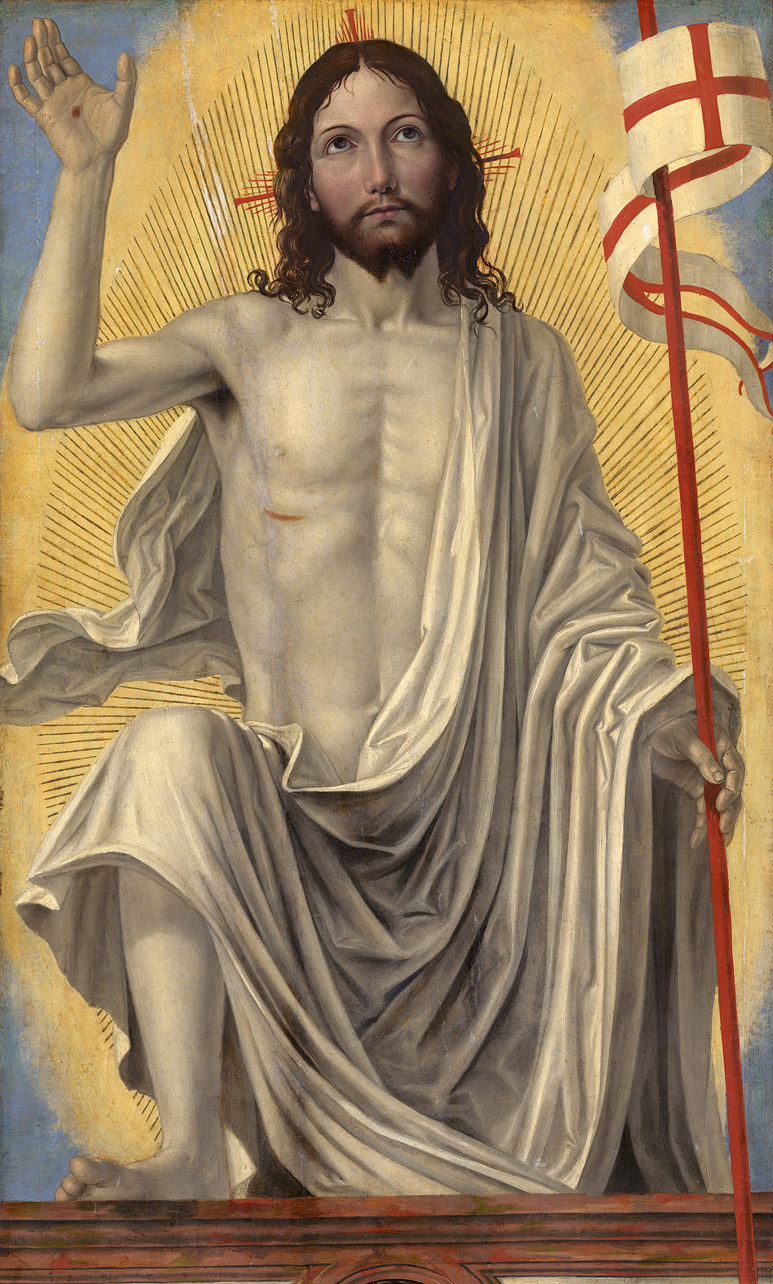
Christ Risen from the Tomb, Ambrogio Bergognone (c. 1470-1523), Samual H. Kress Collection, National Gallery of Art, Washington.

Christ Risen from the Tomb, Ambrogio Bergognone (c. 1470-1523), Samual H. Kress Collection, National Gallery of Art, Washington.

A very happy and blessed Easter to all our readers! Please join us at 6.30 tonight for the Vigil.

Readings for the Easter Vigil:

Word format:  Easter A B C

Pdf format: Easter A B C

Let’s face it, our culture has walked so far away from Jesus that it is now high time we turned around and saw him with fresh eyes.  Christians are not worshipping some mythical figure, wise teacher or guru.

The first witnesses maintain that the same Jesus who had been brutally and unmistakably put to death and buried was, through the power of God, alive again. He was not vaguely “with God,” nor had his soul escaped from his body; nor had he risen in a purely symbolic or metaphorical sense. He, Jeshoua from Nazareth, the friend whom they knew, was alive again. What was expected for all the righteous dead at the end of time had happened, in time, to this one particular man, to this Jesus. It was the very novelty of the event that gave such energy and verve to the first Christian proclamation. On practically every page of the New Testament, we find a grab-you-by-the-lapels quality, for the early Christians were not trading in bland spiritual abstractions or moral bromides. They were trying to tell the whole world that something so new and astounding had happened that nothing would ever again be the same. ( Fr Robert Barron: continue reading at  http://www.wordonfire.org/resources/article/what-easter-means/482/)

Watch this video to find out why the Resurrection of Jesus Christ is credible.

Even today, miracles are occurring to confirm that Jesus is alive and with us.  They just don’t get into the mainstream media.  Read here about the Eucharistic Miracle witnessed by Pope Francis, and attested to by well-known Australian investigative journalist, Mike Willesee.

http://www.loamagazine.org/nr/the_main_topic/eucharistic_miracle_in_buenos.html


Leave a comment

3rd Sunday of Lent, Year B | Jesus, the Embodiment of the Law

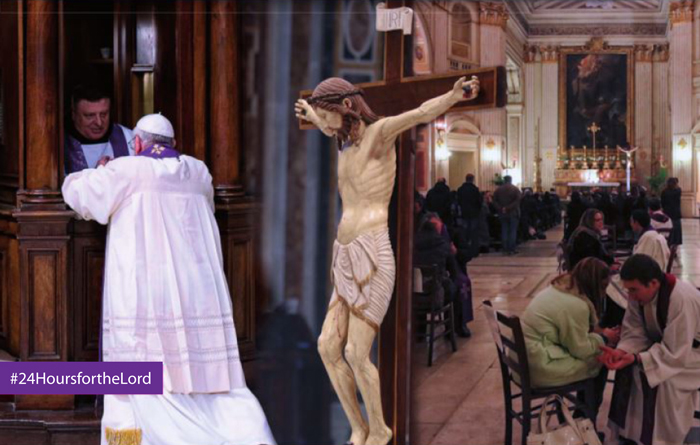
Pope Francis, Penance and Reconciliation during 24 Hours for the Lord

Pope Francis, Penance / Reconciliation during 24 Hours for the Lord

Are The Ten Commandments still relevant for us?  I have friends who claim the Bible is nothing special – just a man-made unenlightened compilation of Bronze Age writings, and certainly not inspired by the Holy Spirit.  If that were the case, Jesus would not fulfil so many prophecies from the Old Testament.  In today’s Gospel, for example, we see Jesus fulfilling prophecies from Isaiah 56:6-7, Jeremiah 7:1-11 and Malachi 3:1-3, to name only a few.

Mass Readings Word format: Year B Lent 3rd Sunday 2015

Mass Readings Pdf format: Year B Lent 3rd Sunday 2015

John Bergsma gives a great analysis of the readings here.

I have to conclude that my friends who denigrate the Bible are too used to thinking of themselves as ‘good people’ and find it too confronting to consider themselves as sinners, so they are compelled to ‘shoot the messenger’.  Getting down to practicalities, Pope Francis has called all Christians to make 13th and 14th March “24 Hours for the Lord”.  He wants us to go to Adoration, examine our consciences (take some time about this – perhaps spend an hour in Adoration asking the Lord to reveal your sins to you) and receive the sacrament of penance / reconciliation / confession during this time.  To prepare for this, why not listen to Fr Barron’s homily on the Ten Commandments here:

Click-here-to-listen


and do a thorough examination of conscience.  You can download these as a guide:

Word format: Confession and Examination of Conscience

Pdf format: Confession and Examination of Conscience

By the way, these lists of sins are not exhaustive – they are just meant as a guide.  If you take time to examine yourself and listen to the Holy Spirit, you’ll find many imperfections that aren’t even on the list.

For those of you in the Perth Northern Suburbs, you can attend 24 hours for the Lord events here:

  • Joondalup Holy Spirit Chapel: Adoration and Confession from 00h00 (midnight) Friday until midnight Saturday.  Mass: 12:10 Friday.   Please put your name on the adoration roster in the front porch.
  • Our Lady of the Mission, Whitfords: Exposition of the Blessed Sacrament: Friday 09.30 a.m. to 7.00 p.m., Mass Friday 9 a.m, Saturday 08.30.  Confession: Saturday 12.00 to 13:00and 17:30 – 18:00.
  • St Simon Peter, Ocean Reef: Blessed Sacrament Adoration Friday 9:00 to 18:50.  Mass: Friday 19:00, Saturday 8:30, Reconciliation: Friday 18:30-18:50, Saturday 17:00-17:45.
  • St Andrew’s, Clarkson: Mass: Friday and Saturday 08:00, Reconciliation: Saturday 17:00 to 17:30, Exposition of the Blessed Sacrament and Benediction: Friday 15:00 to 17:00.

Wishing you joy and grace this Lent!