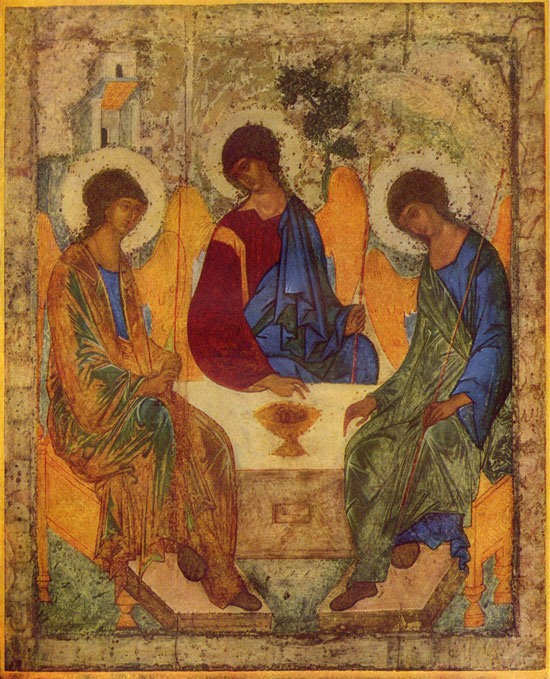
Holy Trinity Icon, Andrei Rublev, 1411-27, Tretyakov Gallery, Moscow
Apologies for the lateness of this post, but we had our first big winter front come through and were without power for most of the day. The electricity being out, we also had to re-locate our Mass from Yanchep to the Presbytery in Two Rocks, where all fourteen of us snuggled up in the Chapel at the back of the house. This is one of the most cheerful chapels I have seen, because Fr Augustine, in typical style, has furnished it with a profusion of the most brightly coloured flowers and candles to be had in plastic. Not ideal according to canon law, but I am sure Our Lord will excuse us due to the small number of volunteers available, and it’s a kind of glorious celebration of our poverty.
Anyway, today we celebrate the Most Holy Trinity, and Fr A’s homily got to the heart of the matter:
- The Trinity is a mystery.
- Don’t fret if you can’t understand it. The main thing is that you can join, with the angels and saints, in a spirit of gratitude, glorifying the Father, the Son and the Holy Spirit.
There’s a lot to be said for this approach, because it’s too easy to botch a homily on the Trinity, if you’re not a philosophy major. But understanding the Trinity, even a little bit, is vitally important if you want to understand God as a God of Covenantal Love, with the humans as family, rather than say, the Islamic understanding of God as Master, with the humans as slaves.
The Mystery of God is much greater than mere human words and thoughts can explain. And humans tend not to be very precise with words, particularly where vested interests try to capture the word market.
If I were to give some advice to priests about homilies on the Trinity, I would say:
- Please don’t confuse the Catholic use of the word, person, with our everyday use of the word people. My friends at the Church of Christ have a very hard time of it describing the trinity because they don’t have the theological vocabulary to make this distinction. When we’re talking about God, we use the word person to distinguish the three persons of Father, Son and Holy Spirit. Make it clear to the congregation that person in this sense is more like an independent consciousness, while God at the same time is one divine essence. Remember God is not a human, he does not fit into human categories, as he is the ultimate Cause of Everything.
- Please define your terms. I have heard some woolly and ill-defined homilies about ‘the Spirit of the Father’, the ‘Spirit of the Son’, the ‘Spirit of the Spirit’. Note that there is only one Spirit in God – the Holy Spirit -which proceeds from the Father and the Son. Stop dividing the Holy Spirit into a kind of exploding fractal.
- Please don’t describe God as ‘a being’. This makes God sound like another creature in the universe. He is totally other than all created ‘beings’, and therefore requires a different language, perhaps in the end, the ‘I am’ of Exodus comes closest.
- Try not to be an Arian in your use of language. Arius thought that God created Jesus, and that Jesus didn’t exist prior to his incarnation. My Church of Christ friends (sorry to pick on you again!) say things like, “God sent Jesus” when they really mean “the Father sent Jesus”. We need to use language which reflects our Trinitarian understanding more accurately and emphasises the Love between the Father and the Son.
- Avoid Modalism. This is where the different hypostases of the Trinity are just God appearing in different forms, like the Marvel shape-shifter Mystique who pops up in different forms whenever its useful to her.
The Catechism of the Catholic Church is well worth reading when it comments on our understanding of the Trinity, and I quote it in large chunks here:
251 In order to articulate the dogma of the Trinity, the Church had to develop her own terminology with the help of certain notions of philosophical origin: “substance”, “person” or “hypostasis”, “relation” and so on. In doing this, she did not submit the faith to human wisdom, but gave a new and unprecedented meaning to these terms, which from then on would be used to signify an ineffable mystery, “infinitely beyond all that we can humanly understand”.
252 The Church uses (I) the term “substance” (rendered also at times by “essence” or “nature”) to designate the divine being in its unity, (II) the term “person” or “hypostasis” to designate the Father, Son and Holy Spirit in the real distinction among them, and (III) the term “relation” to designate the fact that their distinction lies in the relationship of each to the others.
The dogma of the Holy Trinity
253 The Trinity is One. We do not confess three Gods, but one God in three persons, the “consubstantial Trinity”. [83] The divine persons do not share the one divinity among themselves but each of them is God whole and entire: “The Father is that which the Son is, the Son that which the Father is, the Father and the Son that which the Holy Spirit is, i.e. by nature one God.” [84] In the words of the Fourth Lateran Council (1215), “Each of the persons is that supreme reality, viz., the divine substance, essence or nature.” [85]
254 The divine persons are really distinct from one another. “God is one but not solitary.” [86] “Father”, “Son”, “Holy Spirit” are not simply names designating modalities of the divine being, for they are really distinct from one another: “He is not the Father who is the Son, nor is the Son he who is the Father, nor is the Holy Spirit he who is the Father or the Son.” [87] They are distinct from one another in their relations of origin: “It is the Father who generates, the Son who is begotten, and the Holy Spirit who proceeds.” [88] The divine Unity is Triune.
255 The divine persons are relative to one another. Because it does not divide the divine unity, the real distinction of the persons from one another resides solely in the relationships which relate them to one another: “In the relational names of the persons the Father is related to the Son, the Son to the Father, and the Holy Spirit to both. While they are called three persons in view of their relations, we believe in one nature or substance.” [89] Indeed “everything (in them) is one where there is no opposition of relationship.” [90] “Because of that unity the Father is wholly in the Son and wholly in the Holy Spirit; the Son is wholly in the Father and wholly in the Holy Spirit; the Holy Spirit is wholly in the Father and wholly in the Son.” [91]
256 St. Gregory of Nazianzus, also called “the Theologian”, entrusts this summary of Trinitarian faith to the catechumens of Constantinople: Above all guard for me this great deposit of faith for which I live and fight, which I want to take with me as a companion, and which makes me bear all evils and despise all pleasures: I mean the profession of faith in the Father and the Son and the Holy Spirit. I entrust it to you today. By it I am soon going to plunge you into water and raise you up from it. I give it to you as the companion and patron of your whole life. I give you but one divinity and power, existing one in three, and containing the three in a distinct way. Divinity without disparity of substance or nature, without superior degree that raises up or inferior degree that casts down. . . the infinite co-naturality of three infinites. Each person considered in himself is entirely God. . . the three considered together. . . I have not even begun to think of unity when the Trinity bathes me in its splendour. I have not even begun to think of the Trinity when unity grasps me. . [92]
- THE DIVINE WORKS AND THE TRINITARIAN MISSIONS
257 “O blessed light, O Trinity and first Unity!” [93] God is eternal blessedness, undying life, unfading light. God is love: Father, Son and Holy Spirit. God freely wills to communicate the glory of his blessed life. Such is the “plan of his loving kindness”, conceived by the Father before the foundation of the world, in his beloved Son: “He destined us in love to be his sons” and “to be conformed to the image of his Son”, through “the spirit of sonship”. [94] This plan is a “grace [which] was given to us in Christ Jesus before the ages began”, stemming immediately from Trinitarian love. [95] It unfolds in the work of creation, the whole history of salvation after the fall, and the missions of the Son and the Spirit, which are continued in the mission of the Church. [96]
258 The whole divine economy is the common work of the three divine persons. For as the Trinity has only one and the same natures so too does it have only one and the same operation: “The Father, the Son and the Holy Spirit are not three principles of creation but one principle.” [97] However, each divine person performs the common work according to his unique personal property. Thus the Church confesses, following the New Testament, “one God and Father from whom all things are, and one Lord Jesus Christ, through whom all things are, and one Holy Spirit in whom all things are”. [98] It is above all the divine missions of the Son’s Incarnation and the gift of the Holy Spirit that show forth the properties of the divine persons.
259 Being a work at once common and personal, the whole divine economy makes known both what is proper to the divine persons, and their one divine nature. Hence the whole Christian life is a communion with each of the divine persons, without in any way separating them. Everyone who glorifies the Father does so through the Son in the Holy Spirit; everyone who follows Christ does so because the Father draws him and the Spirit moves him. [99]
260 The ultimate end of the whole divine economy is the entry of God’s creatures into the perfect unity of the Blessed Trinity. [100] But even now we are called to be a dwelling for the Most Holy Trinity: “If a man loves me”, says the Lord, “he will keep my word, and my Father will love him, and we will come to him, and make our home with him”: [101] O my God, Trinity whom I adore, help me forget myself entirely so to establish myself in you, unmovable and peaceful as if my soul were already in eternity. May nothing be able to trouble my peace or make me leave you, O my unchanging God, but may each minute bring me more deeply into your mystery! Grant my soul peace. Make it your heaven, your beloved dwelling and the place of your rest. May I never abandon you there, but may I be there, whole and entire, completely vigilant in my faith, entirely adoring, and wholly given over to your creative action. [102]
The Catholic Church. The Catechism Of The Catholic Church (Kindle Locations 1164-1168). . Kindle Edition.
Readings for today:
Word format:Year C Trinity Sunday 2016
Pdf format:Year C Trinity Sunday 2016


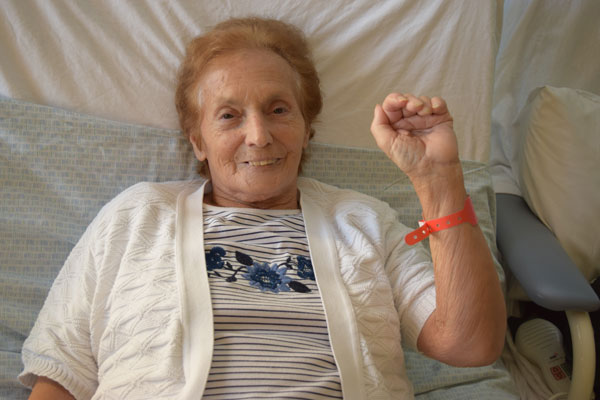 Please join with us in praying for the recovery of our dedicated Sacristan and long-time Two Rocks resident, Josephine Del Bene, who returns home this week after a month in rehabilitation at Osborne Park Hospital for a hip replacement.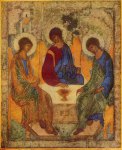

 Catholic in Yanchep