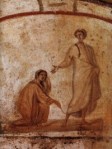
Christ healing the woman with the haemorrhage, 3rd to 4th century, Catacombs of Marcellinus and Peter, Via Casilina, Rome.
Our First Reading from the book of Wisdom today says, ‘Death was not God’s doing … It was the devil’s envy that brought death into the world.’ Obviously creatures have been dying in our universe since time immemorial, so we have to go a bit deeper than a purely literal interpretation of Genesis (and Wisdom). The most satisfying commentary I have been able to find is this excellent one from Fr Barron:
Some helpful Ignatian reflections on physical versus spiritual death can be found here.
Finally, to flesh out the discussion on what Scripture means by death, the Dominicans of the Province of St Joseph have a very helpful article called Molecules and Mourning.
The Storm on the Sea of Galilee, Rembrandt, 1633, Oil on canvas, location unknown, stolen from the Isabella Stuart Gardner Museum, Boston.
Do you trust God? If you want to know what trust in God is, look at the reactions of the relatives of the victims of the Charleston Church Shooting when they are confronted with the murderer of their loved ones in court.
“I just want everyone to know I forgive you,” said Nadine Collier, the daughter of 70-year-old victim Ethel Lance. “You hurt me, you hurt a lot of people, but I forgive you.”
“I forgive you, my family forgives you,” said Anthony Thompson. “We would like you to take this opportunity to repent. … Do that and you’ll be better off than you are right now.” (The Australian)
Trust is putting our faith in God even in the most excruciatingly painful circumstances, and knowing that his plan is much greater than our minds can understand.
In today’s first reading, Job has lost everything – children, property and health – and has been pouring out his heart to God for 37 chapters. God replies by showing Job his omnipotence:
Where were you when I laid the earth’s foundations? Tell me, since you are so well-informed! (Job 38:4)
Job only comes to the end of his sufferings when he realises his own ignorance before God:
I know that you are all-powerful: what you conceive, you can perform. I was the man who misrepresented your intentions with my ignorant words. You have told me about great works that I cannot understand, about marvels which are beyond me, of which I know nothing. Before, I knew you only by hearsay but now, having seen you with my own eyes, I retract what I have said, and repent in dust and ashes. (Job 42:2-3, 5-6)
God rewards Job for his faithfulness and humility:
And the Lord restored Job’s condition, while Job was interceding for his friends. More than that, the Lord gave him double what he had before.
Job still doesn’t understand why he had to go through such suffering, but in this book full of dramatic irony, the reader knows, because back in Chapters One and Two, we saw how Satan wanted to test the faith of Job.
‘Yes,’ Satan said, ‘but Job is not God-fearing for nothing, is he? … You have blessed all he undertakes, and his flocks throng the countryside. But stretch out your hand and lay a finger on his possessions: then, I warrant you, he will curse you to your face.’ ‘Very well,’ Yahweh said to Satan, ‘all he has is in your power.’ (Job 1:9, 11-12)
It was actually Satan who caused all of Job’s misery, not God. God only permits Satan to ‘sift us like wheat’ when He has a larger purpose in mind: an expansion of faith and trust, as in Job’s situation and in today’s Gospel where the Apostles are astounded at Jesus’ Divine Power.
Jesus tells his apostles in today’s Gospel, after he has calmed the storm,
‘Why are you so frightened? How is it that you have no faith?’
Jesus wants a lived faith, a life of radical trust and immersion in Him, not a superficial faith that runs fleeing in the other direction as soon as it encounters a challenge.
Other resources:
Read Dr Michael Barber’s Scripture Study on today’s readings.
Fr Barron in his homily for today relates the readings to today’s crisis within the Church.
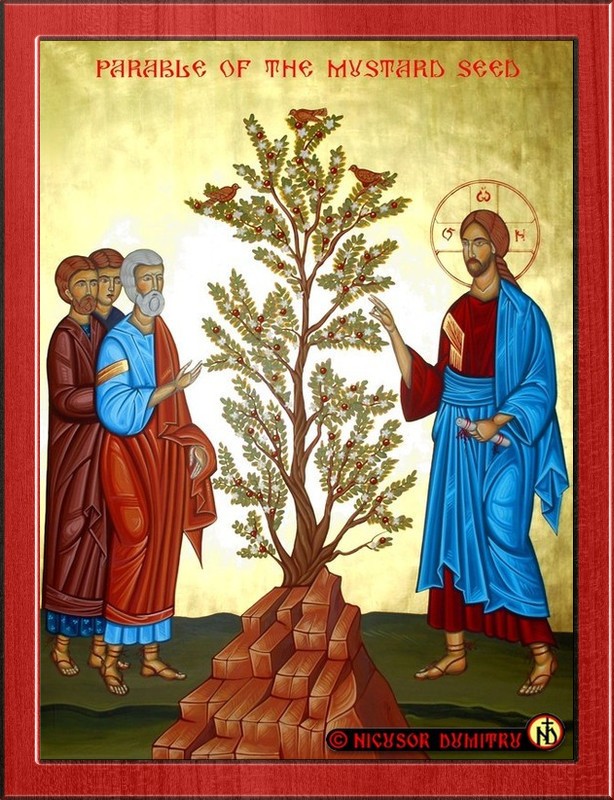
What can we say the kingdom of God is like? What parable can we find for it? It is like a mustard seed which at the time of its sowing in the soil is the smallest of all the seeds on earth; yet once it is sown it grows into the biggest shrub of them all and puts out big branches so that the birds of the air can shelter in its shade. (Mark 4:30-32)
What is this kingdom of God that Jesus keeps talking about in parables? Jesus is the seed described in John 12:24.
Truly, truly, I say to you, unless a grain of wheat falls into the earth and dies, it remains alone; but if it dies, it bears much fruit.
Jesus becomes that ‘smallest of all the seeds’ in his humiliation and death, but what follows is the Resurrection and the expansion of his Kingdom, the Church. We see this pattern repeated in so many ways in church history. Fr Barron illustrates this in his homily for today with the examples of Charles Lwanga, Mother Theresa and St Francis of Assisi.
It’s not only the membership of the church that grows like a mustard tree, but also our understanding of Jesus’ teaching. This is the image that Blessed John Henry Newman used in his Essay on the Development of Christian Doctrine. I have heard the Catholic Church described by Protestants as ‘legalistic’. It seems that part of the objection is that we have too much doctrine. But if we love the Lord, then exploring his word results in a natural growth in our understanding. New understandings never contradict previous understandings, but are brought forth from them in the same way that advances in the deductive sciences are made: by starting on the trunk of the tree with known knowns, and pursuing them along the branches and smaller twigs to areas which require further elucidation. In this way, the tree keeps becoming more all-encompassing. So, for example, the idea of Mary as the Mother of God (Theotokos) was premised on the prior understanding that Jesus the man was also fully Divine, and that he had two natures in one person: a divine nature and a human nature united in a ‘mystical union’ or hypostatic union. This doctrine was only formally defined at the First Council of Ephesus (431) and the Council of Chalcedon (451) as a response to Nestorianism which held that Jesus was not the same as the eternal Word of God, he was just a human who had received divinity from the Father. [For more on Newman’s concept of the Development of Doctrine, go here.]
Because new understandings must be consistent with previous understandings, the Church cannot change its teaching on Marriage, no matter what pressures are brought to bear by the culture. That is the beauty of the Catholic Church: consistent in its teachings from the Apostolic era until today. That is why Archbishop Costelloe has felt it necessary to reiterate the Church’s teaching during the current debate on same-sex marriage in Australia. A pastoral letter will be given out today at all Masses explaining the Church’s position. You can read it here: Same-sex Marriage Pastoral Letter FINAL
Please also read the ‘Don’t Mess with Marriage‘ document from the Australian Catholic Bishops’ Conference. Well done to the Bishops! You may well find that the media and the same-sex lobbyists want to crucify you too, but stand firm!
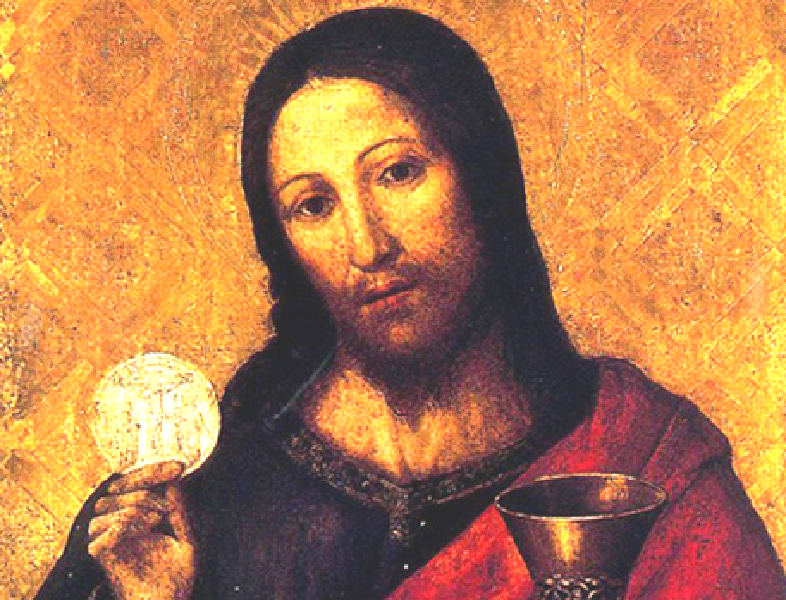
Today’s solemnity gives us an opportunity to talk about one of the chief reasons I remain Catholic: in the Catholic church we still remain faithful and obedient to a particular instruction from the Lord about what we need to do to inherit eternal life. Of course, there are many things that are required: following his commandments, accepting him as our Lord and Saviour, but we can’t ignore this one: eating his body and blood, which is what today’s solemnity is all about.
And he took bread, and when he had given thanks, he broke it and gave it to them, saying, “This is my body, which is given for you. Do this in remembrance of me.” And likewise the cup after they had eaten, saying, “This cup that is poured out for you is the new covenant in my blood. (Luke 22:19-20)
For I received from the Lord what I also delivered to you, that the Lord Jesus on the night when he was betrayed took bread, and when he had given thanks, he broke it, and said, ‘This is my body which is for you. Do this in remembrance of me.’ In the same way also the cup, after supper, saying, ‘This cup is the new covenant in my blood. Do this, as often as you drink it, in remembrance of me.’ For as often as you eat this bread and drink the cup, you proclaim the Lord’s death until he comes. Whoever, therefore, eats the bread or drinks the cup of the Lord in an unworthy manner will be guilty of profaning the body and blood of the Lord. (1 Cor. 11:23-27)
I am the living bread that came down from heaven. If anyone eats of this bread, he will live forever. And the bread that I will give for the life of the world is my flesh.” The Jews then disputed among themselves, saying, “How can this man give us his flesh to eat?” So Jesus said to them, “Truly, truly, I say to you, unless you eat the flesh of the Son of Man and drink his blood, you have no life in you.Whoever feeds on my flesh and drinks my blood has eternal life, and I will raise him up on the last day.For my flesh is true food, and my blood is true drink.Whoever feeds on my flesh and drinks my blood abides in me, and I in him.As the living Father sent me, and I live because of the Father, so whoever feeds on me, he also will live because of me.This is the bread that came down from heaven, not like the bread the fathers ate, and died. Whoever feeds on this bread will live forever.” (John 6:51-58)
When Jesus says, “οὐκ ἔχετε ζωὴν ἐν ἑαυτοῖς” (you have no life in you), the word ζωὴν or “Zoe” refers not to physical life, but to spiritual life – the eternal life of the soul.
The early church certainly understood the Sacrament as literally Christ’s Body, Blood, Soul and Divinity.
St Justin Martyr, First Apology 66, A.D. 151:
“We call this food Eucharist, and no one else is permitted to partake of it, except one who believes our teaching to be true and who has been washed in the washing which is for the remission of sins and for regeneration [i.e., has received baptism] and is thereby living as Christ enjoined. For not as common bread nor common drink do we receive these; but since Jesus Christ our Savior was made incarnate by the word of God and had both flesh and blood for our salvation, so too, as we have been taught, the food which has been made into the Eucharist by the Eucharistic prayer set down by him, and by the change of which our blood and flesh is nurtured, is both the flesh and the blood of that incarnated Jesus”
Ignatius of Antioch, Letter to the Smyrnaeans 6:2-7:1, A.D. 110
“Take note of those who hold heterodox opinions on the grace of Jesus Christ which has come to us, and see how contrary their opinions are to the mind of God. . . . They abstain from the Eucharist and from prayer because they do not confess that the Eucharist is the flesh of our Savior Jesus Christ, flesh which suffered for our sins and which that Father, in his goodness, raised up again. They who deny the gift of God are perishing in their disputes”
Ignatius of Antioch, Epistle to the Philadelphians, 3:2-4:1, 110 A.D.
Take care, then who belong to God and to Jesus Christ – they are with the bishop. And those who repent and come to the unity of the Church – they too shall be of God, and will be living according to Jesus Christ. Do not err, my brethren: if anyone follow a schismatic, he will not inherit the Kingdom of God. If any man walk about with strange doctrine, he cannot lie down with the passion. Take care, then, to use one Eucharist, so that whatever you do, you do according to God: for there is one Flesh of our Lord Jesus Christ, and one cup in the union of His Blood; one altar, as there is one bishop with the presbytery and my fellow servants, the deacons.
Irenaeus, Against Heresies 5:2, A.D. 189
“He has declared the cup, a part of creation, to be his own blood, from which he causes our blood to flow; and the bread, a part of creation, he has established as his own body, from which he gives increase unto our bodies. When, therefore, the mixed cup [wine and water] and the baked bread receives the Word of God and becomes the Eucharist, the body of Christ, and from these the substance of our flesh is increased and supported, how can they say that the flesh is not capable of receiving the gift of God, which is eternal life—flesh which is nourished by the body and blood of the Lord, and is in fact a member of him?”
Clement of Alexandria, The Instructor of Children 1:6:43:3, A.D. 191
“’Eat my flesh,’ [Jesus] says, ‘and drink my blood.’ The Lord supplies us with these intimate nutrients, he delivers over his flesh and pours out his blood, and nothing is lacking for the growth of his children”.
… and these are just a few references from the 2nd century. Many more are found among the Church Fathers.




 Catholic in Yanchep