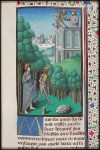
Two of the Temptations of Jesus in the Desert by Satan and Jesus served by the Angels, Maitre François, 1475, miniature, from St Augustine’s “La Cité de Dieu”; manuscript MMW 10 A 11; Koninklijke Bibliotheek, The Hague.
The First Sunday of Lent focuses us on one of the key features of our Lenten journey: finding self-knowledge and working out how to make God the centre of your life. Try these:
Bible Scholar, Dr Brant Pitre, on the readings for the First Sunday of Lent.
In other news, on Friday, 12 February, Pope Francis and Patriarch Kirill of Russia met in Cuba. This is the first time the head of the Catholic Church has met the head of the Russian Orthodox Church since the Great Schism of 1054! Pope Francis and Patriarch Kirill have issued a Joint Declaration. Read and observe how the Holy Spirit is working in the Church today.
Male accipitur Jesus in patria (Jesus is rejected in his hometown), Jerome Nadal, S.J., first published in Evangeliae Historiae Imagines (1593), woodcut.
Nobody loves a preacher. Especially in Australia. We are a practical nation who prefer those who actually do good to those who talk about it. That’s why this year’s Australia Day awards stirred up much controversy in the newspapers and online forums.
This week’s readings offer much practical advice for anyone who considers himself a preacher.
If I have all the eloquence of men or of angels, but speak without love, I am simply a gong booming or a cymbal clashing. If I have the gift of prophecy, understanding all the mysteries there are, and knowing everything, and if I have faith in all its fullness, to move mountains, but without love, then I am nothing at all. If I give away all that I possess, piece by piece, and if I even let them take my body to burn it, but am without love, it will do me no good whatever.
Love is always patient and kind; it is never jealous; love is never boastful or conceited; it is never rude or selfish; it does not take offence, and is not resentful. Love takes no pleasure in other people’s sins but delights in the truth; it is always ready to excuse, to trust, to hope, and to endure whatever comes.
To avoid hypocrisy, I am now going to shut up and go out and see if I can do something constructive. It will probably be something small, because I am a lazy person. And I have to avoid talking about anything positive I might do, because of the injunction not to be ‘boastful or conceited’. In fact I’ve already become a hypocrite, because I’ve showed off about my intention to do good. You just can’t win!
But if you’re after more, Bishop Robert Barron’s comments on the primacy of love are essential listening. And for a scripture study on the readings, I would recommend Dr. John Bergsma at The Sacred Page.
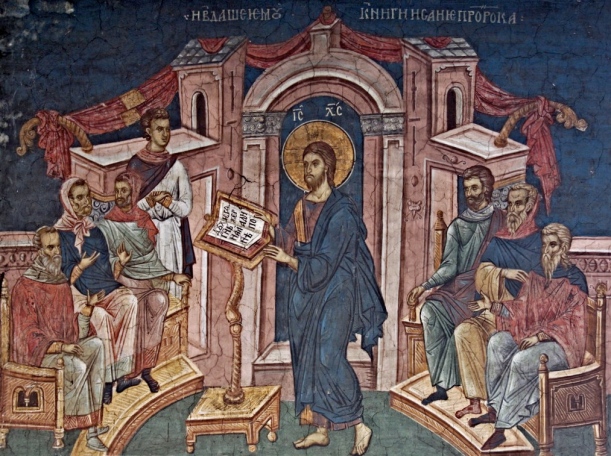
Christ preaching in the synagogue, fresco, ca 1350, Visoki Decani Monastery, Kosovo, Serbia.
Funny how the world seems to divide itself into two camps: those who are open to repentance and those who are closed. Pope Francis talks about this in his new book, The Name of God is Mercy, which he has published to coincide with the Jubilee Year of Mercy. In our Gospel Reading today, Jesus is also proclaiming a Jubilee Year: “He has sent me … to proclaim the Lord’s year of favour.”
On the one hand we have Jeffrey Tayler in Salon Magazine excoriating the Pope for – oh no! – having the audacity to write a book. I add my comments in red:
Not two weeks into the new year, the frocked and beanied capo dei capi of the Catholic Church, Pope Francis, chose to impose upon humanity this a book of his own authorship, “The Name of God Is Mercy.” [That’s just stupid. You might as well say that anyone who writes anything is imposing it on humanity. The Pope isn’t forcing anyone to read it. Are you suggesting that anything the Pope writes should be put on the List of Forbidden Books?] The title alone should have given reviewers cause to dispatch the tome, unopened, straight into the waste bin. “Mercy?” From a purportedly omnipotent Lord who chose to sire a kid whom He subjected to ghastly tortures culminating in execution? [1. God didn’t “choose to sire a kid” as if God (the Father) preceded Jesus. Jesus co-exists eternally as the ‘Son’ of God. Son just happens to be the best word we have to describe the relationship between the First and Second Persons of the Trinity. If you’re going to criticise the Bible, at least criticise an intelligent interpretation of it. 2. God the Father did not subject the Son to anything. Read the Gospels and you will see that it was humans who killed Jesus. And it was out of love for us that Jesus paid the debt that we owed God for our sins.] Who battered and abused poor Job on a whim? [Hello-o, read the text! It was Satan who abused Job, not God.] Who ordered a patriarch to knife his own long-awaited son? [You’re missing the point. The story of Abraham and Isaac is about Trust and Obedience. If you bothered to read the whole story, God actually tells Abraham not to sacrifice his son.] The name of God, were God to exist, would be anything but mercy. [Sigh. Can this writer not hear his own vitriolic tone? He could be describing himself when he talks about ‘lack of mercy.’ But then that’s hypocrisy for you.]
On the other hand, what does Pope Francis actually say?
The Church condemns sin because it has to relay the truth: ‘this is a sin’. But at the same time, it embraces the sinner who recognises himself as such, it welcomes him, it speaks to him of the infinite mercy of God. Jesus forgave even those who crucified and scorned him. To follow the way of the Lord, the Church is called on to dispense its mercy over all those who recognise themselves as sinners, who assume responsibility for the evil they have committed, and who feel in need of forgiveness. The Church does not exist to condemn people, but to bring about an encounter with the visceral love of God’s mercy. I often say that in order for this to happen, it is necessary to go out: to go out from the churches and the parishes, to go outside and look for people where they live, where they suffer, and where they hope. I like to use the image of a field hospital to describe this “Church that goes forth”. It exists where there is combat. It is not a solid structure with all the equipment where people go to receive treatment for both small and large infirmities. It is a mobile structure that offers first aid and immediate care, so that its soldiers do not die. It is a place for urgent care, not a place to see a specialist. I hope that the Jubilee [The Holy Year of Mercy] will serve to reveal the Church’s deeply maternal and merciful side, a Church that goes forth toward those who are “wounded,” who are in need of an attentive ear, understanding, forgiveness, and love.
But to receive mercy, one has to realise that one is a sinner in the first place. Pope Francis continues:
Corruption is the sin which, rather than being recognised as such and rendering us humble, is elevated to a system; it becomes a mental habit, a way of living. We no longer feel the need for forgiveness and mercy, but we justify ourselves and our behaviours. Jesus says to his disciples: even if your brother offends you seven times a day, and seven times a day he returns to you to ask for forgiveness, forgive him. The repentant sinner, who sins again and again because of his weakness, will find forgiveness if he acknowledges his need for mercy. The corrupt man is the one who sins but does not repent, who sins and pretends to be Christian, and it is this double life that is scandalous. The corrupt man does not know humility, he does not consider himself in need of help, he leads a double life. We must not accept the state of corruption as if it were just another sin. Even though corruption is often identified with sin, in fact they are two distinct realities, albeit interconnected. Sin, especially if repeated, can lead to corruption, not quantitatively — in the sense that a certain number of sins makes a person corrupt — but rather qualitatively: habits are formed that limit one’s capacity for love and create a false sense of self-sufficiency. The corrupt man tires of asking for forgiveness and ends up believing that he doesn’t need to ask for it any more. We don’t become corrupt people overnight. It is a long, slippery slope that cannot be identified simply as a series of sins. One may be a great sinner and never fall into corruption if hearts feel their own weakness. That small opening allows the strength of God to enter. When a sinner recognises himself as such, he admits in some way that what he was attached to, or clings to, is false. The corrupt man hides what he considers his true treasure, but which really makes him a slave and masks his vice with good manners, always managing to keep up appearances.
In the reading for today from Nehemiah, the people of Israel are overcome with repentance.
For the people were all in tears as they listened to the words of the Law.
They realise how far from the Lord they have been, and are overwhelmed with sorrow when this knowledge comes upon them. But Ezra tells them, “Do not be sad: the joy of the Lord is your stronghold.” It is only after we experience that metanoia, that we can participate in the Jubilee that flows out of it.
Prayer: Father God, help us to avoid the pride that makes us justify our self-sufficiency. Help us to develop habits of humility and self-examination. Help us to turn towards you daily and find peace and communion with you.
For a scripture study on today’s readings – including the historical background – read Dr John Bergsma’s commentary at The Sacred Page.
Bishop Barron takes this from a different angle – the importance of building our religious identity – in Walls and Bridges.
Also watch scripture scholar, Dr Brant Pitre’s Youtube video on this Sunday’s readings:
Bishop Barron has a homily for today which asks us to look at our part in God’s theo-drama. (Didn’t you know you are an actor in a great play and that it’s not all about you? Best to get in touch with the Director, so that you can understand your part!)
And a very happy 21st birthday to Alistair Mungo Fleming (16th December) who may well be the first person in the Yanchep to Lancelin Pastoral Area to have been baptised here as a baby and still be an active member of our Pastoral Area at the age of 21. Well done, Alistair!
See, the days are coming — it is the Lord who speaks — when I am going to fulfil the promise I made to the House of Israel and the House of Judah:
‘In those days and at that time, I will make a virtuous Branch grow for David, who shall practise honesty and integrity in the land.
In those days Judah shall be saved and Israel shall dwell in confidence. And this is the name the city will be called: The Lord-our-integrity.’ (Jer 33:14-16)
Dr John Bergsma explains Jeremiah’s reference to a branch.
… we notice that the Reading refers to a “just shoot” (other translations: “Righteous Branch”) raised up for David. Here the word is Hebrew tzemakh, “branch, sprout.” In a more famous passage that speaks of the “Branch,” a Hebrew synonym is employed, netzer: “There shall come forth a shoot from the stump of Jesse, and a branch (netzer) shall grow out of his roots.” This word netzer is the root of the geographical name Nazareth, and in Matt 2:23, the Evangelist finds it particularly fitting that Jesus, the “Branch” (netzer) should come from “Branchton” (Nazareth) and be called a “Branchian” (Nazarene).
Jesus is the ultimate fulfilment of ‘the Lord-our-integrity’. There has been a lot of commentary in the media and on social networking sites in recent weeks about the causes of and solutions to the threat of terrorism. I would urge all commentators to examine the life of Jesus next to someone like Mohammed and decide where the integrity really lies. There is a tolerable comparison here. And Marc Barnes has an article which goes to the core of the problem that Western Secular Liberalism has in understanding Islam.
Meanwhile, what is a Christian to do? Let’s look at what Paul says in the second reading: “May the Lord be generous in increasing your love and make you love one another and the whole human race as much as we love you. And may he so confirm your hearts in holiness that you may be blameless in the sight of our God and Father when our Lord Jesus Christ comes with all his saints.”
Perhaps the best advice is to follow our Blessed Mother’s request and pray the rosary for our confused world.


 Need to get to Ash Wednesday Mass? Here is a shortlist of venues for those in the far northern suburbs: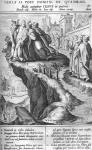


 Catholic in Yanchep