Catholic in Yanchep

Go out into the deep.


2 Comments

Ash Wednesday Masses for Perth far Northern Suburbs 2017

ash-wednesdayHaving trouble finding an Ash Wednesday Mass which fits with your work schedule?  We have the solution – Masses arranged by time for the Perth far northern suburbs.

TIME LOCATION
06:45 Our Lady of the Mission, Whitfords (in the Church, not the Chapel)
08:00 St Andrew’s, Clarkson
08:30 St Simon Peter’s, Ocean Reef
09:00 Our Lady of the Mission, Whitfords
09:00 Presbytery, 3 Blaxland Ave, Two Rocks
09:05 St Luke’s, Woodvale (with the Primary School)
12:10 Holy Spirit Chapel, Joondalup
19:00 St Luke’s, Woodvale
19:00 St Andrew’s, Clarkson
19:30 Our Lady of the Mission, Whitfords


1 Comment

Photos from our Church BBQ!

Thank you to everyone who attended the Yanchep Church BBQ last Sunday!  It was a great way to get to know each other better and farewell Fr Demetri who had been helping us out while Fr Augustine was on holiday.  Thanks especially to Cathy who hosted this at Seatrees Bed & Breakfast!


Leave a comment

8th Sunday, Year A | The depressed person’s guide to escaping from dark times

our-lady-of-walsingham-and-english-saints

Our Lady of Walsingham and English Saints, mural, hall outside Slipper Chapel Shrine, Walsingham. Photo by Norman Servais.

This planet has—or rather had—a problem, which was this: most of the people living on it were unhappy for pretty much all of the time. Many solutions were suggested for this problem, but most of these were largely concerned with the movement of small green pieces of paper, which was odd because on the whole it wasn’t the small green pieces of paper that were unhappy.  Hitchhiker’s Guide to the Galaxy.

Whenever today’s Gospel reading comes up it takes me back to 1991.  This was the year my beloved father died and my daughter was born.  We had taken the decision that I would be a full time Mum some years earlier with the birth of my first child, so making ends meet was difficult, since my husband was in the process of building up his own business, with every spare cent being reinvested back into the business and Australia still suffering a loss of confidence following the 1987 share market crash.  But after Elinor’s birth, life was further complicated by my developing post-natal depression.

The winter of 1991 was probably a perfectly ordinary winter, as winter’s go, but inside my head, the landscape was bleak and, at times, terrifying.  It seemed to rain constantly so that I spent much of the time cooped up indoors with a two year old and an infant, and no support family within two thousand kilometres.  Odd things happened, like the Water Corporation invading the park behind our house to fix a sewerage problem, and the whole neighbourhood being filled with noxious odours for days on end, adding to my general feeling of malaise.  Then I had a great fear that I was going to develop a mental condition that was present in my extended family.  And of course I was grieving for my Father who had wasted away over five years until every breath was a struggle.

But God uses these moments of interior misery to bring us back to him. The children and I had joined the local playgroup which was run by some of the young mums from the Neo-Catechumenate group.  On one particular day, when our bank account was down to about $3 and I was wondering how we were going to manage until payday, the ‘Neocats’ invited me round for some Italian macchinetta-brewed coffee as well as prayer round their kitchen table.  By chance, their Bible reading for the day was this:

‘That is why I am telling you not to worry about your life and what you are to eat, nor about your body and how you are to clothe it. Surely life means more than food, and the body more than clothing! Look at the birds in the sky. They do not sow or reap or gather into barns; yet your heavenly Father feeds them. Are you not worth much more than they are? Can any of you, for all his worrying, add one single cubit to his span of life? And why worry about clothing? Think of the flowers growing in the fields; they never have to work or spin; yet I assure you that not even Solomon in all his regalia was robed like one of these.

  Now if that is how God clothes the grass in the field which is there today and thrown into the furnace tomorrow, will he not much more look after you, you men of little faith?

  So do not worry, do not say, “What are we to eat? What are we to drink? How are we to be clothed?” It is the pagans who set their hearts on all these things. Your heavenly Father knows you need them all. Set your hearts on his kingdom first, and on his righteousness, and all these other things will be given you as well. So do not worry about tomorrow: tomorrow, will take care of itself. Each day has enough trouble if its own.’  (Matthew 6: 25-34)

Sometimes you just know God is trying to tell you something.  I went home and thought about it.  Depression is different from other medical conditions, in that there is a certain amount of control one can have over it merely through the choices one makes.  No, really.  (I can hear people disagreeing with me.)   I have met people who seem almost to identify with their depression to the point where they describe it as being part of their genetic makeup, and love-love-love telling you about how they and all the members of their family are living on anti-depressants due to congenital deficiencies in their parietal lobe.  Fiddlesticks to that, I say.

The reason I have my doubts is that we are humans who are free agents, and free agents can choose at each moment how they are going to behave.  We might not always be able to control how we think, but we can control how we behave.  I can remember thinking while I was depressed, that I was ever so bored with my brain which seemed to want to go round and round in an endless monologue over the same subject matter.  The trick seemed to be actually to do something which would change the subject.  What helped me escape from my depression was meditating on the above reading, telling God that I needed a hand and then going outside myself to think about other people who were in situations far worse than my relatively mundane and self-centred situation.  At one point, I remember seeing a picture in a newspaper about a young boy from Vietnam whose face had been terribly disfigured through burns, but who was coming to Australia for plastic surgery.  These things made me realise I needed to get out of my own head and start doing something positive, even if emotionally I didn’t feel in the mood.  I decided the cure for feeling miserable and broke was to start helping other people who were even more down-and-out than I was.  I looked up the nearest St Vincent de Paul Conference and went to their next meeting.  Soon I was in training with a senior member, learning how to discern whether someone required a food voucher or other assistance.  I had always been a Mass-goer, but now prayer and scripture reading became more of a daily feature of my life.  And the more I concentrated on helping others, the smaller my own problems seemed.  In addition to this, over time, God helped us to prosper our business and manage on our budget.  I look back on this period as my first great re-conversion to the Faith.

This didn’t just happen once in my life – over the course of decades, there have been several occasions where things have gone pear-shaped and I have been tempted to slip into depression and self-centredness.  And every time, God has reached in and shown me the way forward – because Jesus Christ our Saviour is the Light of the World, He cares about our individual situations, He wants us to come into a right relationship with Him, and He wants us to be filled with an unshakeable joy in the midst of life’s trials.

Lent is about to begin on Ash Wednesday.  This is a perfect time to pre-empt Satan’s plans for our misery by deepening our prayer life, coming close to God and asking Him to place in our path those people whom he wants us to help and encourage.

Today’s readings:
Word format: year-a-8th-sunday-2017
Pdf format: year-a-8th-sunday-2017


1 Comment

Seventh Sunday, Year A | The Bible and the Love-Justice Dialectic

jesus-teaching-manuscript-francais-916

Jesus Teaching, Michel Gonnot (priest and scribe), 1474, Manuscript Français 916, fol. 69r, National Library of France, Département des manuscrits, accessed at http://gallica.bnf.fr/ark:/12148/btv1b8539714c/f143.item.

How do we love perfectly?  Jesus gives us some clear examples in our readings for today – and he doesn’t just talk in abstract and generalised terms, he talks in concrete examples that we can apply to our own situations.

‘You have learnt how it was said: Eye for eye and tooth for tooth. But I say this to you: offer the wicked man no resistance. On the contrary, if anyone hits you on the right cheek, offer him the other as well; if a man takes you to law and would have your tunic, let him have your cloak as well. And if anyone orders you to go one mile, go two miles with him. Give to anyone who asks, and if anyone wants to borrow, do not turn away. 

 ‘You have learnt how it was said: You must love your neighbour and hate your enemy. But I say this to you: love your enemies and pray for those who persecute you; in this way you will be sons of your Father in heaven, for he causes his sun to rise on bad men as well as good, and his rain to fall on honest and dishonest men alike. For if you love those who love you, what right have you to claim any credit? Even the tax collectors do as much, do they not? And if you save your greetings for your brothers, are you doing anything exceptional? Even the pagans do as much, do they not? You must therefore be perfect just as your heavenly Father is perfect.’

Of course, we need to discern each case individually.  Because we are also told in the first reading: “You must openly tell him, your neighbour, of his offence; this way you will not take a sin upon yourself.”  So by ‘offering the wicked man no resistance’, Jesus does not mean that we should avoid educating him about his wickedness – otherwise we would become willing participants in evil.  Jesus is talking here about going above and beyond the call of duty.

These statements by Jesus are the last of his Six Antitheses from the Sermon on the Mount, where he uses the form, ‘You have learnt how it was said … But I say this to you …”  Marcion, a second century shipping magnate who used his power and influence to cause a schism in the Church, took this to mean that the God of the Old Testament was mistaken, and that Jesus was correcting him.  Henry Chadwick in The Early Church, describes Marcion’s view in these terms:

The Gnostics liked to contrast the God of the Old Testament as the God of justice, whose principle was an eye for an eye and a tooth for a tooth, with the loving Father proclaimed by Jesus.  This antithesis was especially worked out by Marcion … He wrote a book entitled Antitheses …  in which he listed contradictions between the Old and New Testaments to prove that the God of the Jews, the creator of this miserable world, was quite different from the God and Father of Jesus of whose existence the world had no inkling until the fifteenth year of Tiberius Caesar when Jesus suddenly appeared preaching the Gospel. 

Tertullian tells us:

We know full well that Marcion makes his gods unequal: one judicial, harsh, mighty in war; the other mild, placid, and simply good and excellent. (Against Marcion, Book I, Chapter 6

So desperate was Marcion to demonstrate his case, that he (like many other heretics) then had to change Scripture to suit his interpretation: he rewrote Luke’s Gospel to remove any influence of “Judaising influences” and actually drew up the first canon of Scripture – which excluded all of the Old Testament and much of the New.

What are we to make of Jesus’s statements, then?  Pope Benedict XVI, in the Apostolic Exhortation, Verbum Domini says,

The roots of Christianity are found in the Old Testament, and Christianity continually draws nourishment from these roots. Consequently, sound Christian doctrine has always resisted all new forms of Marcionism, which tend, in different ways, to set the Old Testament in opposition to the New.

… It must be observed, however, that the concept of the fulfilment of the Scriptures is a complex one, since it has three dimensions: a basic aspect of continuity with the Old Testament revelation, an aspect of discontinuity and an aspect of fulfilment and transcendence

Here it must be remembered first and foremost that biblical revelation is deeply rooted in history. God’s plan is manifested progressively and it is accomplished slowly, in successive stages and despite human resistance. God chose a people and patiently worked to guide and educate them. Revelation is suited to the cultural and moral level of distant times. 

Back to the Gospel, then.  Jesus is in continuity with the Old Testament in so far as he quotes from it (“you have heard it said”), but then he shows how he is fulfilling and transcending this teaching with something even more demanding.  He is raising the bar and drawing us into greater union with God.

Where the legal codes of ‘an eye for an eye and a tooth for a tooth’ found in Exodus are suitable for providing legal limits within a societal and juridical setting, if we apply these principles within our own families, we will be engaged in an endless cycle of retribution for wrongs small and large and never be able to escape the cycle of violence and egotistical score-settling.  Jesus is showing us how to love truly – how to have good will even towards those who have no love for us.

In Fr Robert Spitzer’s, New Proofs for the Existence of God, he describes the Five Transcendentals of the Divine Mystery: Perfect Truth, Perfect Love, Perfect Justice/Goodness, Perfect Beauty and Perfect Home, all of which aspects are found in the ultimate unconditioned reality we call God.

So if we relate these attributes of God to our Gospel reading, whereas last week’s antitheses were concerned  with Perfect Justice and Goodness in the areas of murder, adultery, divorce and the swearing of oaths, this week’s antitheses, with their focus on vengeance and hatred, seem to concentrate more on how we can practise Perfect Love.

Fr Spitzer describes love as a movement from autonomy to empathy to self-giving.

Though this unity with the feelings and being of another does not cause a loss of one’s self or self-consciousness, it does cause a break in the radical autonomy one can effect when one focuses on oneself as the centre of one’s personal universe (autonomy).  … This acceptance and identification of the feelings and being of the other give rise to concern for the other, which evolves into care for the other as the relationship grows.  This care, in its turn, can completely reverse the human tendency toward autonomy (over against the other) and give rise to a self-giving that can become self-sacrificial (agapē).

As far as justice/goodness are concerned, Fr Spitzer says,

The “love of justice and the good”  is a natural unifier, for it overcomes the natural barriers and enmity arising out of competition for scarce resources, fear of strangers, natural animosity, survival of the fittest, and suspicion of others’ potential injustice.  It overcomes the natural barriers and enmity of irresponsibility (responsibility to myself alone, or the complete abdication of responsibility), by calling individuals to a higher duty to the just society.  It can also lead to self-sacrifice (the sacrifice not only of one’s advantage and aggrandisement, but of one’s very self) for the sake of the good of society or for goodness and justice within society.

Drawing these two aspects together – Perfect Love and Perfect Justice/Goodness –

… we may do well to pause for a moment and consider the complementarity between love and the good in human self-consciousness.  Three of these complementarities are described in the history of philosophy by the “love-justice dialectic”: (1) Love tends to look first toward care for the individual and through this lens, to move towards care and co-responsibility for the group or even civil society.  Conversely, the good has the connotation of looking first towards the common good, that is, the good of civil society, the culture, and the group, and then moving from this to the good of the individual. (2) Love begins with care and empathy, and from this moves toward co-responsibility and duty.  Conversely, the good tends to move from co-responsibility and duty to empathy and care.  (3) Love proceeds from compassion and mercy, and then moves to justice and the need for law, whereas the good proceeds from justice and respect for the law and then moves to a specific application of the natural law, and then to respect for the individual protected by the law, and then to compassion and mercy under the law.  In sum, love and goodness must eventually overlap, but they overlap each other from opposite directions.

It seems to me that much of the imbalance in society right now, is that empathy towards certain individuals and sectors of the community is drowning out discussion of the common good as far as civil society and culture are concerned.  As Christians, we need to regain our ability to speak without fear about the common good of society, without sacrificing love.   There are arguments to be made about love vs the common good in the areas of immigration policy, the education of children, marriage and family, freedom of speech and freedom of religion, amongst others.  It’s not an easy task, especially when our own sinfulness leaves us open to accusations of hypocrisy, but that doesn’t mean we shouldn’t try.  And in our personal lives, we need to have a good hard look at whether we are practising what Jesus is asking of us, especially in those relationships where we feel the most tension and would rather engage in a culture of avoidance than a culture of encounter.

Today’s readings:
Word format: year-a-7th-sunday-2017
Pdf format: year-a-7th-sunday-2017


Leave a comment

6th Sunday, Year A | The wonders of your law

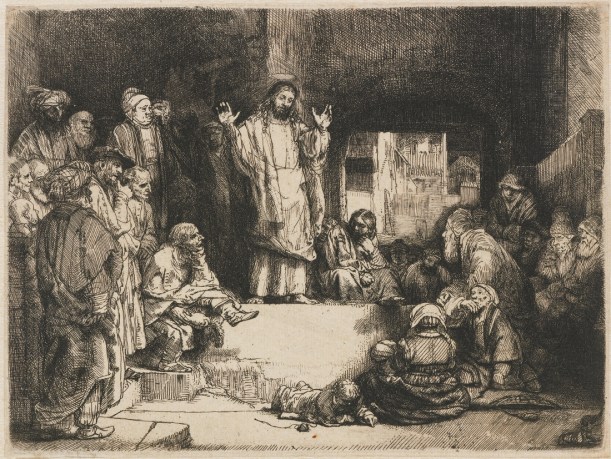
jesus-preaching-rembrandt

Jesus Preaching, Rembrandt Harmenszoon van Rijn, ca. 1567, Rembrandthuis, Amsterdam.

Today’s readings
Word format: year-a-6th-sunday-2017
Pdf format: year-a-6th-sunday-2017


Leave a comment

5th Sunday, Year A | Salt, light and the sex abuse crisis

bruegel-pieter-massacre-of-the-innocents

Massacre of the Innocents, Pieter Brueghel the Elder, 1565-67, Royal Collection, United Kingdom.

God has such impeccable timing.  Here we are with a Gospel reading today that proclaims,

You are the salt of the earth. But if salt becomes tasteless, what can make it salty again? It is good for nothing, and can only be thrown out to be trampled underfoot by men.

  You are the light of the world. A city built on a hill-top cannot be hidden. No one lights a lamp to put it under a tub; they put it on the lamp-stand where it shines for everyone in the house. In the same way your light must shine in the sight of men, so that, seeing your good works, they may give the praise to your Father in heaven (Mt 5:13-16).

while from tomorrow and for the next three weeks  the Church will be reporting to the Royal Commission into Institutional Responses to Child Sexual Abuse about its failures, and the policies and procedures that have been put in place to prevent any recurrence of this lamentable period when we failed to be the salt of the earth and a light to the world.

Our Archbishop, the most reverend Timothy Costelloe SDB, has issued a pastoral letter.

I ask you too, to continue to pray for the victims and survivors of sexual abuse in our Church. The heavy burdens they carry, inflicted on them by people who were supposed to be signs and bearers of God’s love and care but who were the very opposite, and the dismissive, disbelieving and insensitive way in which they were treated by so many of our Church leaders, impels us as a community to do all we can to assist them now and into the future. This last public hearing of the Royal Commission will inevitably be a stressful and painful time for many. Paradoxically it might also be a time of healing. 

As a community we are deeply shamed by the failures of so many in our Church in relation to the care of our children and young people. More than this we are horrified by the suffering which has been inflicted on so many innocent people. 

As I have in the past, I want now to again express our profound sorrow and apology for this shocking failure on our part and for the pain it has caused to so many. As a Church we are committed now to doing everything we can to ensure that this evil is eradicated from our midst.

 You can read the rest here.

Francis Sullivan, the head of the Church’s Truth, Justice and Healing Council has also made the point that the data that will be revealed this week will be ‘the first time in the world the Catholic Church’s records on child sexual abuse have been compiled and analysed for public consideration’.  (The Australian, Horrific extent of Catholic child abuse, 2 February 2017).  I’m not sure exactly how Australia’s contribution is unique: there has been a veritable boatload of reports issued in other countries: the John Jay Report, the Murphy Report and the Ferns Report, to name a few.

We, as a Church, can expect to be thoroughly humiliated in the public forum – and deservedly so.

Nevertheless, let’s not lose sight of the fact that this is not just a Church problem, but a societal one.  Kelly Richards, writing in Trends and Issues in Crime and Criminal Justice, No. 429, writes,

According to the Australian Bureau of Statistics’ (2005) Personal Safety Survey, of all those who reported having been victimised sexually before the age of 15 years, 11.1 percent were victimised by a stranger. More commonly, child sexual abuse was perpetrated by a male relative (other than the victim’s father or stepfather; 30.2%), a family friend (16.3%), an acquaintance or neighbour (15.6%), another known person (15.3%), or the father or stepfather (13.5%; see Figure 1). It should be noted that these totals add to more than 100 percent (103.7%); this indicates that a small proportion of child sexual abuse victims (3.7%) were abused by perpetrators belonging to more than one category.

In other words, the vast majority of child-sexual abuse perpetrators have not been targeted by the Royal Commission, since it is dealing with institutional not familial responses.  Writing in The Australian, Gerard Henderson makes the point that even among institutions, the Catholic Church may be being unfairly scapegoated (Child Abuse Royal Commission: Don’t Just Target Catholic Church).  And the irony is that even while the government with one hand is busy rooting out this sort of child sexual abuse, with the other hand it is actively promoting the abuse and sexualisation of children through insidious programs such as Safe Schools.

What does all this mean for the ordinary parishioner like you or me?  In practice, the issue has already largely been dealt with, through various Safeguarding offices and through the Diocesan Professional Standards Office.  For my part, I can’t say I have ever actually met either a sexually abused parishioner or an abusive priest, although I do know someone who, as a child, had a teacher who attempted (unsuccessfully) to groom him.  So the problem is not front-of-mind in the experience of currently practising Catholics, as it is to some degree historical, not current.

What parishioners are finding, though, is a certain guardedness in interactions between parishioners, the general public and clergy.  Priests are now more cautious about placing themselves in situations where they might be vulnerable to accusations, and unfortunately in the mind of the general public, the two words ‘priest’ and ‘paedophile’ have become associated with each other.  If ever Satan wanted to undermine the effectiveness of the Church in carrying out its mission of telling the world about Jesus Christ, this would be the way he would have chosen: to insert sufficient paedophiles and unconcerned bishops into our ranks to cause chaos. Fortunately most of the priests I know are  concentrating on serving their communities and living good and holy lives.  And most parishioners are trying to get on with doing the same.

As we see in today’s Psalm, “A light rises in the darkness for the upright.”  We need to go through the darkness of chastisement and purification and pray for our Archbishop, the leadership of our Archdiocese and our priests.  What I think we will find, when the Royal Commission has done its work and people have found closure, is that the task of evangelisation will start to get its legs in Australia, as it has already done in the US.  At the moment, we can’t evangelise effectively, because we’re still undergoing purgation and being rightly shamed for our past mistakes.  But, as Bishop Robert Barron explains in his YouTube video, God will ‘rebuild his Holy City’ through those who have remained faithful through it all.

You might also enjoy watching these recent videos on current topics from Bishop Barron, interviewed here by Dave Rubin from The Rubin Report:

Part 1: Belief, Faith and the Church Sex Scandal

Part 2: Abortion, Gay Marriage and Porn 

Today’s readings:
Word format: year-a-5th-sunday-2017
Pdf format: year-a-5th-sunday-2017