

Last week, while on holiday in Tasmania, I was excited to hear that my visit coincided with a travelling exhibition of the Holy Shroud believed to be the burial cloth of Jesus Christ – of course, the exhibition features not the real shroud, but a 14 foot replica – obviously an artefact as unique and priceless as the Shroud of Turin is kept very closely guarded and can’t be allowed to travel; its location since 1578 has been at the Cathedral of St John the Baptist in Turin. So on Wednesday morning, Mark and I drove up to Launceston to catch The Man of the Shroud at St Patrick’s College, Prospect.
Then another coincidence occurred: Tucker Carlson, arguably in the top three of America’s most influential political commentators, released an interview (9 August) with Jeremiah Johnston of the Christian Thinkers Society (CTS) about that same Shroud. Mr Carlson has 16.5 million followers on X, 5.3 million on Instagram and 4.4 million on YouTube. Anything he promotes is going to gain traction in the wider culture, so the fact that the Shroud of Turin is receiving international attention is good news!
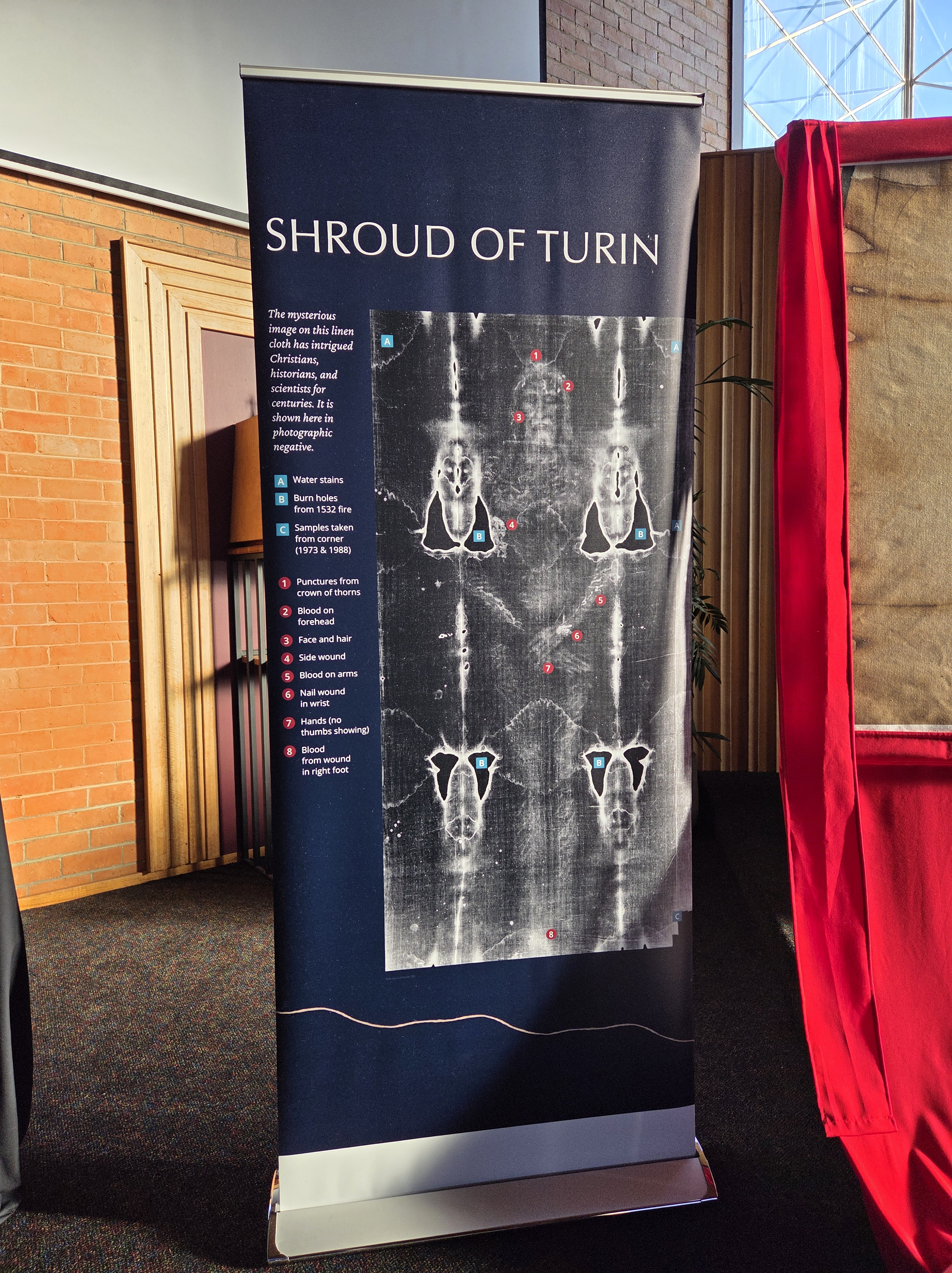
In the interview with Carlson, Jeremiah Johnston spoke enthusiastically and with clarity about all the aspects of the Shroud which lend credence to its likely status as Christ’s burial cloth. Some dot points:
- Injuries are consistent with the gospel accounts of the crucifixion.
- The bloodstain patterns – 120 of them matching the Sudarium of Oviedo, the cloth presumed to match the one mentioned in John 20:6-7.
- The image resides only on the uppermost fibers of the cloth, ruling out the possibility of chemical reactions forming the image. (Magis Centre)
- Although the image shows the entire body, not all parts of the cloth touched the body. (Magis Centre)
- The image was not created by vapours from chemicals or the corpse itself. A major breakthrough in understanding the Shroud of Turin came when John Jackson proposed that an intense burst of ultraviolet (UV) radiation created the image on the uppermost fibrils of the cloth. According to this theory, the body wrapped in the Shroud emitted a powerful flash of vacuum ultraviolet radiation, forming the perfect 3D negative image of the body on both the front and back of the cloth without scorching it. This process, however, is unlike any natural phenomenon we know of, as no known human body can emit such radiation. (Magis Centre, source https://www.magiscenter.com/blog/shroud-turin-radiation-image)
- The Shroud has a double image on both the front and back but no image in the middle, suggesting that the cloth collapsed into a mechanically transparent body. (Magis Centre)
- The image reveals details inside the body, resembling an X-ray effect. (Magis Centre)
- Anatomical precision and detail, not typical of medieval art.
- The mystery of how the image was created, since there is no evidence of paint, dye, ink or other art materials, and the image penetrates to a depth of only 2 micrometres.
- The presence of pollen grains typical of Jerusalem and Syria.
- The physical presence of both pre- and post-mortem type AB blood as well as serum, separately from the image of the body. The blood absorbs all the way through the material (unlike the image). The blood matches that of the Sudarium and moreover, the separate occurrence of the blood and serum match St John’s description of “blood and water” flowing out after the piercing with the lance.
- The previous attempt at radiocarbon dating which dated the shroud to the medieval period, has now been shown to be on a part of the shroud which had been patched by nuns during the late medieval period, using cotton, not the linen comprising the main section of the shroud. No radiocarbon dating has been carried out on the “linen only” parts of the cloth.
- The herringbone weave of the linen is typical of Middle Eastern linen shrouds of the first century, and not of medieval European cloth.
But there was something in the Johnston interview that disturbed me greatly, and that was his overt anti-Catholicism and misunderstanding of what the Catholic Church is.
Some examples follow, with my commentary in red:
JEREMIAH JOHNSTON: timestamp 19:05. “I have an allergic reaction to Catholic relics. There are over 20,000 relics in the Catholic Church. And a relic is interesting because it has this apocryphal history to it and yet it can’t be studied by the physical sciences.“
(There are A LOT MORE THAN 20,000 RELICS. Many of them have indeed been studied, and their provenance is well known. He appears to be ignorant about the different classes of relic.)
JEREMIAH JOHNSTON: “The Catholic Church has only two artifacts now that we can call both an artifact and a relic. We have the Shroud of Turin because it can be tested through history, through sciences we’re going to get to the pollen spores. I mean, this is like a CIA CSI experiment. When you look at the shroud, it’s amazing.
“And then we have the Sudarium of Oviedo in Spain, which is the face cloth that John’s Gospel talks about that covered his face. That was in the corner of the tomb when the disciples came to see that the tomb was empty that first Easter morning in John chapter 20. So in that cloth also has human blood. Guess what the blood type is? Type AB. You can’t make this stuff up. It’s mind boggling.”
(OK, I can agree on this.)
He continues at timestamp 57:43.
“One of the things that’s interesting to me and one of the things I had to get over as I began studying the Shroud, Tucker, is I thought it was a Catholic relic. Now we need to … again, I want to just hammer on this because you have a lot of Protestants that watch your program and a lot of Christians who think, oh, that’s just a Catholic relic. I’m not interested in the Catholic Church, therefore I’m not interested in the Shroud.“
(Protestants who dismiss Catholic relics just because they are Catholic have unfortunately been propagandised by the disinformation of the Protestant Reformation / Revolt. Any historical artifact should be considered on its own merits.)
“The Catholic Church did not take control of the Shroud of Turin until 1983. Two years of probate court. The last king of Savoy bequeaths the Shroud to the current Pope, who was Pope John Paul II at the time. And after two years of probate court, finally the Catholic Church becomes the custodian of the shroud in the 1980s.“
(Huh? Nonsense, the Shroud has been in Catholic hands at least since Geoffroy de Charny, and even prior to that, especially when we consider that prior to the Great Schism of 1054 Christians of East and West were unified. What does Johnston mean by “The Catholic Church”? The Catholic Church is not “THE VATICAN”. The Catholic Church is the very large family (over 1 billion we are told) who willingly subscribe to the teachings of the Catholic Church. The kings of Savoy he refers to were the (Catholic) predecessors of the Italian Republic, and had been around for a millenium. As an aside, if Victor Emmanual III had not made the mistake of tolerating Mussolini, we would probably still have a Kingdom of Italy. Furthermore, the Kings of Savoy were all Catholic and had two Orders of Chivalry: The Supreme Order of the Most Holy Annunciation, founded in 1362, and the second oldest Order of Knighthood, the Order of Saints Maurice and Lazarus, dating back to 1098. The only reason the Shroud had its ownership transferred to the Pope was that in 1983, the last King of Italy, Umberto II, died. There was nothing nefarious about this transfer. And while the Pope is the owner of the Shroud, the Archbishop of Turin is its Custodian. There has been no change in location of the Shroud since 1578.)
TUCKER CARLSON: So it was in private hands. So you said it was in eastern Turkey for 900 years. Where?
JEREMIAH JOHNSTON: In Edessa, which is eastern Turkey.
(According to Eusebius, it was in the hands of King Agbar V of Edessa, who had been miraculously cured of a disease when the Mandylion/Shroud was brought to him by the apostle Jude Thaddeus after Jesus’s death and resurrection.)
JEREMIAH JOHNSTON: It was a stronghold of the Christian movement.
(The so-called “Christian movement” at this point was the One, Holy, Catholic and Apostolic Church, which still enjoyed great unity and didn’t have any Baptist preachers, as the Baptist Church originated in England in the 17th century.)
JEREMIAH JOHNSTON: … as it was escaping the … But then when the Muslim invasion started and again the 7th century, it escapes to Constantinople and then Athens and then beyond that, as I mentioned, it keeps moving west.
In the 7th century, the Holy Land had been captured by the Rashidun Caliphate, and by the 11th century, the more aggressive Seljuk Turks (Sunni Muslims) had begun to threaten Christians dwelling in the Levant, notably in the Battle of Manzikert (1071). This led to the Byzantine Emperor calling for military assistance to defend the local Christian population. Pope Urban II responded and encouraged faithful Christians to join the First Crusade. The result of the ensuing battles was the establishment of four Crusader States from 1099: The Kingdom of Jerusalem, the County of Edessa, the Principality of Antioch and the County of Tripoli. However, in 1144 Edessa was besieged by Zengi, Turkoman Atabeg of the Seljuk Empire, and it fell to the Seljuk Turks. At some point between the first and second crusades, the Mandylion/Shroud was taken to Constantinople for safekeeping. It appears that the Shroud was taken from Constantinople by Geoffroy de Charny during the infamous Fourth Crusade.
This is how this particular period is described on the Othonia website. (The Man of the Shroud Exhibition is run under the aegis of Othonia, one of whose partners is Jeremiah Johnston’s organisation.)
“Geoffroy I de Charny and his descendants never said how they came to possess the Shroud and the travels of the Shroud before it came to the de Charny family are debated.
Some theories suggest the Shroud was in Constantinople before the Fourth Crusade (1204), possibly as the Mandylion or the Image of Edessa, and later taken to France.
Pope Innocent III condemned the looting of Constantinople, the desecration of Christian sites, and the stealing of relics. Many stolen relics were transported to Venice and France. This deepened the divide between the Eastern Orthodox Church and the Roman Catholic Church, making reconciliation almost impossible.
Around 1353, Geoffroy I and his wife, Jeanne de Vergy, displayed a cloth bearing the image of a man who had suffered crucifixion wounds. This cloth was exhibited at a church in Lirey, a small town in northeastern France. Jeanne is believed to have been a descendant of Othon de la Roche, the French knight who became Lord of Athens after the sack of Constantinople during the 4th Crusade.
TUCKER CARLSON: As the Ottoman Empire rises.
JEREMIAH JOHNSTON: Rises totally.
TUCKER CARLSON: And Islam sweeps over the land of the Bible.
JEREMIAH JOHNSTON: Remember Islam killed the bishops, the Bibles and the buildings. And so it’s escaping that. So it’s amazing the embarrassment of riches we have from an artifactual standpoint.
And then when you actually look too, there’s something else we haven’t touched on. The iconography. The early Christian art, Tucker, I mean is remarkable. On my social media, we created an AI image. My friend Doug Powell and me. Doug gets all the credit. He’s an amazing artist. He imported the information of the face of the crucified man and compares it with the icon Pantocrator, Lord over all, which is at the currently at St. Catherine’s Monastery where it’s been since the 6th century. This is an icon of Jesus. It’s famous.
It’s curious that Johnston praises the Pantocrator Icon, but later in the interview, talks about sins against the second commandment, by which he means “You shall not make for yourself a carved image, or any likeness of anything that is in heaven above, or that is in the earth beneath, or that is in the water under the earth. You shall not bow down to them or serve them.” What he fails to understand is that neither Catholics nor Eastern Orthodox Christians worship icons or religious pictures. We merely venerate WHAT THEY REPRESENT. It seems he has no gripe against the Greek Orthodox of St Catherine’s Monastery, but only against those dastardly Catholics!
Anyway, my point in this post is to give credit to Johnston and Tucker Carlson for drawing the world’s attention to the astounding existence of the Holy Shroud, and to ignore Jeremiah Johnston’s anti-Catholicism – perhaps it is merely a strategy to get Protestants to take the shroud seriously. The Othonia exhibit is well worth a visit if it comes to your area. If you would like a more balanced interview, replete with scientific information about the Holy Shroud, then I recommend Fr Spitzer’s interview with Charbel Raish of Parousia Media, linked below. This is truly an astonishing artefact, and meditating on all the aspects revealed by this linen cloth is an act of reverence towards the sufferings of Christ. He died for your redemption, purely out of love for your soul.





 Catholic in Yanchep